
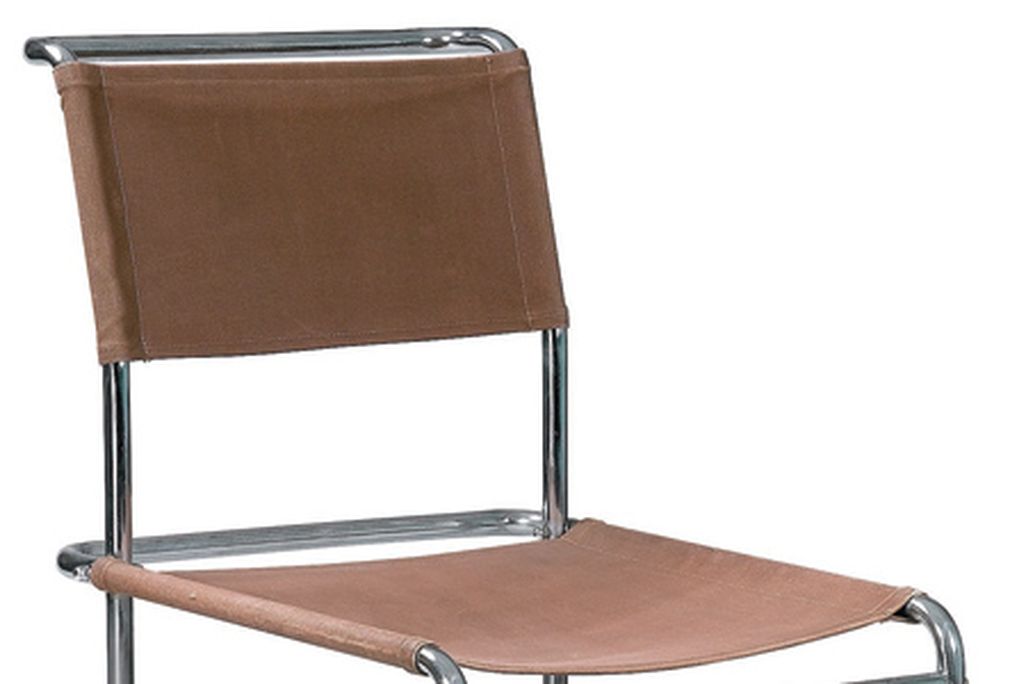
Breuer Chair, 1926
Marcel Breuer’s Bauhaus minimalism redefined a household basic
/https://tf-cmsv2-smithsonianmag-media.s3.amazonaws.com/accounts/headshot/Owen-Edwards-240.jpg)
To paraphrase the great comic-strip possum Pogo, "We have seen chairs, and they are us."
Unlike the practical table or the bland, beckoning bed, a chair is never simply a chair. Taking the shape of a person, chairs are the most metaphoric of humanity's furniture, imitating us when we are in them, echoing us when we are not.
Because of this, and also because chairs are everywhere (at least in the Western world), they became an imperative challenge for some of the greatest architects and designers of the 20th century, from Ludwig Mies van der Rohe to Charles and Ray Eames to Frank Gehry. Many of the most influential attempt to reinvent the chair were those made by Europeans associated with the Bauhaus school in Germany starting in the early 1920s. By combining bent metal with canvas, caning or leather, Bauhaus designers introduced chairs with lightness, strength and minimalism that echoed the 19th-century bentwood furniture of the Austrian and German Thonet company, even as they leapt into the industrial age.
Marcel Breuer, a Hungarian furniture maker and architect who studied at the Bauhaus and became one of its most important faculty members, was among the first to use tubular steel in chairs. An early Breuer design, the B5 chair from 1926, has recently been added to the collection of the Smithsonian's Cooper-Hewitt, National Design Museum in New York City.
"This chair is an iconic design that has been on our furniture wish list for a long time," says Sarah Coffin, curator of decorative arts at the museum. "We like to tell the history of design by showing things as part of a continuum, and Breuer's work relates to bentwood furniture and industrial design."
Born in Pecs, Hungary, in 1902, Breuer is one of the founders of the Modernist movement, and his vision was central to the concept of merging form and function in the simplest way possible. The B5 is one of two revolutionary Breuer chairs that served as a dramatic antidote to the overstuffed seating of the Edwardian era and gave birth to a new way of seeing furniture. The other is the B3 armchair, created the year before; it came to be known as the Wassily Chair because the painter Wassily Kandinsky, also on the Bauhaus faculty, admired and owned one.
Both chairs—particularly the B5—have a spare elegance that epitomizes the clarity that Breuer and his associate Walter Gropius brought to their architecture. But since a chair requires less compromise than a building, the B5 is considered one of the most perfect expressions of modern design. It seems fresh after more than 80 years. Rob Forbes, founder of the furniture retailer Design Within Reach, describes it as "Shaker meets Bauhaus." "This is a great piece and one I picked for our first catalog," he says. "The B5 was very radical for its time, though now it seems so logical, both delicate and strong, with very happy, compact proportions."
Don Chadwick, co-designer of the ubiquitous Aeron office chair, agrees: "The side chair represents one of the first attempts to industrialize bent steel tubing as the support structure for the sling seating surfaces, very pure in its simplicity."
Breuer's first bent metal designs were made with aluminum, the essential modern metal, but that proved both expensive and difficult to weld, so the designer soon switched to tubular steel. The example now at the Cooper-Hewitt, bought at auction in New York City last spring, was a rare find. "This is a vintage piece," Coffin says, "with chrome-plated steel tubing and the original paraffin-infused canvas fabric that Breuer used, known as Eisengarn [iron yarn]. The first chairs came in four colors: black, green, rust red and blue. This one was rust red but has mellowed with age to a shade of brown."
After Hitler came to power in the '30s, Breuer left Germany for England, where he continued to experiment with new materials—he designed his Long Chair in shaped laminated wood there—and then immigrated to the United States. He taught at Harvard with his friend Gropius, passing along the Modernist credo to Philip Johnson, among others. Breuer later designed houses and large urban buildings, such as the Unesco headquarters in Paris. He died in New York City in 1981 at age 79, but the B5 lives on, with exact replicas still being manufactured. In Germany.
Owen Edwards is a freelance writer and author of the book Elegant Solutions
/https://tf-cmsv2-smithsonianmag-media.s3.amazonaws.com/accounts/headshot/Owen-Edwards-240.jpg)