• Smithsonian
    Institution
  • Travel
    With Us
  • Smithsonian
    Store
  • Smithsonian
    Channel
  • goSmithsonian
    Visitors Guide
  • Air & Space
    magazine

Smithsonian.com

  • Subscribe
  • History & Archaeology
  • Science
  • Ideas & Innovations
  • Arts & Culture
  • Travel & Food
  • At the Smithsonian
  • Photos
  • Videos
  • Games
  • Shop
  • Art
  • Design
  • Fashion
  • Music & Film
  • Books
  • Art Meets Science
  • Arts & Culture

35 Who Made a Difference: Andy Goldsworthy

Using nature as his canvas, the artist creates works of transcendent beauty
| | | Reddit | Digg | Stumble | Email |
  • By Arthur Lubow
  • Smithsonian magazine, November 2005, Subscribe
View Full Image »
$Alt
(Julian Calder)

On a typical autumn day, Andy Goldsworthy can be found in the woods near his home in Penpont, Scotland, maybe cloaking a fallen tree branch with a tapestry of yellow and brown elm leaves, or, in a rainstorm, lying on a rock until the dry outline of his body materializes as a pale shadow on the moist surface. Come winter, he might be soldering icicles into glittering loops or star bursts with his bare fingers. Because he works outdoors with natural materials, Goldsworthy is sometimes portrayed as a modern Druid; really, he is much closer to a latter-day Impressionist. Like those 19th-century painters, he is obsessed with the way sunlight falls and flickers, especially on stone, water and leaves. Monet—whose painting of a sunrise gave the Impressionist movement its name—used oil paint to reveal light's transformative power in his series of canvases of haystacks, the Rouen Cathedral and the Houses of Parliament. Goldsworthy is equally transfixed with the magical effect of natural light. Only he has discovered another, more elemental way to explore it.

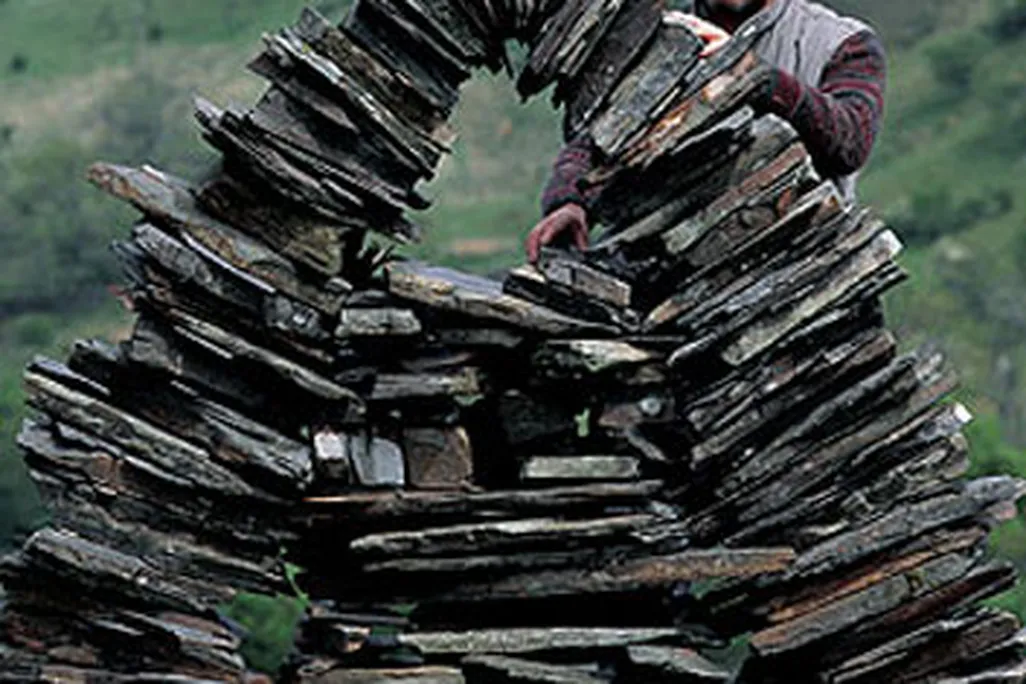
As a fine arts student at Preston Polytechnic in northern England, Goldsworthy, now 49, disliked working indoors. He found escape nearby at Morecambe Bay, where he began constructing temporary structures that the incoming tide would collapse. Before long, he realized that his artistic interests were tied more closely to his youthful agricultural labors in Yorkshire than to life classes and studio work. The balanced boulders, snow arches and leaf-rimmed holes that he crafted were his versions of the plein-air sketches of landscape artists. Instead of representing the landscape, however, he was drawing on the landscape itself.

Throughout the 20th century, artists struggled with the dilemma of Modernism: how to convey an experience of the real world while acknowledging the immediate physical reality of the materials—the two-dimensional canvas, the viscous paint—being used in the representation. Goldsworthy has cut his way clear. By using the landscape as his material, he can illustrate aspects of the natural world—its color, mutability, energy—without resorting to mimicry. Although he usually works in rural settings, his definition of the natural world is expansive. "Nature for me isn't the bit that stops in the national parks," he says. "It's in a city, in a gallery, in a building. It's everywhere we are."

Goldsworthy's principal artistic debt is to "Land Art," an American movement of the 1960s that took Pollock's and de Kooning's macho Abstract Expressionism out of the studio to create giant earthworks such as Robert Smithson's Spiral Jetty in the Great Salt Lake of Utah or Michael Heizer's Double Negative in Nevada. Unlike Smithson and Heizer, however, Goldsworthy specializes in the ephemeral. A seven-foot-long ribbon of red poppy petals that he stuck together with saliva lasted just long enough to be photographed before the wind carried it off. His leaves molder, his ice arabesques melt. One work in which he took special joy, a sort of bird's nest of sticks, was intended to evoke a tidal whirlpool; when the actual tide carried it into the water, its creator marveled as it gyrated toward destruction. The moment was captured in Rivers and Tides, a documentary film by Thomas Riedelsheimer that portrayed Goldsworthy at work and underscored the centrality of time to his art.

Even those stone stacks and walls that he intends to last for a long time are conceived in a very different spirit from the bulldozing Land Art of the American West. An endearing humility complements his vast ambition. "There are occasions when I have moved boulders, but I'm reluctant to, especially ones that have been rooted in a place for many years," he says, noting that when he must do so, he looks "for ones on the edge of a field that had been pulled out of the ground by farming. The struggle of agriculture, of getting nourishment from the earth, becomes part of the story of the boulder and of my work."

The modesty in his method is matched by a realism in his demands. He knows that nothing can or should last forever. Once a piece has been illuminated by the perfect light or been borne away by the serendipitous wave, he gratefully bids it a fond farewell.


On a typical autumn day, Andy Goldsworthy can be found in the woods near his home in Penpont, Scotland, maybe cloaking a fallen tree branch with a tapestry of yellow and brown elm leaves, or, in a rainstorm, lying on a rock until the dry outline of his body materializes as a pale shadow on the moist surface. Come winter, he might be soldering icicles into glittering loops or star bursts with his bare fingers. Because he works outdoors with natural materials, Goldsworthy is sometimes portrayed as a modern Druid; really, he is much closer to a latter-day Impressionist. Like those 19th-century painters, he is obsessed with the way sunlight falls and flickers, especially on stone, water and leaves. Monet—whose painting of a sunrise gave the Impressionist movement its name—used oil paint to reveal light's transformative power in his series of canvases of haystacks, the Rouen Cathedral and the Houses of Parliament. Goldsworthy is equally transfixed with the magical effect of natural light. Only he has discovered another, more elemental way to explore it.

As a fine arts student at Preston Polytechnic in northern England, Goldsworthy, now 49, disliked working indoors. He found escape nearby at Morecambe Bay, where he began constructing temporary structures that the incoming tide would collapse. Before long, he realized that his artistic interests were tied more closely to his youthful agricultural labors in Yorkshire than to life classes and studio work. The balanced boulders, snow arches and leaf-rimmed holes that he crafted were his versions of the plein-air sketches of landscape artists. Instead of representing the landscape, however, he was drawing on the landscape itself.

Throughout the 20th century, artists struggled with the dilemma of Modernism: how to convey an experience of the real world while acknowledging the immediate physical reality of the materials—the two-dimensional canvas, the viscous paint—being used in the representation. Goldsworthy has cut his way clear. By using the landscape as his material, he can illustrate aspects of the natural world—its color, mutability, energy—without resorting to mimicry. Although he usually works in rural settings, his definition of the natural world is expansive. "Nature for me isn't the bit that stops in the national parks," he says. "It's in a city, in a gallery, in a building. It's everywhere we are."

Goldsworthy's principal artistic debt is to "Land Art," an American movement of the 1960s that took Pollock's and de Kooning's macho Abstract Expressionism out of the studio to create giant earthworks such as Robert Smithson's Spiral Jetty in the Great Salt Lake of Utah or Michael Heizer's Double Negative in Nevada. Unlike Smithson and Heizer, however, Goldsworthy specializes in the ephemeral. A seven-foot-long ribbon of red poppy petals that he stuck together with saliva lasted just long enough to be photographed before the wind carried it off. His leaves molder, his ice arabesques melt. One work in which he took special joy, a sort of bird's nest of sticks, was intended to evoke a tidal whirlpool; when the actual tide carried it into the water, its creator marveled as it gyrated toward destruction. The moment was captured in Rivers and Tides, a documentary film by Thomas Riedelsheimer that portrayed Goldsworthy at work and underscored the centrality of time to his art.

Even those stone stacks and walls that he intends to last for a long time are conceived in a very different spirit from the bulldozing Land Art of the American West. An endearing humility complements his vast ambition. "There are occasions when I have moved boulders, but I'm reluctant to, especially ones that have been rooted in a place for many years," he says, noting that when he must do so, he looks "for ones on the edge of a field that had been pulled out of the ground by farming. The struggle of agriculture, of getting nourishment from the earth, becomes part of the story of the boulder and of my work."

The modesty in his method is matched by a realism in his demands. He knows that nothing can or should last forever. Once a piece has been illuminated by the perfect light or been borne away by the serendipitous wave, he gratefully bids it a fond farewell.

    Subscribe now for more of Smithsonian's coverage on history, science and nature.


Related topics: Artists


| | | Reddit | Digg | Stumble | Email |
 

Add New Comment


Name: (required)

Email: (required)

Comment:

Comments are moderated, and will not appear until Smithsonian.com has approved them. Smithsonian reserves the right not to post any comments that are unlawful, threatening, offensive, defamatory, invasive of a person's privacy, inappropriate, confidential or proprietary, political messages, product endorsements, or other content that might otherwise violate any laws or policies.

Comments (40)

+ View All Comments

WOW!!!!!He IS VERY TALENTED!!!!

Posted by asia connors on May 3,2013 | 01:34 PM

Hello,
I am really not a fan. I find his art lacking in thought and provocation. To me, his art is one or two notches above flower arranging for the village hall. Arranging leaves by color or piling stones can give some visual impact. But its not art because there is no questioning, provocation or idea. The only aspect that is challenging is the patience and time required to do it. Time which should be spent creating real concepts and ideas. Still, at least he gives A-level art students something easy to copy and write about.
JP.

Posted by JP on February 10,2012 | 01:23 PM

Does anybody know where Andy will be now in september 2011? I'm doing a artproject now, and my goal is to find him in september... any help is very welcome, I'm leaving next week!

Posted by Nick Steur on August 26,2011 | 05:52 AM

Does anyone know what date Andy's Rowan Leaves & Hole was completed and by any chance the media used to create it?

Posted by Tan on July 26,2011 | 09:49 PM

I'm trying to do an art assessment for school on andy goldsworthy and i cant find the dates for when some of his works were created. does anyone know when he made :

- Ice Spiral Tree Soul
- Twigs and Water
- Rowan Leaves and Hole

Posted by Keely on June 19,2011 | 03:03 AM

I like that andy makes a creative way of artwork i like this type of artwork aswell as looking great it ca show emotios and feelings

Posted by brittany rogers on June 13,2011 | 11:01 PM

Andy Goldsworthy is such an inspiration. His work is amazing... Even with the incredible result i dont think i could muster enough patience to create the work that he does....Not that i have any where near the talent. Fascinating.

Posted by Ella on March 11,2011 | 03:05 AM

he made it on the 12th january 1987...

Posted by Anonymous 2 on April 16,2010 | 03:00 PM

does anyone know what year mr. goldsworthy made his icicle star???

Posted by anonymous on March 24,2010 | 06:44 PM

I have been studying his art for my art exam in school and I find some of the pieces captivating but there are others I just don't understand. I feel that for the effort that Goldsworthy puts into his work it is a shame the they have such a short life span, photographs don't always capture how beautiful his work can be. At first when I was given the task and told to research Andy I didn't like any of his work (sorry :-S) but now it has grown on me, I'm not totally converted yet but I think if more people knew about the possibilities with nature they would stop abusing it

Sarah :)

Posted by Sarah on November 3,2009 | 04:57 PM

I find his work soo deep and it truely represents What art truely can be. It doesnt have to be paintings , i personally think using the world around us as the materials to create something amazing from something that was already here. Amzing , im studying art gcse at the moment and we are currently studying this amazing artist. God bless :Dxx

Posted by Jessica May on October 12,2009 | 10:01 AM

i went to one of the exibitions and i was totally conquered by his work his vision and his nature friendly way to work .He is one of my favorite sculptors.He can equally use the strenth of stone and the lightness of leaves to their best,there is no material that he cannot use

Posted by enrica Bertolini Cullen on September 3,2009 | 01:01 PM

im a year 10 student, and we have to do an in class essay about "how Andy Goldsworthy represents and interperates organic forms (from nature) into his artworks" before reading this site i had absolutily no idea. but now i can really see the imaginatve side of his beautiful artworks. nature is already eautiful, but its just harder for some to se it, however with people like Andy Goldsworthy in the world it becomes possible for everyone to imagine, and for once in their lives, stop and enjoy. :)
Andy you are an inspiration to us all. thank you

Posted by brooke :) on May 27,2009 | 05:36 AM

I think Andy is a great artist i think it is the coolest thing that he works with nature. Nature is already beautiful but he really brings out the true colors. im very inspired by what he dose. KEEP UP THE GREAT WORK!!:]

Posted by sam on May 15,2009 | 07:41 PM

+ View All Comments


Advertisement


Most Popular

  • Viewed
  • Emailed
  • Commented
  1. TKO By Checkmate: Inside the World of Chessboxing
  2. Will the Real Great Gatsby Please Stand Up?
  3. Never Underestimate the Power of a Paint Tube
  4. Teller Reveals His Secrets
  5. When Did Girls Start Wearing Pink?
  6. The Saddest Movie in the World
  7. The Story Behind Banksy
  8. How Posters Helped Shape America and Change the World
  9. Real Places Behind Famously Frightening Stories
  10. Before There Was Photoshop, These Photographers Knew How to Manipulate an Image
  1. The Revolutionary Effect of the Paperback Book
  2. When Did Girls Start Wearing Pink?
  3. TKO By Checkmate: Inside the World of Chessboxing

View All Most Popular »

Advertisement

Follow Us

Smithsonian Magazine
@SmithsonianMag
Follow Smithsonian Magazine on Twitter

Sign up for regular email updates from Smithsonian.com, including daily newsletters and special offers.

In The Magazine

May 2013

  • Patriot Games
  • The Next Revolution
  • Blowing Up The Art World
  • The Body Eclectic
  • Microbe Hunters

View Table of Contents »


First Name
Last Name
Address 1
Address 2
City
State   Zip
Email


Travel with Smithsonian


Smithsonian Store

Stars and Stripes Throw

Our exclusive Stars and Stripes Throw is a three-layer adaption of the 1861 “Stars and Stripes” quilt... $65


View full archiveRecent Issues


  • May 2013


  • Apr 2013


  • Mar 2013

Newsletter

Sign up for regular email updates from Smithsonian magazine, including free newsletters, special offers and current news updates.

Subscribe Now

About Us

Smithsonian.com expands on Smithsonian magazine's in-depth coverage of history, science, nature, the arts, travel, world culture and technology. Join us regularly as we take a dynamic and interactive approach to exploring modern and historic perspectives on the arts, sciences, nature, world culture and travel, including videos, blogs and a reader forum.

Explore our Brands

  • goSmithsonian.com
  • Smithsonian Air & Space Museum
  • Smithsonian Student Travel
  • Smithsonian Catalogue
  • Smithsonian Journeys
  • Smithsonian Channel
  • About Smithsonian
  • Contact Us
  • Advertising
  • Subscribe
  • RSS
  • Topics
  • Member Services
  • Copyright
  • Site Map
  • Privacy Policy
  • Ad Choices

Smithsonian Institution