
Who Do You Love?
Bo Diddley’s beat changed the course of rock music. And his lyrics evoked a history that reached all the way to Africa
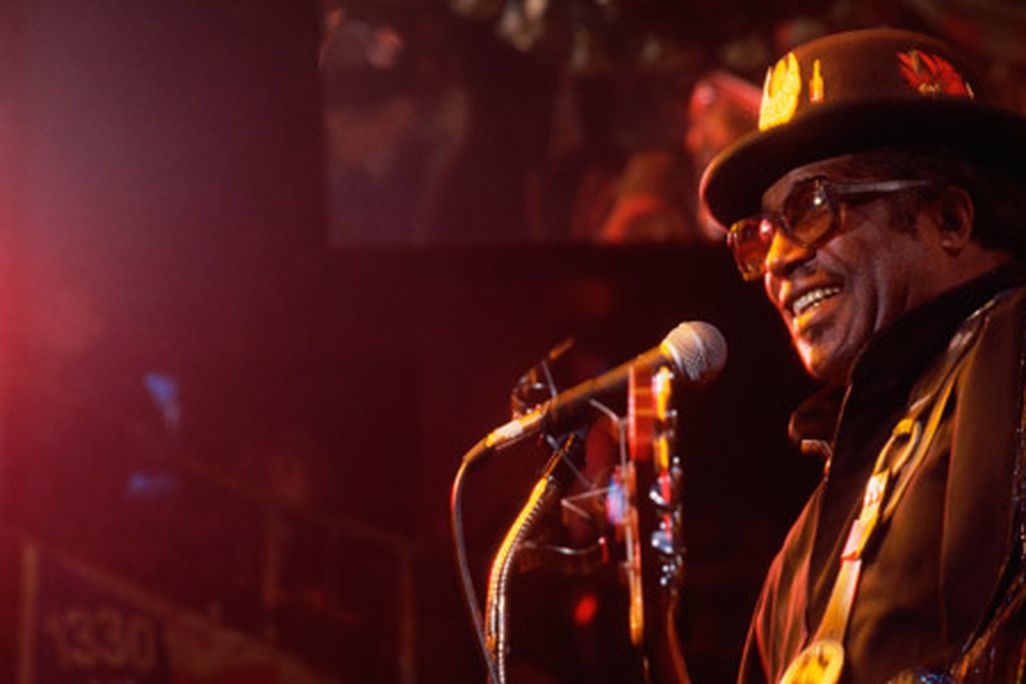
I helped Bo Diddley find a drummer once.
It was in 1971. I was 19, reading underground comics one sleepy afternoon at Roach Ranch West, a spacious, hippie-stuff shop in Albuquerque, when a black man wearing a big black hat walked in and said: "I'm Bo Diddley."
It was, in the argot of the day, a cosmic moment. Could this really be Bo "47 miles of barbed wire" Diddley stepping out of the blue, announcing his presence in a remote desert city? Was I hallucinating?
No, it really was that founding father of rock 'n' roll. He had relocated his family from Southern California to Los Lunas, New Mexico, after being shaken up by a big earthquake, and he wanted to play a free show.
"Do you know any drummers?" he asked.
It happened that there was a drummer in the Roach Ranch at that very moment—Mike Fleming, who played with a local cover band called Lemon. I pointed him out. They spoke, and Bo Diddley said he'd be back later. Somebody called the local Top 40 station to announce the show.
Bo Diddley played that night to a packed-out back room at Roach Ranch West, with his wife and three daughters singing with him and Mike Fleming on drums. I sat on the floor in front of the improvised stage, close enough for him to sweat on me, studying him as he pulled a variety of sounds out of his cranked-up rhythm guitar to drive the audience wild. He wasn't doing an oldies show, he was doing funky new material. I shouted and shouted for "Who Do You Love." Which, finally, he played.
Ellas McDaniel, professionally known as Bo Diddley, died June 2 at the age of 79. He is remembered above all for his signature rhythm. Tell any drummer, in any bar band anywhere, to play a Bo Diddley beat, and he'll know what to do.
But Bo Diddley was so much more than a beat. He was a transforming figure. After him, music was different. His debut single, "Bo Diddley" (1955), announced that the whole game had changed. He showed how you could build a whole pop record around a rhythm and a rhyme. You didn't even need chord changes.
He put the beat front and center. To make that work, he chose the most compelling beat he could: the two-bar rhythm that Cubans know as clave. All the Chicago blues guys dipped into rumba blues, but this was another take on it. The Latin connection was so strong that Bo Diddley used maracas as a basic component of his sound. But sidekick Jerome Green didn't play maracas like a Cuban, and Bo Diddley didn't play that rhythm like a Cuban; he swung it, like an African-American who'd been playing on street corners in Chicago. And Bo Diddley's way of expressing that two-bar feel, known across a wide swath of Africa, was in turn a fountainhead for the development of rock 'n' roll, which would repeatedly cross Afro-Cuban and Af-rican-American rhythmic sensibilities.
Cover bands play the Bo Diddley beat formulaically. But in Bo Diddley's hands, the beat was alive. He did something different with it every time he recorded it. It's the difference between copying and creating.
He was born Ellas Bates in McComb, Mississippi, not far from the Louisiana border, on December 30, 1928. His teenage mother was unable to care for him, and he never knew his father, so the future Bo Diddley was adopted by his mother's cousin Gussie McDaniel, who gave him her last name and moved him to Chicago when he was about 7. There he was present at the creation of one of the great American musics: the electric Chicago blues.
The city was full of African-Americans looking for work and escaping the poverty, discrimination and lynchings of the Jim Crow South, and they constituted a strong local audience for music. More than a decade younger than Muddy Waters, and almost 20 years younger than Howlin' Wolf, Ellas McDaniel was a punk kid by comparison. "We used to be three dudes going down the street with a washtub, a little raggedy guitar and another cat with maracas," he told writer Neil Strauss in 2005. "Bo Diddley," his first record, went to No. 1 on the rhythm and blues chart without denting the pop chart. He appeared on "The Ed Sullivan Show" on November 20, 1955—almost a year before Elvis Presley did. But Sullivan got mad at him for playing "Bo Diddley" instead of his one-chord cover version of "Sixteen Tons" (then the top recording in the nation, but by Tennessee Ernie Ford) and never had him back.
A generation of white kids first heard the Bo Diddley beat through cover songs and knockoffs, such as the Everly Brothers' 1957 hit "Bye Bye Love." Buddy Holly's "Not Fade Away" (1957), originally a B-side but his most-covered song over the years, was based on Bo Diddley's "Mona." The entire British Invasion generation felt Bo Diddley's impact. He played dates in the United Kingdom in 1963 with Little Richard, the Everly Brothers and, making their first tour, the Rolling Stones. Bo Diddley's material was a basic building block of the Stones' sound. In 1964, their version of "Not Fade Away," in a style that was more Diddley than Holly, became their first U.S. single.
Bo Diddley revolutionized the texture of pop music. He put the rhythm in the foreground, stripping away the rest, and customized the space with tremolo, distortion, echo and reverb, to say nothing of maracas. The way he chunked on the lower strings was a primary model for what was later known as rhythm guitar. He had lots of space to fill up with his guitar, because his records had no piano and no bass. Which also meant no harmonic complications.
Hanging on a single tone, never changing chords—the writer Robert Palmer called that the "deep blues," something that reached from Chicago back to the front-porch style of Missis- sippi and Louisiana. Howlin' Wolf and Muddy Waters recorded one-chord songs before Bo Diddley did, but he made them central to his repertoire.
Both sides of Bo Diddley's first single were one-chord tunes. "I'm a Man," the B-side, cut at the same March 2, 1955, session as "Bo Diddley," was just as potent, with a marching, swinging, one-bar throb that hit a bluesy chord insistently every fourth beat. It was a rewrite of Muddy Waters' "Hoochie Coochie Man," and Waters in turn reworked "I'm a Man" into one of his biggest hits, the one-chord "Mannish Boy," the stretched-out highlight of Martin Scorsese's concert film The Last Waltz.
The very name Bo Diddley implies a single chord, though he disclaimed having known the term "diddley bow" when he began using his stage name. The diddley bow, a single strand of wire nailed at both ends to a board, was a fundamental African musical instrument of the down-home American South. Bo Diddley played guitar as if it was a diddley bow with frets, barring up and down with his index finger—he did not play with a bottleneck—while chopping the rhythm with his right hand.
He was a key figure in the invention of psychedelic guitar. He found new ways to mess with the sound, making rhythm out of everything the pickups could detect. At first he couldn't afford an electric guitar; he used spare parts to electrify his acoustic one. He built his own tremolo device, creating a complex sound pattern when he played rhythm chords through it. "Down Home Special" (1956), with its railroad-chug guitar, echo, distorted vocal, rhythmic train whistle sound effect and wash of maracas, all in a minor-key blues, was ten years ahead of its time. The now-classic, much-abused Pete Townshend string scrape—running the edge of the guitar pick down the length of the wrapped wire of the low E string—was lifted from Bo Diddley's 1960 proto-garage classic "Road Runner."
The first instrument Bo Diddley played as a child was the violin—along with the banjo, a common African-American instrument in the 19th and early 20th centuries—and he may have been the first person to play a blues violin solo in a rock 'n' roll context. With echo, of course.
Bo Diddley was an inspired poet with a consistent voice. His lyrics sounded spontaneous and tossed off, but they were coherent. Whatever the improvised circumstances of a song's creation, it resonated with all kinds of meanings, evoking a mysterious reality lurking beneath daily life that reached back to Africa via Mississippi. If Bo Diddley was comical, he was a jester who'd seen something horrifying. In the first four lines of "Who Do You Love" (think of it as "Hoodoo You Love") he walks 47 miles of barbed wire, uses a cobra for a necktie and lives in a house made of rattlesnake hide.
The lyrics of "Bo Diddley" owed something to "Hambone," Red Saunders' 1952 Chicago-made rhythm novelty hit, which in turn referred to a popular lullaby: Hush little baby, don't say a word / Papa's gonna buy you a mockingbird / And if that mockingbird don't sing / Papa's gonna buy you a diamond ring. But Bo Diddley ditched the bird and went straight to the ring, creating one of the iconic verses of rock 'n' roll:
Bo Diddley buy baby diamond ring,
If that diamond ring don't shine,
He gonna take it to a private eye
By the third verse, he was singing about a hoodoo spell: Mojo come to my house, a black cat bone.
Bo Diddley had been the name of an old vaudeville comedian who was still kicking around on the chitlin circuit when Ellas McDaniel recorded "Bo Diddley." The song's lyrics originally referred to an "Uncle John." Bandmate Billy Boy Arnold claimed to have been the one who suggested replacing those words with the comedian's name. It was an on-the-spot decision, he said, and it was the producer and label owner Leonard Chess who put out the record "Bo Diddley" using Bo Diddley as the artist's name.
It was positively modernist: a song called "Bo Diddley" about the exploits of a character named Bo Diddley, by an artist named Bo Diddley, who played the Bo Diddley beat. No other first-generation rock 'n' roller started out by taking on a mystical persona and then singing about his adventures in the third person. By name-checking himself throughout the lyrics of his debut record, Bo Diddley established what we would now call his brand. Today this approach to marketing is routine for rappers, but Bo Diddley was there 30 years before. He was practically rapping anyway, with stream-of-consciousness rhyming over a rhythm loop.
At a time when black men were not allowed overt expressions of sexuality in mainstream popular music, Bo Diddley, like his Chicago colleagues, was unequivocally masculine. But that did not make him antifeminist: he was the first major rock 'n' roll performer—and one of the few ever—to hire a female lead guitarist, Lady Bo (Peggy Jones), in 1957, and he employed female musicians throughout his career.
"I'm a Man" was recorded the year after the Supreme Court ruled in Brown v. Board of Education. Anyone who hears that song as mere machismo misses a deeper reading of it. It was just 60 years before Ellas Bates was born that the 14th Amendment acknowledged as human beings people who had previously had the legal status of cattle, and who had been forbidden to learn to read and write: I'm a man / I spell M! A! N!
In case you didn't get what he was driving at, he spelled it out for you. His lyrics evoked a history that the white cover bands could never express: Africa, slavery, the failure of Reconstruction, Jim Crow, peonage, discrimination.
The Yardbirds had a U.S. hit in 1966 with what was by the standards of British rock a very good version of "I'm a Man," but they changed the third verse, because they wouldn't even try to step up to the African-American legend alluded to in the original:
I'm goin' back down
To Kansas to
Bring back the second cousin,
Little John the Conqueroo
High John the Conqueror was a root that root doctors used. You might come back to Chicago from down South with some in your pocket. But in African-American lore, John the Conqueror was also an African king sold into slavery. Bo Diddley was claiming kinship to a king.
Bo Diddley made records for decades, improvising lyrics as he went along, creating a body of work that has yet to be appreciated in full. He had a long life, and a good life. He should have had a better one. He complained bitterly that he had been screwed on the money his songs generated. He had to keep working to pay the bills, still traveling around in his 70s.
He played for President and Mrs. Kennedy, as well as for the inauguration of George H. W. Bush. The day after Bo Diddley died, Senator Barack Obama clinched a major party's nomination for president. The general election won't be held until November, but in the meantime we can measure the distance African-Americans have traveled in the half-century since Bo Diddley made those records we still play.
Talk about your 47 miles of barbed wire.
Ned Sublette's most recent book is The World That Made New Orleans: From Spanish Silver to Congo Square. He lives in New York City.