
Van Gogh’s Night Visions
For Vincent Van Gogh, fantasy and reality merged after dark in some of his most enduring paintings, as a new exhibition reminds us
With his bright sunflowers, searing wheat fields and blazing yellow skies, Vincent van Gogh was fanatic about light. "Oh! that beautiful midsummer sun here," he wrote to the painter Émile Bernard in 1888 from the south of France. "It beats down on one's head, and I haven't the slightest doubt that it makes one crazy. But as I was so to begin with, I only enjoy it."
Van Gogh was also enthralled with night, as he wrote to his brother Theo that same year: "It often seems to me that the night is much more alive and richly colored than the day....The problem of painting night scenes and effects on the spot and actually by night interests me enormously."
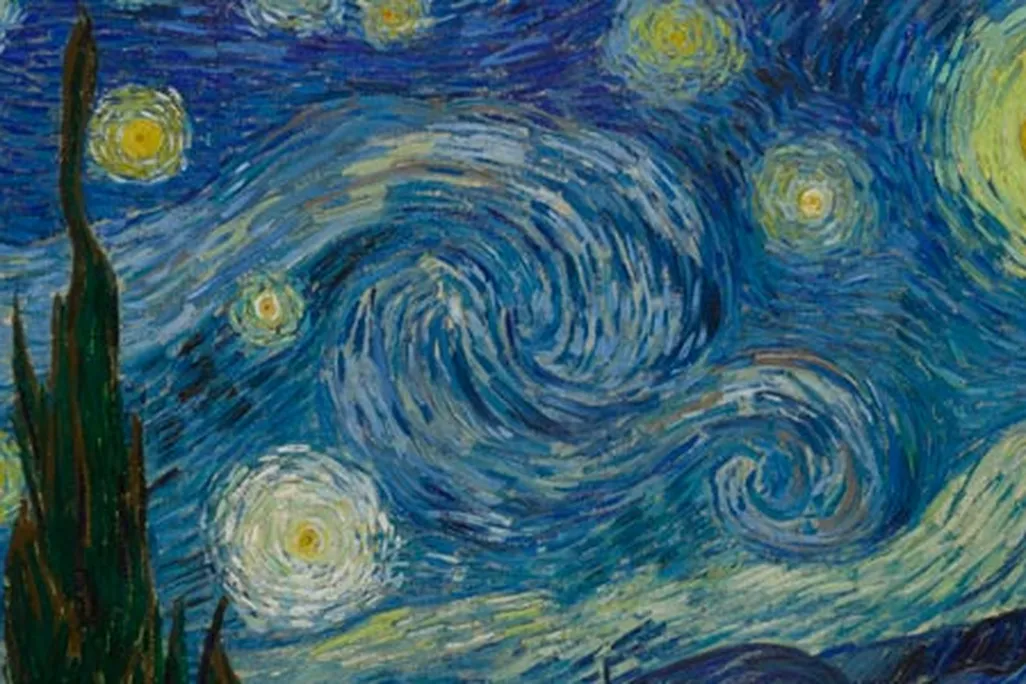
What van Gogh fixed on, by daylight or at night, gave the world many of its most treasured paintings. His 1888 Sunflowers, says critic Robert Hughes, "remains much the most popular still life in the history of art, the botanical answer to the Mona Lisa." And van Gogh's visionary landscape The Starry Night, done the next year, has long ranked as the most popular painting at New York City's Museum of Modern Art (MoMA). This inspired the museum, in collaboration with Amsterdam's Van Gogh Museum, to mount the exhibition "Van Gogh and the Colors of the Night" (through January 5, 2009). It will then travel to the Van Gogh Museum (February 13-June 7, 2009).
"The van Gogh we usually think of, that painter of the most audacious, crazy, passionate, frenzied, unleashed bursts of brushwork, may be more evident in his daylight paintings," says MoMA's curator for the show, Joachim Pissarro, great-grandson of the French Impressionist Camille Pissarro. "But in paintings such as the Arles café at night, his touch is more restrained and you really see his intelligence at work. Despite all the mental anguish and depression he experienced, van Gogh never ceased to enjoy an astonishingly clear self-awareness and consciousness of what he was doing."
In an essay for the exhibition catalog, Pissarro tries to clear up some popular mythology: "Contrary to an enduring misconception of van Gogh as a rough and ready chromomaniac driven by his instincts to render what he saw almost as quickly as he saw it, the artist's twilight and night scenes are actually elaborate constructions that also call on his vast literary knowledge." Van Gogh himself hinted at this in a letter to his sister Wil, written in 1888 as he was painting his first starry night canvas. He was inspired, he said, by imagery in the poems by Walt Whitman he was reading: "He sees...under the great starlit vault of heaven a something which after all one can only call God—and eternity in its place above the world."
It seems that van Gogh never dreamed his paintings would become such fixed stars in the art firmament. In 1890, less than two months before he ended his life with a pistol shot, he wrote to a Paris newspaper critic who had praised his work, "It is absolutely certain that I shall never do important things." He was then 37 years old, had been painting for less than ten years and had sold next to nothing. In his last letter to Theo, found on the artist at his death, he had written: "Well, my own work, I am risking my life for it, and my reason has half foundered because of it."
Like his paintings, van Gogh's biography has gone into legend. He was born in 1853 in the Netherlands; his father was a minister, his uncles, successful art dealers. He was dismissed while working as a missionary in southwest Belgium for being too zealous and failed as an art salesman by being too honest. When he took up drawing and painting, his originality offended his teachers. One student later described the scene at the Antwerp Academy where van Gogh enrolled: "On that day the pupils had to paint two wrestlers, who were posed on the platform, stripped to the waist. Van Gogh started painting feverishly, furiously, with a rapidity that stupefied his fellow students. He laid on his paint so thickly that his colors literally dripped from his canvas on to the floor." He was promptly kicked out of the class.
But alone in a studio or in the fields, van Gogh's discipline was as firm as his genius was unruly, and he taught himself all the elements of classical technique with painstaking thoroughness. He copied and recopied lessons from a standard academic treatise on drawing until he could draw like the old masters, before letting his own vision loose in paint. Although he knew he needed the utmost technical skill, he confessed to an artist friend that he aimed to paint with such "expressive force" that people would say, "I have no technique."
By the early 1880s, Theo, who was four years younger than Vincent, was finding success as a Paris art dealer and had begun supporting his brother with a monthly stipend. Vincent sent Theo his astonishing canvases, but Theo couldn't sell them. In the spring of 1889 after receiving a shipment of paintings that included the now-famous Sunflowers, the younger brother tried to reassure the elder: "When we see that the Pissarros, the Gauguins, the Renoirs, the Guillaumins do not sell, one ought to be almost glad of not having the public's favor, seeing that those who have it now will not have it forever, and it is quite possible that times will change very shortly." But time was running out.
Growing up in the Brabant, the southern region of the Netherlands, Vincent had absorbed the dark palette of great Dutch painters such as Frans Hals and Rembrandt. As an art student in Antwerp, he had the opportunity to visit museums, see the work of his contemporaries and frequent cafés and performances. In March 1886, he went to join Theo in Paris. There, having encountered young painters like Toulouse-Lautrec, Gauguin and Signac, as well as older artists such as Pissarro, Degas and Monet, he adopted the brighter colors of modern art. But with his move to Arles, in the south of France, in February 1888, the expressive force he'd been searching for at last erupted. Alone in the sun-drenched fields and gaslit night cafés of Arles, he found his own palette of bright yellows and somber blues, gay geranium oranges and soft lilacs. His skies became yellow, pink and green, with violet stripes. He painted feverishly, "quick as lightning," he boasted. And then, just as he achieved a new mastery over brush and pigment, he lost control of his life. In a fit of hallucinations and anguish in December 1888, he severed part of his ear and delivered it to a prostitute at a local brothel.
Gauguin, who had come to Arles to paint with him, fled to Paris, and van Gogh, after his neighbors petitioned the police, was locked up in a hospital. From then on, the fits recurred unpredictably, and he spent most of the last two years of his life in asylums, first in Arles and then in Saint-Rémy, painting what he could see through the bars of his window or from the surrounding gardens and fields. "Life passes like this," he wrote to Theo from Saint-Rémy in September 1889, "time does not return, but I am dead set on my work, for just this very reason, that I know the opportunities of working do not return. Especially in my case, in which a more violent attack may forever destroy my power to paint."
When the attacks seemed to subside in May 1890, van Gogh left Saint-Rémy for Auvers-sur-Oise, a small village near Paris where Dr. Paul Gachet, a local physician and friend to many painters, agreed to care for him. But van Gogh's paintings proved more successful than the doctor's treatments. Among the artist's last efforts was the tumultuous Wheatfield with Crows, in which dark and light, near and far, joy and anguish, all seem bound together in a frenzy of paint that can only be called apocalyptic. Van Gogh shot himself soon after painting it and died two days later. He was buried in a graveyard next to the field.
Theo had been at Vincent's side as the artist died and, according to Bernard, left the graveyard at Auvers "broken by grief." He never recovered. He barely had time to present a show of Vincent's paintings in his Paris apartment. Six months later he, too, died—out of his mind and incoherent in a clinic in Holland, where he had been taken by his wife because of his increasingly violent outbursts. (One theory holds that both Theo and Vincent, and probably their sister Wil, all suffered from an inherited metabolic disorder that caused their similar physical and mental symptoms.) He now lies buried next to his brother in Auvers.
Against the backdrop of this poignant biography, the new exhibition of van Gogh's night pictures at MoMA takes on added significance. For it was to the night sky, and to the stars, that van Gogh often looked for solace. The problems of painting night scenes on the spot held more than a technical interest and challenge for him. When he looked at the night sky, he wrote to Theo in August 1888, he saw "the mysterious brightness of a pale star in the infinite." When you are well, he went on, "you must be able to live on a piece of bread while you are working all day, and have enough strength to smoke and drink your glass in the evening....And all the same to feel the stars and the infinite high and clear above you. Then life is almost enchanted after all."
Van Gogh saw the night as a period of reflection and meditation after a day of activity, says MoMA curatorial assistant Jennifer Field, one of the organizers of the exhibition. "It was also this kind of metaphor for the cycle of life. And he linked this with the changing of the seasons."
In Arles, in 1888 and 1889, van Gogh's paintings took on a mystical, dreamlike quality. Straight lines became wavy, colors intensified, thick paint became thicker, sometimes squeezed straight onto the canvas from the tube. Some of these changes were later taken as a sign of his madness, and even van Gogh feared that "some of my pictures certainly show traces of having been painted by a sick man." But there was premeditation and technique behind these distortions, as he tried to put a sense of life's mysteries into paint. In a letter to Wil, he explained that "the bizarre lines, purposely selected and multiplied, meandering all through the picture, may fail to give the garden a vulgar resemblance, but may present it to our minds as seen in a dream, depicting its character, and at the same time stranger than it is in reality."
The artist's focus on the relationship between dreams and reality—and life and death—had a profound meaning for him, as he had confided to Theo in a letter a year before his first crisis in Arles. "Looking at the stars always makes me dream, as simply as I dream over the black dots representing towns and villages on a map. Why, I ask myself, shouldn't the shining dots of the sky be as accessible as the black dots on the map of France? Just as we take the train to get to Tarascon or Rouen, we take death to reach a star."
His interest in mixing dreams and reality, observation and imagination, is particularly evident in the night paintings he made in Arles and Saint-Rémy in 1889 and 1890, in which he not only conquered the difficulties of using color to depict darkness but also went a long way toward capturing the spiritual and symbolic meanings that he saw in the night.
"He lived at night," says Pissarro. "He didn't sleep until three or four in the morning. He wrote, read, drank, went to see friends, spent entire nights in cafés ...or meditated over the very rich associations that he saw in the night. It was during the night hours that his experiments with imagination and memory went the farthest."
Van Gogh told Theo that in depicting the interior of a night café, where he had slept among the night prowlers of Arles, "I have tried to express the terrible passions of humanity by means of red and green." He stayed up three consecutive nights to paint the "rotten joint," he said. "Everywhere there is a clash and contrast of the most disparate reds and greens in the figures of little sleeping hooligans, in the empty, dreary room...the blood-red and the yellow-green of the billiard table."
Van Gogh considered it one of the ugliest paintings he'd made, but also one of the most "real." His first painting of the starry sky, The Starry Night over the Rhône (1888), was another exercise in contrasting complementary colors (pairs chosen to heighten each other's impact). This time, the effect of the painting, with its greenish blue sky, violet-hued town and yellow gaslight, was more romantic. He wrote Wil that he had painted it "at night under a gas jet."
Van Gogh considered his now-iconic The Starry Night, which he painted from his barred window at Saint-Rémy, a failed attempt at abstraction. Before leaving Saint-Rémy, he wrote to Émile Bernard: "I have been slaving away on nature the whole year, hardly thinking of impressionism or of this, that and the other. And yet, once again I let myself go reaching for stars that are too big—a new failure—and I have had enough of it."
Theo liked the painting but was worried. He wrote Vincent that "the expression of your thoughts on nature and living creatures shows how strongly you are attached to them. But how your brain must have labored, and how you have risked everything...." Vincent didn't live to know that in his reaching for the stars, he had created a masterpiece.
New Mexico-based painter and printmaker Paul Trachtman wrote about new figurative painters in the October 2007 issue.
/https://tf-cmsv2-smithsonianmag-media.s3.amazonaws.com/filer/Vincent-van-Gogh-The-Dance-Hall-in-Arles-9.jpg)
/https://tf-cmsv2-smithsonianmag-media.s3.amazonaws.com/filer/Vincent-van-Gogh-Cafe-Terrace-at-Night-17.jpg)
/https://tf-cmsv2-smithsonianmag-media.s3.amazonaws.com/filer/Vincent-van-Gogh-Gauguins-Chair-16.jpg)
/https://tf-cmsv2-smithsonianmag-media.s3.amazonaws.com/filer/Vincent-van-Gogh-The-Cottage-15.jpg)
/https://tf-cmsv2-smithsonianmag-media.s3.amazonaws.com/filer/Vincent-van-Gogh-Landscape-at-Twilight-14.jpg)
/https://tf-cmsv2-smithsonianmag-media.s3.amazonaws.com/filer/Vincent-van-Gogh-Evening-Landscape-13.jpg)
/https://tf-cmsv2-smithsonianmag-media.s3.amazonaws.com/filer/Vincent-van-Gogh-The-Sower-12.jpg)
/https://tf-cmsv2-smithsonianmag-media.s3.amazonaws.com/filer/Vincent-van-Gogh-The-Sower-11.jpg)
/https://tf-cmsv2-smithsonianmag-media.s3.amazonaws.com/filer/Vincent-van-Gogh-Night-after-Millet-10.jpg)
/https://tf-cmsv2-smithsonianmag-media.s3.amazonaws.com/filer/Vincent-van-Gogh-Eugene-Boch-The-Poet-2.jpg)
/https://tf-cmsv2-smithsonianmag-media.s3.amazonaws.com/filer/Vincent-van-Gogh-The-Stevedores-in-Arles-8.jpg)
/https://tf-cmsv2-smithsonianmag-media.s3.amazonaws.com/filer/Vincent-van-Gogh-The-Potato-Eaters-7.jpg)
/https://tf-cmsv2-smithsonianmag-media.s3.amazonaws.com/filer/Vincent-van-Gogh-Lane-of-Poplars-at-Sunset-6.jpg)
/https://tf-cmsv2-smithsonianmag-media.s3.amazonaws.com/filer/Vincent-van-Gogh-Landscape-with-Wheat-Sheaves-and-Rising-Moon-5.jpg)
/https://tf-cmsv2-smithsonianmag-media.s3.amazonaws.com/filer/Vincent-van-Gogh-The-Night-Cafe-4.jpg)
/https://tf-cmsv2-smithsonianmag-media.s3.amazonaws.com/filer/Vincent-van-Gogh-Starry-Night-over-the-Rhone-3.jpg)
/https://tf-cmsv2-smithsonianmag-media.s3.amazonaws.com/filer/Vincent-van-Gogh-The-Starry-Night-520.jpg)