
/https://tf-cmsv2-smithsonianmag-media.s3.amazonaws.com/filer_public/06/62/0662cbc4-0ea2-4a0f-86cd-fc2f19c0b87e/robinsontheaterrichmondva2013-3-8dsc_4217bvanwinklebvanwinkle.jpg)
In a Plea to Preserve Them, One Photographer Has Captured 1,200 American Movie Theaters and Counting
For more than 40 years, Benita VanWinkle has photographed vintage movie houses in all 50 states
:focal(1000x714:1001x715)/https://tf-cmsv2-smithsonianmag-media.s3.amazonaws.com/filer_public/06/62/0662cbc4-0ea2-4a0f-86cd-fc2f19c0b87e/robinsontheaterrichmondva2013-3-8dsc_4217bvanwinklebvanwinkle.jpg)
Growing up, I felt a strong sense of community whenever I went to the local movie theaters in Clearwater, Florida. Going to the movies influenced and shaped my weekends back then. The films affected how I saw aspects of the world. The theater was also a place where one could escape for a while and forget about the angst of childhood. I remember reading S.E. Hinton’s popular coming-of-age novel The Outsiders soon after I turned 11. The first line really resonated with me: “When I stepped out into the bright sunlight from the darkness of the movie house, I had only two things on my mind: Paul Newman and a ride home.” Those words express perfectly the moment of transition upon exiting the darkened auditorium, leaving behind the make-believe world of film and re-entering reality, surrounded by strangers with whom I now shared a connection.
I have spent the past 40-plus years photographing American movie houses that, like my own hometown theater, were built before the advent of the multiplex cinema. This body of work is from my ongoing documentary photography project, Please Remain Standing, which began from a photojournalist’s desire to record these older structures before they were torn down and forgotten. A few years in, I shifted focus to celebrate the endurance of the American movie theater, not memorialize its demise. Despite the decline in attendance, groups as well as individuals have made remarkable efforts to save their hometown cinemas. The energy and enthusiasm behind these restorations is inspiring. In the same spirit, I hope my work will create awareness and encourage the preservation of these architectural gems, reminding us of the benefits gained from the moviegoing experience.
/https://tf-cmsv2-smithsonianmag-media.s3.amazonaws.com/filer_public/50/9a/509afab3-e20f-4d93-9fec-385bbd073d12/carib_color_outsideclearwaterfl1982-5-3bvanwinklebvanwinkle.jpg)
Collectively, the photographs are a personal anthem, a visual cry for the earlier movie theaters to please remain standing and to maintain their relevance within our communities. Through their survival, one of the greatest American pastimes will continue to bring people together. Don’t we all, regardless of age, need to escape reality occasionally, to immerse ourselves in the fantasy being projected in a darkened auditorium, far from whatever worries await us once the credits fade from the screen?
I grew up in Largo, Florida, four miles from Clearwater. Largo’s downtown stretched only two blocks in each direction, but we had our own movie theater, at least until I was in junior high. The theater’s curved facade touted a vertical neon blade sign that read “LARGO.” Housed in an old Quonset hut, one of the metal arched buildings left over from World War II, the theater was small, with only 400 seats. The locals knew better than to go to the movies on a stormy day, when the sound would be drowned out by rain pelting against the metal roof. The Largo had a large single screen, the popcorn was buttery and the concrete floor was sticky from spilled soda—just as in thousands of other movie theaters across the country.
/https://tf-cmsv2-smithsonianmag-media.s3.amazonaws.com/filer_public/01/99/0199dd83-9f77-4888-9404-8f1a0fad526d/earle_mt_airyncinsidecandycounter2014-5bvanwinklebvanwinkle.jpg)
After the Largo closed, my family’s weekend entertainment moved to Clearwater, the next town over, with twice the population. Clearwater’s downtown was much larger, and it had two movie theaters—the quirky Carib, with 1,194 seats and the much fancier Capitol, with a seating capacity of 944. Both had much bigger screens than the old Largo. When Steven Spielberg’s Jaws was released, in 1975, I went to see it with a friend at the Capitol. I still remember jumping out of my seat when the giant shark leaped out of the water at Richard Dreyfuss: I tossed my bag of popcorn in the process. By then, the Capitol had surround sound, which enhanced the impact of John Williams’ effective score. Unsurprisingly, the film left many of us in Florida with a newfound fear of swimming in the Gulf.
/https://tf-cmsv2-smithsonianmag-media.s3.amazonaws.com/filer_public/fd/75/fd75130e-6396-4ec2-a9c9-1c6b51eb04a6/wylincolntheatrecheyennewy2022-5-21-5211749bvanwinklebvanwinkle.jpg)
Up the street from the Capitol was the Carib, where I saw director Herbert Ross’ 1977 film Turning Point six times. The theater’s name was pronounced “Care-ib,” short for “Caribbean.” Fittingly, a sculptural depiction of the islands stretched across the building’s facade. Whimsical creatures frolicked in the blue-green sea, among them a mermaid riding a turtle. It was a sight to behold. At night the sidewalk glowed from the large neon cursive letters that rose from both sides of the marquee, spelling out the theater’s name. Before every showing, the manager, Clarence, would start a scratchy film with “The Star-Spangled Banner” playing over an image of the American flag blowing against the sky. He would loudly instruct the patrons in the auditorium to “please remain standing for our national anthem.” The worn-out film reel, with its torn sprockets, would barely make it through the roughly eighty seconds we stood at attention. If someone in the audience refused to stand, Clarence would repeat his announcement. If the offending patron still did not comply, he would abruptly flip the house lights on. Ultimately, the defiant—and now embarrassed—moviegoer would stand up, unable to tolerate the angry stares of patrons who were annoyed that the show was being delayed. The Carib became my go-to as a teenager, and it would be the first movie theater I photographed.
/https://tf-cmsv2-smithsonianmag-media.s3.amazonaws.com/filer_public/18/1b/181b2410-6657-4441-8b62-dfe72bf7953a/poncantheatrecurtainandinsideponcacityok2021-6-9p6090482bvanwinklebvanwinkle.jpg)
Having decided to be a photojournalist, I enrolled at Daytona Beach Community College, now Daytona State College. At the time, it was one of the few community colleges that offered a two-year degree in professional photography. During my first year, a teacher gave the class an assignment to “paint with light,” a photography technique that involves creating an image in a darkened space. It requires a long exposure as the photographer systematically moves a source of illumination across the designated area. The Carib was the perfect place to capture what was barely ever seen. I arranged with Clarence that I would arrive at the theater before the Saturday matinee. I adjusted my Nikon F to the bulb setting and kept the shutter open for six to ten minutes for each exposure. Holding a clamp light with a very hot tungsten bulb, I methodically swept light across one five-foot section at a time, then quickly moved back a few rows and repeated the action, trailing two hundred feet of extension cord behind me with the assistance of my boyfriend.
/https://tf-cmsv2-smithsonianmag-media.s3.amazonaws.com/filer_public/34/19/34192ca8-8bee-43c1-b716-35d7da752d45/mncozytheatrewadenamn2022-5-17-5170705-1bvanwinklebvanwinkle.jpg)
I made three frames, only one of which came out perfectly. Visible in that photograph is one side of the auditorium, which was decorated with huge Egyptian-style figures and symbols running the length of the wall. They appear to depict the history of sound and music. Those looming figures had terrified me as a child, but as a teenager I was intrigued by the aesthetic mismatch between the tropical exterior and the Egyptianesque interior. Less than three years after I shot my assignment, the Carib was demolished. I was devastated to see how easily an architectural pillar of the community could be destroyed. (The Capitol had closed around the same time, but a few years later it reopened as a live theater venue.)
In 1988, I moved to Illinois to earn a master’s degree in photography at Southern Illinois University (SIU). Although I had read all the admissions material, I somehow overlooked the requirement that incoming graduate students have a thesis topic before arriving. By that time, I had already been photographing movie theaters for six years, so when a professor asked what I would be working on, I hesitated only briefly before declaring, “The documentation of vintage movie theaters.” What had been a pastime became a serious project that has continued well beyond the three-year graduate program.
/https://tf-cmsv2-smithsonianmag-media.s3.amazonaws.com/filer_public/3e/0d/3e0d0d48-e067-44fd-9c47-4d6fedb41803/nmriograndetheaterlas_crucesnm2020-1p1040786bvanwinklebvanwinkle.jpg)
Before moving to Illinois, I had photographed movie theaters mostly in black-and-white, as with the Carib’s interior. Soon after I arrived at SIU, one of my professors, Charles Swedlund, persuaded me to switch to color, noting that by shooting in black-and-white I was missing a large part of my subject’s appeal. He was so right. Many of these older theaters showcase a vibrant decor—designed with bright, saturated colors in neon signage, terrazzo floors, carpeting and wall coverings. Their enchanting facades transport the moviegoer and enhance the sense of anticipation. At night, the impression is heightened when the marquee is illuminated and the building is ablaze with neon lights. The effect is dazzling. As the most prominent architect of Art Deco movie theaters on the West Coast, S. Charles Lee, famously proclaimed: “The show starts on the sidewalk.”
For about 15 years now—while teaching full-time at High Point University in North Carolina—I have planned multistate trips between semesters. Almost without exception, these “theater tours” include driving hundreds of miles and stopping at dozens of movie houses. Throughout the year, I keep a notebook to jot down places people tell me about. I use these recommendations as a jumping-off point to map out the next region of “best theater potential.” In the decades since graduate school, locating theaters has become much easier. There are now extensive online resources, including several websites created by and for people passionate about movie theaters and drive-ins. Among the most useful has been Cinema Treasures, a website launched in 2000 that documents movie houses, whether still screening movies, repurposed as live-event venues—many of which show classic films—or torn down. As the site invites users to contribute information, it is an invaluable database.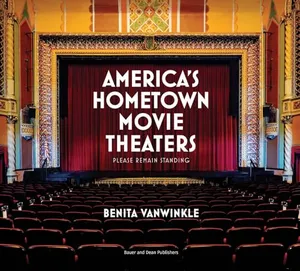
/https://tf-cmsv2-smithsonianmag-media.s3.amazonaws.com/filer_public/77/04/77046ad1-b751-4b8e-af1c-5871b4ca5c92/statetheaterlewellenne2022-5-20-5201433-1bvanwinklebvanwinkle.jpg)
Despite the short amount of time allotted for each stop, I rarely manage to visit all the theaters on the itinerary. Sometimes I get lucky and am allowed inside to photograph. Other times, I attempt to wait out obstacles: bad weather, backlighting, pickup trucks blocking the theater’s facade. For challenges such as fading light, I am grateful that I decided early on not to abandon my 35 mm camera for the heavier and more cumbersome 4x5 format. The smaller camera provides flexibility to get the shot quickly. My husband, Phil Norman, who has accompanied me on trips over the past 37 years, is an adept assistant. Phil looks out for traffic as I sprawl in the middle of a road, holds an umbrella over my head to shield the camera from rain and keeps an eye out for theaters not on the list.
By the numbers: The decline of movie theaters
- The United States was home to about 22,000 movie theaters in 1930. By 2024, that number had dropped to a mere 2,007, according to America's Hometown Movie Theaters.
/https://tf-cmsv2-smithsonianmag-media.s3.amazonaws.com/filer_public/d0/4e/d04ea6db-748e-482b-a870-5d966655b870/callicoontheatercallicoonnyoutside2019-6p617017bvanwinklebvanwinkle.jpg)
Going out to the movies is one of the few activities that unite strangers from different backgrounds, political parties and social classes. Aside from transporting us out of our day-to-day mind-set, the experience creates a momentary sense of belonging to a broader group, beyond our family or circle of friends. When an audience exits onto the sidewalk after a movie or performance, its constituents share a state of mind. As Kristina Smith, owner of the Callicoon Theater in Callicoon, New York, told me in 2019, “We are becoming so isolated from each other that we can no longer tolerate our differences. Even within our own homes, we separate and watch different shows in different rooms, no longer sitting down to laugh with our families. In a theater, you have to sit next to a neighbor who might have different politics or values, sharing the same space. In this age, it’s one of very few places where this actually happens. I think it’s good for the soul.”
/https://tf-cmsv2-smithsonianmag-media.s3.amazonaws.com/filer_public/67/71/6771b5d2-9d2a-4f49-a379-5c8ee5ff44ec/plazatheatrerinsideatlantaga2016-7-31p7310144bvanwinklebvanwinkle.jpg)
Having completed my goal of photographing theaters in all 50 states plus the District of Columbia, I cannot imagine stopping. There is always another theater to document, another story to capture. After more than four decades and visiting more than 1,200 theaters, I have heard numerous oral histories, which have greatly heightened my appreciation of these architectural treasures that were once the cornerstones of their communities.
As long as I still feel that thrill when pulling up to a theater for the first time, I plan to keep going. “Just one more,” she tells herself, like so many photographers do.
From the forthcoming book America’s Hometown Movie Theaters by Benita VanWinkle, courtesy of Bauer and Dean Publishers.
Planning Your Next Trip?
Explore great travel deals
A Note to our Readers Smithsonian magazine participates in affiliate link advertising programs. If you purchase an item through these links, we receive a commission.