
How an Irish Backroad Tradition Is Rolling Into Small-Town America
With roots in County Armagh and County Cork, the sport of road bowling is finding new life stateside, both as a fun pastime and as a way for a group of Americans to honor their heritage
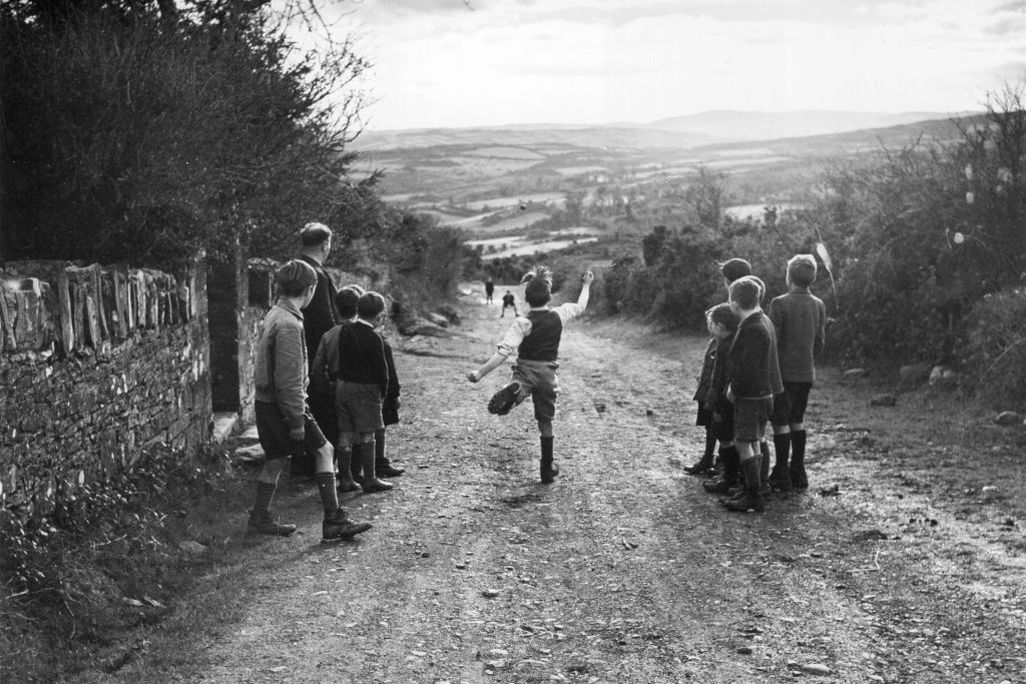
On a rural backroad in West Virginia one might come across an unusual sign, stenciled in block letters: “Slow Please, Irish Road Bowling Ahead.”
Somewhere up the road, a player takes a running start and heaves a solid 28-ounce iron ball about the size of a baseball, underhanded, down the asphalt. Spectators track the sphere with their eyes—some are quite invested, with money riding on where it lands. The West Virginia Irish Road Bowlers then take turns to try to cover the course of 1 to 2.5 miles in the fewest throws.
If this sounds familiar, it may be because the retired football star Jason Kelce recently took a swing at the sport for ESPN with the Boston Road Bowling team, a squad mostly composed of Irish expats. Their brogue was the star of the show: “I played two matches, lost one won one, and struggled to understand at least 50 percent of what was said,” wrote the retired NFL star on Instagram, before vowing to try the sport again.
A deeply rooted Irish tradition, road bowling might seem a little archaic: In matches, or scores, teams take turns hurling a small cannonball down a course, while others watch from the sidelines. In Ireland, there’s now a campaign underway to include it in the UNESCO Intangible Cultural Heritage list. And the game is gaining traction stateside. The sport asks for little more than a ball—called a bullet, or a bowl—and a road, and West Virginia has plenty of both, plus its own road bowling history. Dan Harvey, an Irish military historian, concluded that troops of Irish origin most likely bowled on the streets of West Virginia, passing time between battles during the Civil War. Since then, the sport lay dormant in the region, until about 30 years ago, when it was revived by environmental journalist and documentary producer David Powell. These days, thanks in major part to evangelist Powell, and to the visuals afforded by social and traditional media, it has become part of the state’s identity.
Powell, of Scotch-Irish descent, first discovered it on television. “I saw it on one of the sports shows, either ESPN or ABC’s ‘Wide World of Sports,’ and I thought, ‘Oh, what a great sport for West Virginia,’” he says. “We have some of the most beautiful country roads anywhere.” Then comes a joke he relishes telling: “We even have a very popular song about our country roads.”
He tracked down a book on road bowling from the Library of Congress and used it to teach himself the sport. In 1994, on a trip to Cork, Ireland, with his mother, he bought six bullets at a hardware store and later sent away for nine more.
A year later he debuted the sport at the Irish Spring Festival in, poetically, Ireland, West Virginia, the tiny town where his mother happened to hail from. At first, people kept their distance. “They were scared about getting run over,” Powell says. Then a family of boys came out to play, along with a father in a wheelchair, recovering from a tobogganing accident. “The crowd said, ‘Well, if Don can be out there in a wheelchair, we can’t be scared,’” Powell recalls. “So they came out, and before you know it, we had a big match there.”
The sport caught on in West Virginia, but Powell had grander ambitions. He contacted the road bowling team in Boston—the same one that played with Kelce, established in 1996 as the first road bowling team stateside, and known for its championship-winning bowling skills. Cork-born Cornelius O’Callaghan, a founding member of the North American Road Bowling Region and winner of two All-Ireland Championships who’s known affectionately as “Con,” came down to check out their legitimacy. They passed muster. In 2004, a team of Boston bowlers traveled to West Virginia—12 players, 9 men and 3 women—for the first serious match. “They knew what they were doing,” Powell says. “We did not.” Quick learners, by 2006, West Virginia was competing alongside Boston and New York in the North American Regional Finals, held annually in different locations.
Quick fact: Another Irish export
- What makes an Irish pub an Irish pub? The Dublin-based Irish Pub Company would tell you it's in the craftsmanship. The design group has created upwards of 2,000 pubs in more than 100 countries around the world.
Today, the West Virginia club is a registered nonprofit with about 50 dedicated members and roughly 100 more who show up when the mood strikes. Powell says they’ve never had to recruit: They publicize a match, and people come. One just needs to check the West Virginia Irish Road Bowling site or the Team WV Irish Road Bowling Facebook page for the next get-together. Or pull over if you see some folks chucking an iron ball down a rural road.
Powell recounts a recent match where a young schoolteacher he knew, intrigued by the stenciled sign, pulled over and jumped out of his car to ask what was going on. “We said, ‘Come on, get in the match,’” Powell says. “And I let him take my shot for the rest of the day.”
The young man, clearly athletic, took the bullet, gave it a whirl and bowled perfectly on his first try.
“Anybody can learn it in five minutes. That’s what’s deceptive,” says Powell. “But to be really good at it, it takes a lifetime.”
The Cork Screw vs. the UnderArmagh
I’m a testament that not everybody has beginner’s luck. Last year, I tried my own hand at road bowling in Armagh, Northern Ireland. My first encounter with the sport, my teacher was lifelong enthusiast and competitor Chris Mallon. I met him and some other newbies in and around the Cardinal Tomás Ó Fiaich Memorial Library and Archive, a free public library whose collection includes historic road bowls and archival road bowling books. The class opened with a history lesson, then shifted to hands-on.
Beyond flinging a bullet down a country road to best your opponents, road bowling in Ireland is both heritage and a community. Today, it is organized as an official sport, but its origins remain a matter of debate. One popular story holds that it dates to the mid-1600s, when locals supposedly rolled the cannonballs left behind by Oliver Cromwell’s soldiers along country lanes. Another theory credits Dutch soldiers who came with William of Orange during the Williamite War (1689-91), and points to similar bowling games still played in the Netherlands. A third suggests the game arrived with English and Scottish settlers, perhaps including weavers, who came to Ireland in the 1600s. Whatever its beginnings, the sport thrived because it needed so little: an iron ball, a public road and a few willing neighbors.
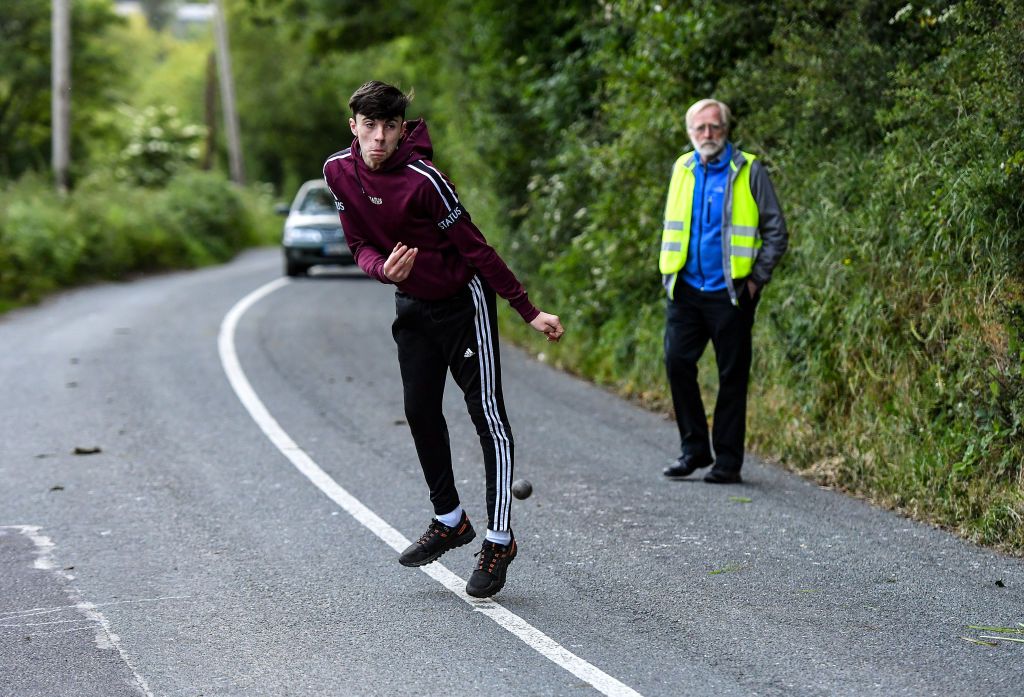
Road bowling has two distinct footholds in Ireland: County Armagh and County Cork. Ask Mallon why the sport thrived in the two distant counties, and he has a theory. “Historians would say it originated around the flax and linen trade, which was big in Armagh, then moved down to Cork, so I’d nearly say there’s a good chance we’re the natural home of it.” Then he grins. “My friends in Cork would probably argue that.”
Mallon explains that today’s bullets are perfect spheres, while the old ones were cast in two halves and joined while still molten, always leaving a rim around the middle. The two counties still can’t agree on how to throw them. “They’re two absolutely different styles,” he says. “The Cork lads do a full 360-degree turn of the arm, but we use underarm.”
He’s been bowling since he was a wee lad, in his words. “Me and my brothers would go out on a Sunday just for the craic,” he says. “Then I got interested, and I went out in the evenings all summer. Home from school, get the homework done, and away down the fields to the bowling road. It was as simple as that.”
For my lesson, Mallon takes me to the parking lot of the library. The ideal road bowling surface for a competition is a smooth, paved asphalt or tarmac rural back road with minimal potholes and curves that allow skilled players to maneuver around bends. This parking lot offers all a beginner needs, mainly an upward slope and wide berth. Mallon instructs me to take a running start, pitch the bowl underhand and let go. I neglected to warn him that my aim leaves much to be desired. In an almost Chaplinesque scene, he learned quickly and dove out of the way as the bullet whistled past.
Bullet points
Walk into a bar in Dublin and ask if anyone has heard of road bowling, and you’ll most likely get blank stares. But where it’s famous, it’s really famous, placed alongside Gaelic football and hurling in national importance. An overarching organization, Bol Chumann na hEireann (the Irish Road Bowling Association) oversees the sport across Ireland; its King & Queen of the Roads is the world’s biggest road bowling championship, drawing international competitors from Europe and daily spectators numbering upwards of 5,000. Last year, in Ballincurrig, it had its 40th anniversary—with television stations from Germany, Italy and more capturing the road bowling debut of Bill Murray (yes, that Bill Murray).
Road bowling in Ireland has never followed a straight road—thanks to the street gathering nature and gambling opportunities, it has on occasion been banned. It might have faded away altogether if not for social media. One popular Facebook page, Road Bowls in Ireland, which launched in 2009, regularly streams matches from Cork and Armagh to viewers around the world, amassing over 156,000 followers and counting. Clips of this curious Irish sport are shared on TikTok, Instagram, YouTube and Facebook—a marriage of technology and ancient tradition.
The challenge in Ireland is recruiting new blood. Road bowling is passed down through families, and Mallon, a former chairman of Bol Cumann Uladh, the Ulster branch of Bol Chumann na hEireann, and still its vice chairman, has made efforts to bring in new interest. “In 2016, I started a school competition,” he says. “We went to primary schools in or on the outskirts of bowling areas and tried to take in as many as we could. We had a bit of success. But that all stopped when Covid came along, and we never got it going again.” He’d like to give it another go, though: “The older they get, the harder it is to get them into it.”
Membership in Bol Cumann Uladh stands around 500, and most of it runs in the family. “Ask people in our world and they’ll name four, five, six bowling families,” Mallon says. “Somebody’s father won something, then their children won, then their children’s children. You could see it from the start of the championships in 1963. No matter how hard you try, the ones whose parents were bowlers nearly always come to the fore.”
Take his own daughter, Kelly Mallon, the most decorated player in the history of Irish road bowling as a 12-time All-Ireland senior champion and eight-time Queen of the Roads champion.
“I used to take her out with the boys and get her to throw the bullets back,” Mallon says. “I quickly noticed they were coming back nearly as fast as they were going out.”
His outreach, he admits, has had limited success, though there are now some young bowlers with no family ties to the sport at all. Social media might create awareness and fandom, but what really keeps it alive, he says, are the big tournaments, where members meet in person and grow the community, and spectators can attend. “Without them, there wouldn’t be the same interest,” he says.
Bowled over, across the Atlantic
Family tradition doesn’t stop at the Irish coast—the sport has its own pedigreed diaspora. One such prodigal son is Fergal Carr, who left Armagh for college in the United States a little over two decades ago. By then he was already an All-Ireland champion, having won his first title in 1998, followed by another one in 2009. Road bowling was in the family’s blood, as he’d grown up with a father who played and a brother who was a world champion, with three All-Irelands under his belt.
But that doesn’t mean it was an inherent skill. “It came easily for my brother, but for me, it took a lot more work,” Carr says. His father even switched him from left-handed to right for the sport, which made sense: Most people throw right-handed, so the tracks on the road are easier to read.
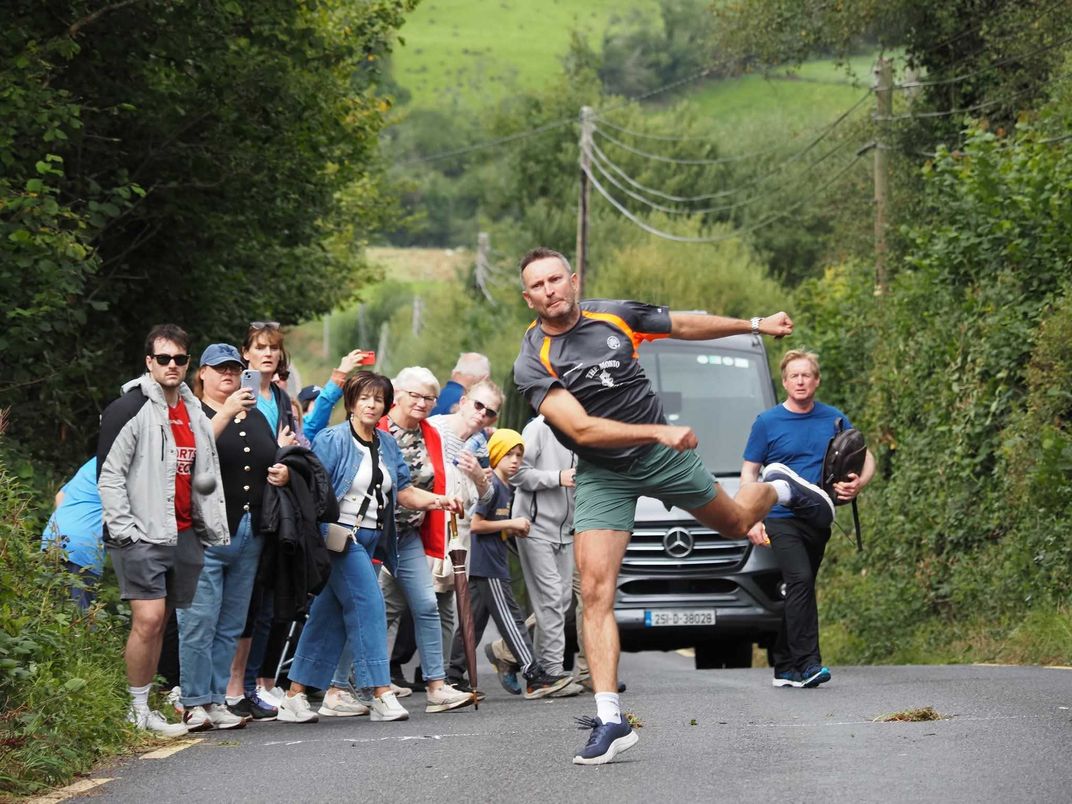
When Carr arrived in New York, a league was already underway, the result of a few Irish-born lads meeting in a bar and thinking a road bowling match was a good excuse to grab a few beers. The expats from Armagh and Cork created Bol Chumann New York, which has now been going for 25 years strong, today with a core 10 to 15 players who practice and compete in North American tournaments and the All-Ireland series every year. Regular practice happens in Riverdale in the Bronx; in the summer, they head to a private road in, fittingly, the Irish Catskills, a patchwork of Irish pubs, dance halls and old family resorts in a stretch of mountain farmland that still hosts Irish music festivals every summer.
In North America, the official road bowling tournament consists of five grades, or classifications that determine a player’s skill level, three of which qualify to represent North America in the All-Ireland series. Carr, now a vice president of product at Peacock, made a triumphant return to the All-Ireland this summer, his first since 2009, and won in the junior C grade. “I had a lot to live up to,” he says, “but I caught up with my brother at the weekend, because now I have three All-Irelands too.”
Bol Chumann New York’s goal is less to recruit than to preserve the game—Carr’s daughter plays only occasionally. But he’s in awe of what Powell and his team have built out in West Virginia. “There’s a huge audience base there, and they have events every weekend,” he says. “Last month, we went down to a place called Ireland, West Virginia, to compete. It actually looks like Ireland.”
Outside the three major hubs in Massachusetts, New York and West Virginia—and competing this year at the North American Road Bowling Championship in Tennessee—you’ll find pockets of road bowling throughout the U.S. Farther west, in a town with no shortage of Irish history, the sport is finding people with no family ties to it at all.
Butte, Montana, has been called “the most Irish town in America,” and not just because its hills resemble Ireland’s. Scores of Irish crossed the Atlantic fleeing the Great Famine (1845-1852), and for many of them, America meant Butte. They came to work in the mines; by 1900, a quarter of the town’s residents were Irish, and they helped build it into one of the most prosperous cities in the world.
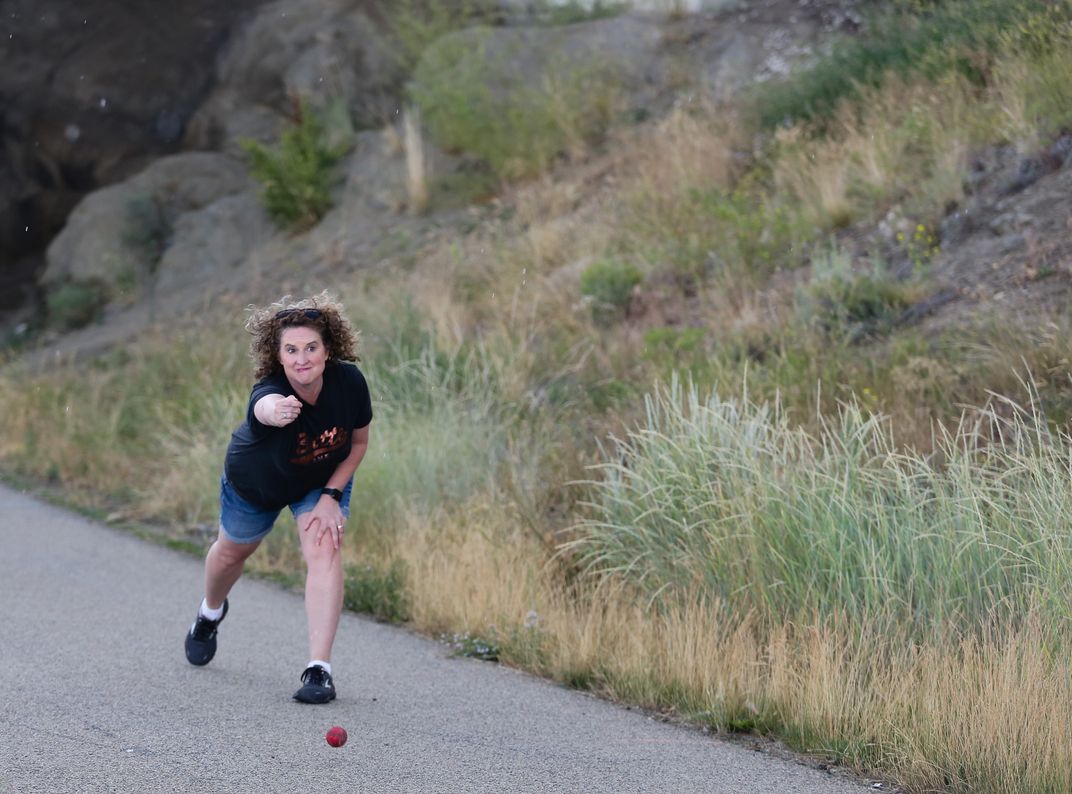
“I grew up on stories of Butte,” says Johnny Gallogly, better known as “Irish Johnny.” An Armagh native like Mallon and Carr who has lived in the U.S. since the ’90s, he moved to Butte in 2020 and is now co-owner and “director of blarney” at the popular Shawn O’Donnell’s American Grill and Irish Pub.
He wanted to see the “Ireland of the Rockies” for himself. “As a little boy in Ireland, you can imagine hearing there’s a place called the Ireland of the Rockies in Montana, which is really cowboy territory,” he says with a laugh. “It sounds like an oddity, but it stuck with me.”
The heritage still runs through everyday life. “You walk into somebody’s house in Butte, Montana, and they have a St. Brigid’s Cross on the wall,” Gallogly says. “They’re drinking Barry’s Tea.” St. Patrick’s Day has been celebrated here since 1882 and draws an estimated 30,000 people. Since 2019, the town has also thrown a Halfway to St. Patrick’s Day event every September at the World Museum of Mining, which preserves the area’s mining history and culture.
The celebration includes road bowling, and it attracts interest from all around. “We’re seeing people coming from other parts of Montana, Wyoming, the Dakotas and Washington to play here,” Gallogly says. The appeal is that almost anyone can do it, rain, shine or ice. “You don't need money to play it. You just need a fire in your belly.”
Back in West Virginia, Powell is a one-man band, working hard to spread the gospel of road bowling. He actually wrote the book on it—a strategy booklet, that is, which as a hobby he sells, along with bowls, through an online store. He has shipped them to curious would-be players in 49 of the 50 states, with help from his wife, Judy Mize.
When a club anywhere in the country wants to get started, it turns to Powell, who was the inaugural inductee into the North American Road Bowling Hall of Fame this year. The booklet keeps it simple. “It’s very plain, basic rules, and we provide all that,” he says.
Today the sport is so woven into West Virginia lore that when Seán Fleming, Ireland’s minister for the diaspora, visited in June 2023, he joined a game at the State Capitol to mark the creation of the West Virginia-Ireland Trade Commission, which aims to strengthen economic, cultural and educational ties between Ireland and the state. The relationship deepened on St. Patrick’s Day this year with the launch of the West Virginia-Ireland Education Alliance, which will open new pathways for collaboration between West Virginia and Irish colleges. Presumably, a little road bowling will be involved.
So if you happen upon a stenciled sign in West Virginia, and Powell is somewhere around, don’t expect to just watch from the sidelines. “We don’t have spectators,” he says. “If you come, we say, ‘There’s a bowl. Take it in your hand and throw it.’” Armagh or Cork pitch, take your pick.
Planning Your Next Trip?
Explore great travel deals
A Note to our Readers Smithsonian magazine participates in affiliate link advertising programs. If you purchase an item through these links, we receive a commission.