
/https://tf-cmsv2-smithsonianmag-media.s3.amazonaws.com/filer_public/ba/4e/ba4e90ed-49e5-42ff-84f8-59e10c3f86d1/3cgp84x.jpg)
Yayoi Kusama Created Fantastical ‘Infinity Mirror Rooms’ That Became the Art World’s Most Famous Backdrops. Her Work Spanned Counterculture to the Cosmos
The Japanese artist, who died on August 14 at 97, sought solace from hallucinations in her art, developing a visual language of polka dots, pumpkins and mirrors that entranced the world
:focal(4128x2752:4129x2753)/https://tf-cmsv2-smithsonianmag-media.s3.amazonaws.com/filer_public/ba/4e/ba4e90ed-49e5-42ff-84f8-59e10c3f86d1/3cgp84x.jpg)
No artist is more closely associated with the concept of infinity than Yayoi Kusama. For her famous “infinity mirror rooms,” she presented whimsical objects in a space with reflective surfaces on the floor and walls. There, she absorbed the public in magical, never-ending worlds.
In the spring of 2017, the career-spanning exhibition “Yayoi Kusama: Infinity Mirrors” smashed attendance records at the Smithsonian’s Hirshhorn Museum and Sculpture Garden in Washington, D.C. On Thursday, Kusama’s representatives announced that she had died at a hospital in Tokyo on August 14, at age 97.
Though she first came to prominence in Japan in the 1950s, Kusama traced her fascination with polka dots and other repetitive imagery back to 1939, when she was 10 years old. She began drawing and painting as a child as a means of asserting control over the terrifying hallucinations she suffered. But the repetitive forms she created as a bulwark against terrors that only she could see would eventually become a globally recognizable visual language. And Kusama would go on to be one of the world’s most popular creatives: In 2014, her 1960 painting White No. 28 commanded $7.1 million at auction, setting a record (since broken) for the highest price ever paid for a work by a living woman artist.
/https://tf-cmsv2-smithsonianmag-media.s3.amazonaws.com/filer_public/04/8b/048bc3d0-2abe-49a7-9bf9-ee560f19ba20/gettyimages-1485709170.jpg)
Kusama had a wild 1960s, then a more obscure 1970s, and later enjoyed a favorable reappraisal when “Yayoi Kusama: A Retrospective,” the first show to survey the entirety of her career up to that point, opened at the Center for International Contemporary Arts in New York City in September 1989.
Four years later, when the artist represented Japan at the Venice Biennale, it felt like a coronation—the beginning of a multidecade final act in which she would be embraced as a global icon. She turned the interior of Japan’s pavilion into a mirrored landscape of glowing yellow polka-dotted pumpkins, an expression of one of the motifs for which she’d become well known. She worked in a dizzying number of mediums, including prose fiction and playwriting.
“The fact that she stayed rooted in the sort of visual culture that she originated at an early age, and that she used it to develop these different motifs—that has become a constant framework that has run beneath and given a structure to her work ever since,” says Betsy Johnson, a Hirshhorn curator who specializes in conceptual and Japanese art. “It’s given her a remarkable consistency of vision. That means that she’s been kind of unswayed by trends in the art market or the art world.”
/https://tf-cmsv2-smithsonianmag-media.s3.amazonaws.com/filer_public/d0/ef/d0efc683-d12a-4880-95cf-238d6cf6362d/3cgp85w.jpg)
Born in 1929 in Matsumoto, Japan, about 130 miles northwest of Tokyo, Kusama spent part of her youth in a factory sewing parachutes for the Japanese military during World War II. Even as a child, hallucinations haunted her, images seeming to arrange themselves into endless patterns, a void of repetition that she feared would swallow her up. Replicating these patterns in pen and brush became her only defense. Sometimes her mother would snatch the paper from her hands as she worked. Kusama’s mother also ordered her to follow her philandering father and spy on him as he conducted his extramarital affairs—an experience that would leave the artist with a lifelong aversion to sex.
Attending art school over the objections of her parents, she began to attract admiring notices from critics. But she credited the artist Georgia O’Keeffe, whom she called “my first and greatest benefactor,” with helping her find the courage to pursue a career in New York. In 1955, Kusama sent O’Keeffe, then in her late 60s, a letter expressing her admiration for the older artist’s work. She enclosed two of her own watercolors.
“I’m only on the first step of the long, difficult life of being a painter,” Kusama wrote. “Will you kindly show me the way?” O’Keeffe answered, creating an epistolary relationship that would continue until her death in 1986. (They would meet in person only once.) In 1958, at 29, Kusama moved to Manhattan—but not before destroying some 2,000 paintings she’d already created, by her own estimation. She intended to reinvent herself completely.

Her first New York solo exhibition, in October 1959, won an admiring review in ARTnews from critic and sculptor Donald Judd, who purchased one of her “infinity net” paintings at the show for $200. They became close friends and, for several years in the mid-1960s, neighbors in a building at 53 East 19th Street. Judd even wrote to the Immigration and Naturalization Service on Kusama’s behalf in 1961 to help her obtain permanent residency status in the United States.
In 1962, Kusama met artist Joseph Cornell, who was 26 years her senior. The two enjoyed a relationship that Kusama would later describe as intimate but platonic until his death in 1972.
Kusama created the first of her “infinity mirror rooms” in 1965. Subtitled Phalli’s Field, it’s now part of the Hirshhorn’s permanent collection.
Kusama sought “to create a situation where people would walk barefoot through a field of phalli,” Johnson says. “Part of this was based in her own sexual inhibitions and trauma. And so this idea of creating these handmade, lumpy phallic sculptures and then draping her body over them, it was a way for her to do a sort of immersion therapy. It was a way to exorcise a certain sort of fear out of her system.”
/https://tf-cmsv2-smithsonianmag-media.s3.amazonaws.com/filer_public/7d/16/7d164073-6f20-4560-baa7-b1dba8f6dadc/hmsg_exh_kusama_ppl_2021_013.jpeg)
Despite these haunting origins, the artist’s work was playful, too. Finding the physical assembly of so many soft, phallic objects to be exhausting, Kusama hit upon the notion of placing them within a “mirrored environment as a way to have it go on and on and on for infinity and make people feel like they’re wandering through this sort of infinite realm,” Johnson says. It was a motif that the artist would stick with.
Despite the friends and allies she had in this period, Kusama struggled. The art world of the time was an overwhelmingly male one, and while contemporaries like Claes Oldenburg and Andy Warhol were earning great acclaim for work that was in conversation with Kusama’s output in this era, she believed that they were stealing her ideas. When Lucas Samaras debuted his own mirror-room exhibition seven months after Infinity Mirror Room—Phalli’s Field first appeared, Kusama was so aggrieved by his actions that she flung herself out of a window of her Greenwich Village apartment. After surviving this attempt at self-harm, she papered over the windows of her studio to prevent others from copying her work.
Former Smithsonian curator Mika Yoshitake organized “Yayoi Kusama: Infinity Mirrors” for the Hirshhorn before overseeing two subsequent Kusama surveys as an independent curator: 2021’s “Kusama: Cosmic Nature” at the New York Botanical Garden and “Yayoi Kusama: 1945 to Now,” which opened at Hong Kong’s M+ museum in 2022 before traveling to other venues.
As Yoshitake points out, Kusama was fully conscious of the toll that mental illness took on her. The external pressures she faced were very real. Many critics lined up to dismiss her as a publicity-seeking provocateur over her performance art: “body festivals” at sites like Wall Street and the Brooklyn Bridge, for example, or her November 1968 open letter to President-elect Richard Nixon, offering to paint polka dots on his “hard, masculine body” if he would end the U.S. war in Vietnam. She implored him to “calm your manly fighting spirit!”
This perceived exhibitionism mortified Kusama’s family and made her a pariah in Japan. In Matsumoto, her high school removed her name from its list of alumni. Relatives would buy every newsstand copy they could find of magazines that reported on her often-unclothed American exploits to prevent neighbors from seeing them.
Cornell’s death in 1972 dealt Kusama another blow. She returned to Japan the following year. The aura of shame that seemed to surround her marked this as a low point in her life. But even despair could fuel her creativity.
/https://tf-cmsv2-smithsonianmag-media.s3.amazonaws.com/filer_public/52/5a/525a9845-d65a-4185-988f-6c57358f773d/kusama-flower_overcoat-98_38cc-2-scaled.jpeg)
“I think the reason why there’s so much joy in her work now is because she went through this dark, incredibly soulful period” in the ’70s and ’80s, Yoshitake says. “In Japan in the ’80s, when there was an economic boom … it was a very male-driven world, the art world, and she represented a source of strength and grotesqueness and independence and power that a lot of people were not ready for.”
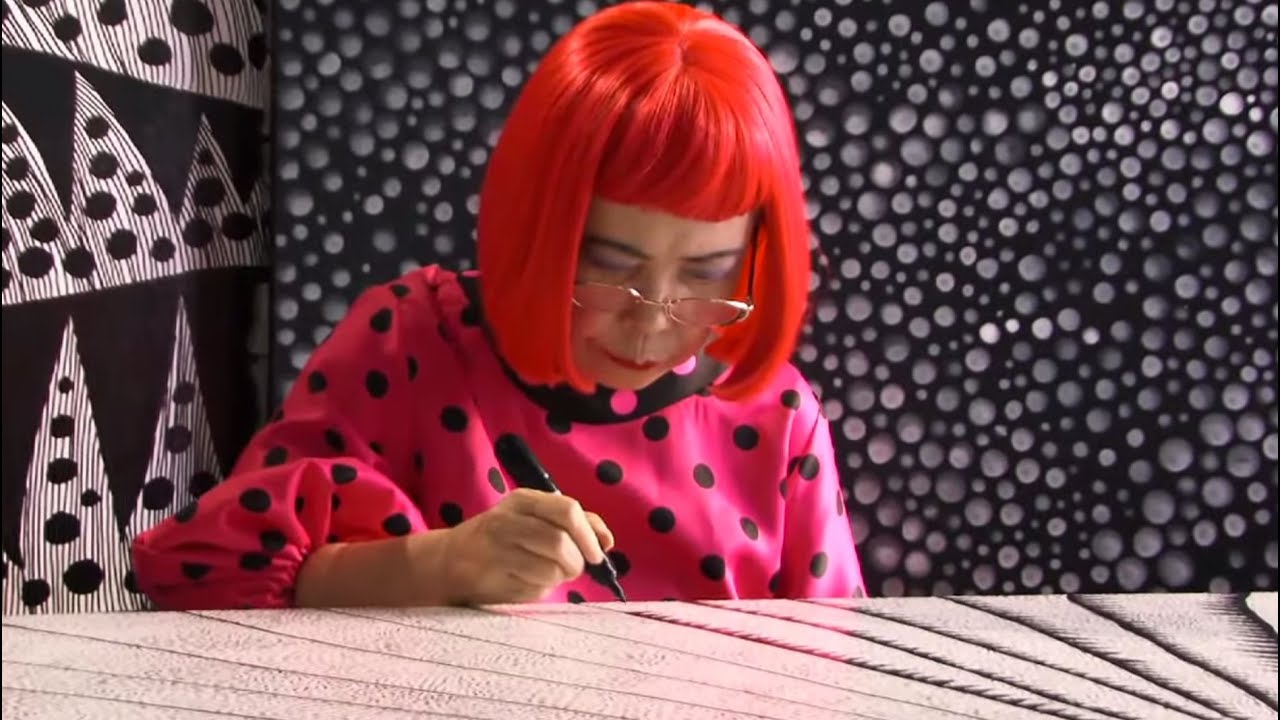
In the late 1970s, Kusama voluntarily checked herself into a psychiatric facility. (Around that time, in 1978, she published her first novel, Manhattan Suicide Addict.) She would choose to become a permanent resident at the hospital, even after she became a globally beloved figure. Into her 90s, she continued the daily practice of walking to her studio, located a short distance from the hospital, each morning and returning each night. In her final years, the walk became too taxing, so she painted in her room.
By 1989, Kusama’s work had evolved far beyond its engagement with current events of two decades earlier, Yoshitake says. Her concerns and inspirations were no longer topical; they were cosmic, infinite.
/https://tf-cmsv2-smithsonianmag-media.s3.amazonaws.com/filer_public/d1/8a/d18abc33-9ab0-4450-8129-6ae17bf986d6/hmsg_exh_kusama_ppl_2021_010.jpeg)
When Kusama was tapped for the 1993 Venice Biennale, she had the honor of being both the first woman and the first artist to represent Japan as a solo act. Kusama brought her psychiatrist with her, fearing she might suffer a nervous breakdown at the event. It was a dramatic reversal of fortune for an artist who’d crashed the Biennale in 1966: Back then, she’d set up her installation Narcissus Garden, composed of thousands of small, mirrored globes, on a lawn outside the pavilions without the permission of the organizers. They were especially shocked that she was selling the balls for $2 each, and eventually the police escorted her off the grounds. But 27 years later, she was welcomed as a hero.
The rise of social media, which began during Kusama’s later years, created an environment in which she could be seen as a global communicator channeling the zeitgeist. In 2017, “Yayoi Kusama: Infinity Mirrors” attracted around 160,000 visitors and tens of thousands of Instagram posts during its run at the Hirshhorn.
Johnson sees another reason that interest in Kusama’s work has exploded: “For the past maybe three decades now, there has been a rise in people craving immersive experiences in art—to be in a new place, to feel like you’re in a new time, to feel like you’re in an environment that has nothing to do with the rest of the world.” Given the nature of Kusama’s hallucinations and her attempts to recreate them in a sculptural environment, Johnson continues, immersion “is what she was always trying to do.”
The curator concludes, “She was trying to put you in a space and time that feels very disconnected from the world that you normally traverse.”
Even after her death, the rest of us are still catching up.