
To Capture the Beauty and Wonder of Flight, These Celebrated Artists Created Spectacular Visions of Astronauts, Aviators, Rocket Launches and the Moon
At the National Air and Space Museum, a recently opened gallery space features artworks by Norman Rockwell, Alma Thomas, Francisco Goya and other luminaries
/https://tf-cmsv2-smithsonianmag-media.s3.amazonaws.com/accounts/headshot/Angelica_Aboulhosn_headshot.png)
/https://tf-cmsv2-smithsonianmag-media.s3.amazonaws.com/filer_public/58/0a/580a77b9-7590-43c5-b70d-e3a590810348/smithmag-rockwell-edit.jpg)
Norman Rockwell’s Man on the Moon (Portrait of an Astronaut) is unlike many of his other paintings. Rather than portraying an American tableau, scenes from everyday life, this work pictures a tightly cropped face with blue-green eyes, his nose a faint line of turquoise and white stars glimmering in the middle distance.
Commissioned by Look magazine to document the space program in 1966, Rockwell took as his subject not only the mystery of lunar landscapes, but also the inner life of an American faced with new and boundless worlds. The man depicted, Rockwell’s neighbor, has a marvelous depth of feeling in his eyes. Rockwell’s subjects were not “faceless heroes,” asserts National Air and Space Museum curator Carolyn Russo, but men and women in whom readers could see themselves.
The 1967 painting, on view in the museum’s current exhibition “The Art of Air and Space: Interpretations of Flight,” speaks to a fundamental impulse, Russo writes in the show’s catalog, to “transcend earthly bounds.” Featuring oil paintings and sculptures, etchings and prints, the show, on view through next summer, is “a window into the soul of flight,” the curator notes.
Quick fact: New galleries at the National Air and Space Museum
This fall, the museum will open two more galleries—“At Home in Space” and “Modern Military Aviation”—completing its multiyear renovation.
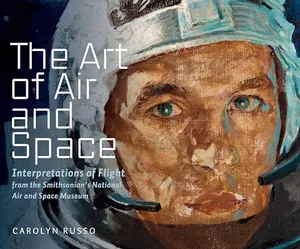
The Art of Air and Space: Interpretations of Flight from the Smithsonian's National Air and Space Museum
Explore the sky and space like never before in this first-ever space and aviation coffee table book dedicated to the renowned art collection at the Smithsonian’s National Air and Space Museum.
“Science explains how we fly; art explores what flight means,” Russo tells Smithsonian magazine. The exhibition, spotlighting the museum’s impressive art collection, is a testament to the power of the visual realm in understanding the history of flight. “Artists often help society imagine possibilities before they become realities,” Russo says. “Space artists visualized the moon landings; NASA recognized the value of artistic interpretation through its pioneering art program.” In fact, James D. Dean, who became the museum’s first art curator in 1974 after serving as director of the NASA Art Program, made a concerted effort to bring the agency’s artwork into the museum’s collection. Since then, Smithsonian curators have been acquiring works that bring to life the breadth of human imagination.
/https://tf-cmsv2-smithsonianmag-media.s3.amazonaws.com/filer_public/5e/32/5e32a5a2-39ce-4793-9ed7-fdb68384b819/55350881961_673e2f7181_o.jpg)
/https://tf-cmsv2-smithsonianmag-media.s3.amazonaws.com/filer_public/20/e1/20e17723-9262-402b-b47d-b0fb02e4d60e/55350881956_58dd62682c_o.jpg)
Consider Francisco Goya’s etching Los Disparates (No. 13: Modo de Volar), completed between 1815 and 1823, which depicts winged figures, men with beaked headpieces, cutting across a murky expanse. The work gestures to the “freedom of imagination,” as Russo puts it, and the possibilities of flight long before the invention of airplanes.
French artist Henri Farré’s 1915 print Avion Canon Voisin Combattant un Aviatik also has that air of freedom. In the sprawling picture, a dogfight is underway, set against lilac-tinged clouds. A fighter pilot fires at a plane in the corner, the shot a needle-thin line. It’s a propulsive work, the eye drawn to the feverish scene, to the plumes of smoke to come. The first known aerial combat artist, Farré flew with a sketchpad strapped to his leg, dashing off notes in midair. He once said he could “paint things with an aerial vision.”
That vision runs through the show, where curiosity is at work.
/https://tf-cmsv2-smithsonianmag-media.s3.amazonaws.com/filer_public/88/5b/885bb569-b24f-428f-84c4-d915d069dd48/55351100539_6587c27f25_o.jpg)
Robert Shore, whom NASA commissioned to document the Mercury program in 1963, places the viewer on the moon in an evocative pastel. Completed in 1969, Shore’s work overlays a man’s face on the moon’s surface, his eyes fixed on something out of frame. It’s a playful imagining of a celestial body, with pale blues and icy mints.
American artist Alma Thomas reveled in that sense of play. The space program, for her, was an endless wonder. “I’m way up there on the moon,” she once pronounced. “Stay down there if you want to. I’m long gone.” The first graduate of the art program at Howard University, Thomas was clear-sighted, a painter enamored by the moon landing, she gushed, by “the thrill of these adventures.” In Blast Off, an exuberant acrylic from 1970, Thomas envisions a rocket jetting into the sky with a kaleidoscope of colors: coral, navy, ochre, pale pink and more. She sees a new frontier, Russo says, “a vision for the future.”
/https://tf-cmsv2-smithsonianmag-media.s3.amazonaws.com/filer_public/27/02/2702955f-88c3-4e7c-8b80-7f3bb1089463/55351099824_724b6df84c_o.jpg)
/https://tf-cmsv2-smithsonianmag-media.s3.amazonaws.com/filer_public/3b/90/3b906f3a-8ea5-4c45-a810-c7be4be379c3/55351040068_f10d4cb3ff_o.jpg)
That sense of possibility suffuses photographer Anne Noggle’s images. In one, American aviator Mary Retick Wells leaps into the air, her hands turned outward like a bird in flight. The photograph is lively, with Wells’ spirit coming through. Noggle, herself a former Women Airforce Service Pilot, flew a crop duster, performed aerial circus stunts and served as an Air Force captain in the Korean War. Later, she studied photography and took as her subject the women she knew, bringing out “their courage,” Russo says, “their zeal for flight.” In a letter to pilots, Noggle wrote, “We may not be young any longer, but we are very much alive.”
So, too, is this exhibition, a look at the beauty of flight and the wonder of realms still unexplored. The artists here have a navigator’s impulse: to venture, to find, to see in the stars a world beyond one’s own.
The show, featured in one of several galleries that opened this summer at the recently renovated museum, speaks not only to the evolution of technology and invention, but also to the development of artistry and creative fervor. To see these works alongside the museum’s aircraft and rockets, space suits and rovers is to understand the role art plays in this history. For Russo, “art allows visitors to connect emotionally with exploration, innovation, risk, achievement and discovery.”
“To dream of flying,” she writes, “is to dream of possibility, expansion and transcendence.” As Rockwell mused, the best artists are “always looking ahead to something new and exciting. The secret is not to look back.”

A Note to our Readers
Smithsonian magazine participates in affiliate link advertising programs. If you purchase an item through these links, we receive a commission.
/https://tf-cmsv2-smithsonianmag-media.s3.amazonaws.com/accounts/headshot/Angelica_Aboulhosn_headshot.png)