
See the Amazing Images That Showcase the Short, Brilliant Lives of Honeybees Throughout the Seasons
A new book follows the insects through rain and shine and highlights the unique behaviors of each bee in a colony
/https://tf-cmsv2-smithsonianmag-media.s3.amazonaws.com/filer_public/d9/be/d9beba45-85f5-447b-92ff-bbbfcee0ecc0/abd_53_page_2.jpg)
The “hive mind” of honeybees is often lauded as an exemplar that humans should strive to emulate. Much scholarship on the insects explores them as a “superorganism”—one animal as a collective, rather than the tens of thousands of unique insects that make up a hive.
But Diary of a Honey Bee, a new book by filmmaker Dennis Wells out on April 14 from Smithsonian Books, explores honeybees as individuals through a synthesis of research, photographs and narrative storytelling.
“Honeybees have been for a very long time the ideal of everybody playing his or her part in a society and working for the greater good,” Wells says. But he notes that for the insects, individuality is not just relevant; “it’s actually existential. A honeybee colony would not survive if they were all the same.”
Wells began learning about the honeybee when he made the 2015 film Secrets of the Hive, which focuses on the more than 20,000 species of wild bees.
During that production process, Wells says, he was captivated by the honeybee.
“I told some of the stories of the life cycle of bees to the editor in the editing suite, and he says, ‘Gee, this is just like Game of Thrones for insects.’ There’s so much going on, and it’s so brutal at times.”

Quick fact: The queen bee
In a bee colony, the queen is surrounded by a “royal court” of about ten to 12 bees that feed and care for her.
/https://tf-cmsv2-smithsonianmag-media.s3.amazonaws.com/filer_public/74/a9/74a9b51c-7e45-46b3-b174-9583d002870f/abd_103_page_55.jpg)
After that conversation, Wells produced a 2020 film called A Bee’s Diary, which was shot from the perspective of two honeybees and followed them through their life spans.
Throughout the two bees’ lives, Wells and his team emphasized unique preferences, behaviors and so-called personalities. But because the story was told from the point of view of the bees themselves, Wells could not explicitly include many of the research findings he had uncovered while creating the film.
“People just were really fascinated by the research behind it, and I still was fascinated about it,” he says. “Then I thought, ‘OK, we have this great photography, and I have all these stories and all the research done; why don’t we turn this into a book?’”
/https://tf-cmsv2-smithsonianmag-media.s3.amazonaws.com/filer_public/f5/ec/f5ec8db3-cdb2-465c-9155-7edfe038b1c3/abd_253_page_53.jpg)
The culmination of this work, Diary of a Honey Bee, examines research about the neuroscience of honeybees and their behaviors as individuals, whether that’s communication, pollinating practices or movement.
“Publications about honeybees could fill libraries,” says scientist Jürgen Tautz, who studies communication among honeybees and wrote the foreword to the book. “There’s lots of books and scientific publications and popular work for good reason. … Usually, you talk about the superorganism and the colony as one big animal. And in the book, it’s a new perspective.”
The book follows a colony through the four seasons, starting with winter. In their winter cluster, the insects cling together in a tight ball and vibrate to stay warm within the hive. Their objective in the winter is “essentially just staying alive,” says Wells.
The honeybee will die if its body temperature dips below 40 degrees Fahrenheit. With the queen bee at the center, the colony spends the winter eating the honey it collected the previous spring and summer. Each bee has slightly different temperature thresholds and preferences, Wells writes, which allows for more efficient heating, because all bees don’t need to be warming the cluster simultaneously. As the days get longer, the queen bee lays the first eggs of the year.
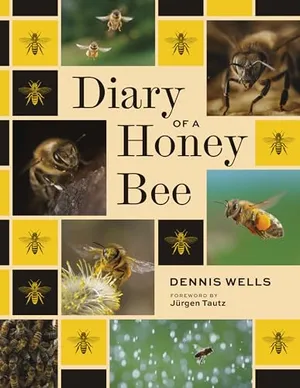
Diary of a Honey Bee
Witness the life cycle of the honeybee with this entomological guide featuring 120 full-color macro photographs.
/https://tf-cmsv2-smithsonianmag-media.s3.amazonaws.com/filer_public/0b/97/0b97044a-86fa-4f72-b1c4-091d888d419a/abd_58_page_40.jpg)
For honeybees, spring starts in February or early March, when they leave the hive in search of the first flowers of the year. Of the 10,000 to 15,000 bees that survive the winter, only some are bold enough to leave the hive at the beginning of the season—another example of bees’ distinct individual characteristics, Wells writes.
“They have to go into very hostile, cold landscapes, and if the sun disappears behind a cloud or if they stay in the shade for too long, they die, so they have to make it back to the hive in time,” he says.
/https://tf-cmsv2-smithsonianmag-media.s3.amazonaws.com/filer_public/32/8a/328a92b5-caa4-4425-80eb-f9257fc70a1a/abd_265_page_70.jpg)
New bees are born throughout the spring, and the hive guides them through metamorphosis. These new bees are called “summer bees,” and although they are the same species as the bees that survived the winter in the hive, their life spans tend to be only six weeks. The “winter bees” tend to live for about six months after their fall births. These two types of honeybees adapt differently for different seasonal needs. As winter bees raise the summer bees and begin to die off, summer bees develop heightened senses and memories as they prepare to leave the hive at around 21 days old—halfway through their typical life span.
Summer is defined by “abundance,” Wells says, and a new generation of bees. Bees brave several animal and climate dangers as they search for pollen and bring it back to the hive, often carrying half their body weight in the substance. Bees within the hive make and store honey from these deliveries. During this season, the colony decides whether it is thriving enough to split up into two hives for the following year. If so, a new queen is born, and the old queen leaves with about two-thirds of the colony in search of a new hive, all carrying as much honey as they can to survive the next winter.
/https://tf-cmsv2-smithsonianmag-media.s3.amazonaws.com/filer_public/f5/b7/f5b7d83a-ad51-465a-bc9d-87b1335a756a/abd_191_page_191.jpg)
In the fall, “not much happens,” says Wells. As long as the weather remains warm, bees from both colonies continue to collect and harvest honey, and a new generation of winter bees is born before the entire cycle begins again.
Scattered among the book’s narrative of bee lives and descriptions of scientific research are close-up photos of the insects inside and outside the hive, taken by photographer Brian McClatchy in 2019 and 2020 during the filming of A Bee’s Diary. To capture the bees inside the hive, Wells says, the team had to build more than 30 sets.
“As soon as you have light, bees tend to try to close the light source off with wax, because to them, it’s just a crack in the shell of where they live, and it’s not supposed to be that way,” says Wells. “So you can only film for 30 seconds to a minute, and then you have to close it again and set up a new set.”
/https://tf-cmsv2-smithsonianmag-media.s3.amazonaws.com/filer_public/16/fb/16fbdf6f-c231-4394-ab5f-f600f502989d/abd_203_page_40.jpg)
Tautz says that accessible writing and images like those in Diary of a Honey Bee are the best way to communicate science about the bees, ecosystems and the climate more broadly, and engage the public. He did not begin his academic career as a honeybee scholar, but when he was gifted a colony of them more than 40 years ago, he was immediately “fascinated” and has been studying them since.
“The trick is to get the interest of people,” he says, “and honeybees are wonderful bridges into the heads of people.”
/https://tf-cmsv2-smithsonianmag-media.s3.amazonaws.com/filer_public/cd/b6/cdb6c1ed-5efa-4ba4-9467-120272d28c76/abd_201.jpg)

A Note to our Readers
Smithsonian magazine participates in affiliate link advertising programs. If you purchase an item through these links, we receive a commission.