
How Did Our Galaxy End Up in the Shape of a Spiral? And More Questions From Our Readers
You’ve got questions. We’ve got experts
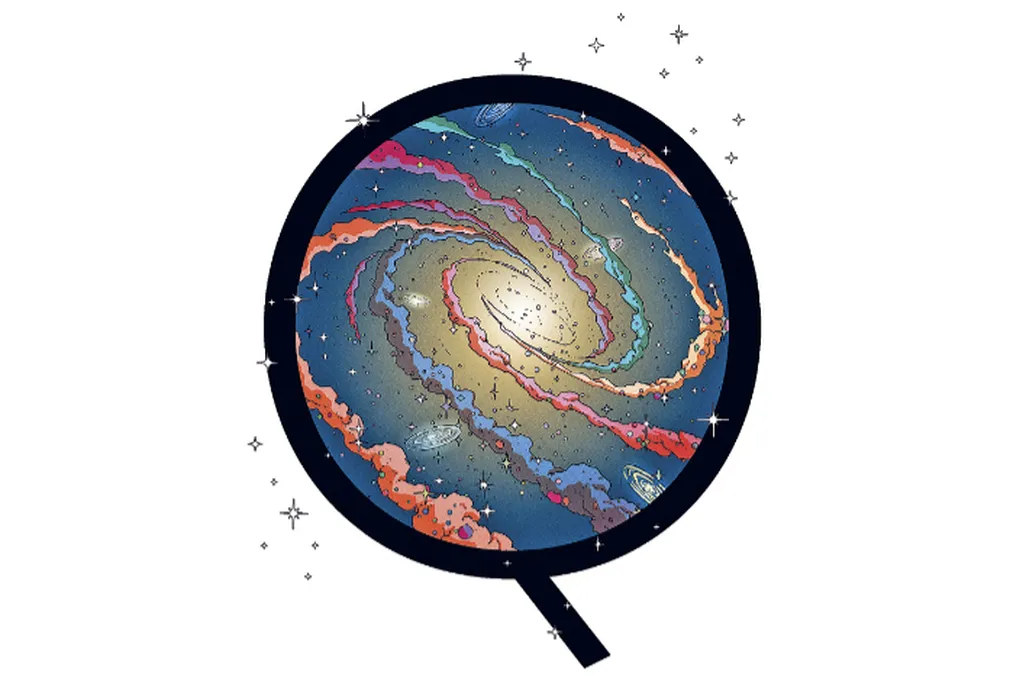
Why is the Milky Way shaped like a spiral?
The Milky Way has spiral-shaped arms, but its inner region is more complex, with a stellar bulge in the middle and a long bar running through its center. The cause of these spiral arms has been elusive for decades. Recent work supports a picture in which colliding galaxies, or even small gravitational tugs from orbiting bodies, can create instabilities that lead to spirals. Galaxy collisions can also compress and disturb gas and dust in ways that create strange arcs, rings and spoke-like structures. Such shapes can be seen in the Cartwheel Galaxy, for example, where they arose from its collision with a smaller companion about 400 million years ago. Collisions like these sometimes lead to vastly enhanced star formation—a phenomenon known as a starburst. In a single year, a starburst galaxy can create enough stars to equal, or even exceed, 1,000 times the mass of our sun. For comparison, our own Milky Way galaxy creates only about two suns’ worth of new star mass every year. —Matthew Ashby, chair of the Center for Astrophysics’ Optical and Infrared Astronomy Division, Smithsonian Astrophysical Observatory
With so many birds flying around my neighborhood, why don’t I see dead birds unless they’re killed by a cat or by hitting a window?
It’s worth noting that cats and window strikes truly are major sources of mortality for birds—together accounting for roughly three billion deaths each year in the United States alone. But when birds die of other causes, the evidence is harder to find. I would expect a sick or aging bird to instinctively move somewhere sheltered—but this is a guess. Until very recently, most birds were too small to be fitted with trackers. But miniature GPS tracking tags and radio telemetry transmitters now allow us to study smaller birds. We will soon have more understanding of how they behave in the lead-up to death and what might happen to their carcasses, both of which are important for conservation. —Scott Yanco, migratory bird research ecologist, Smithsonian’s National Zoo and Conservation Biology Institute
Where did the skateboarding halfpipe get its name? Did people use to skate inside actual pipes?
The skateboarding halfpipe does get its name from actual pipes. In 1975, Tom Stewart traveled to the Arizona desert to skate the enormous concrete pipes associated with a federal public works project bringing water from the Colorado River to major cities. Inside these pipes, skateboarders could use gravity to gain the speed they needed for ambitious tricks. With the help of his architect brother, Stewart designed and built the first official skateboarding halfpipe in 1977, mimicking the shape of “half a pipe.” Stewart had his brother draw up blueprints for the design, and he began selling the template for $19.99. Soon, halfpipes were showing up in yards across the country and around the world. Over time, the shape transformed into the flat-bottomed halfpipe we know today. By 1983, this design also made its way into snowboarding, as athletes transferred skateboarding tricks onto snow. Freestyle skiing and BMX soon followed. The ESPN X Games, which launched in 1995, helped establish the halfpipe as a catalyst for the
aerial tricks of extreme sports. —Jane Rogers, curator, division of culture and the arts, National Museum of American History

Subscribe to Smithsonian magazine now for just $19.99
This article is a selection from the December 2026 issue of Smithsonian magazine