
With A.I.’s Help, a Family Realized Their Mysterious Thrift-Store Find Is a Portrait by a Great Scottish Painter
The oil painting, the work of “Scottish Colorist” FCB Cadell, just sold at auction for more than $250,000
/https://tf-cmsv2-smithsonianmag-media.s3.amazonaws.com/accounts/headshot/Sonja_headshot.png)
:focal(750x500:751x501)/https://tf-cmsv2-smithsonianmag-media.s3.amazonaws.com/filer_public/40/b1/40b16f5a-9862-4527-8ec7-ed11be2f1479/lead_art_painting.jpg)
In the 1960s, a young woman with an art degree spotted a painting in a thrift shop in White Plains, New York. The colorful portrait was of a seated, red-haired subject, wearing dark clothes and an iridescent green headwrap. The woman bought it for less than $100.
“My background in art history and studio practice drew me to this piece instantly,” recalls Helene Plotkin, now 88, to PA Media’s Lucinda Cameron. “The painting had an undeniable, regal presence, but it was the color theory at play that held my attention. … The way the pastels were integrated into the composition was both interesting and bold—it was clearly the work of a significant hand with a deep understanding of light and form.”
Recently, thanks to modern technology, Plotkin discovered just how good her judgment was. Her 60-year-old son Barry uploaded a photo of the artwork to Google’s A.I. program, Gemini. The verdict? It’s a Francis Campbell Boileau Cadell.
/https://tf-cmsv2-smithsonianmag-media.s3.amazonaws.com/filer_public/14/e6/14e649fa-77c9-4a9b-a2d9-13df763ee184/0001_ilqkct_original.jpeg)
Information from Gemini pointed out the painting’s orange accents, lilac background and Art Deco style—all characteristics “unmistakably” Cadell, reports the New York Times’ Malia Mendez. “Your mother didn’t just find a ‘Cadell,’” read text from Gemini, “she found a large-scale, 1920s studio portrait of his primary muse, painted in his most famous Edinburgh studio.”
Known as FCB Cadell, the artist in question is a famous early 20th-century Scottish painter. He was one of the four Scottish Colorists, “radical artists” who “enlivened the Scottish art scene with the fresh vibrancy of French Fauvist colours,” per the National Galleries of Scotland. As National Galleries deputy director Patricia Allerston said in a short documentary, the four men “painted in a certain way, had a particular interest in color, and in the application of paint, and in the properties of paint, and in representing nature, and in representing form.”
Gemini suggested the son and his mother check the back of her painting for markings. They found scrawled numbers, an auction marking and a canvas stamp. The A.I. suggested the family contact art specialists Nick Curnow and Alice Strang, of the Edinburgh auction house Lyon & Turnbull.


“This is the stuff of auctioneers’ dreams,” Strang tells the Times. After inspecting the painting under different types of light and performing additional research, she and Curnow confirmed Cadell was the artist. He was “an absolute master of the paintbrush,” Strang tells the Times. “He says ‘I am Cadell’ over and over in these paintings.”
The model in the recently identified painting is May Easter, an auburn-haired sitter who Cadell painted wearing the same green turban in Pink and Gold. The Lyon & Turnbull specialists titled the newest addition to Cadell’s oeuvre Interior: The Lady in Black. According to the auction house, it dates to the 1920s—Cadell’s “most important and successful period.”
“This is the peak of his career; he’s painting in this extraordinarily modern manner with aspects of Art Deco style, before that term has even been coined,” Strang tells Artnet’s Richard Whiddington. “He’s having fun and showing off because he’s brought together so many of his most famous visual motifs.”
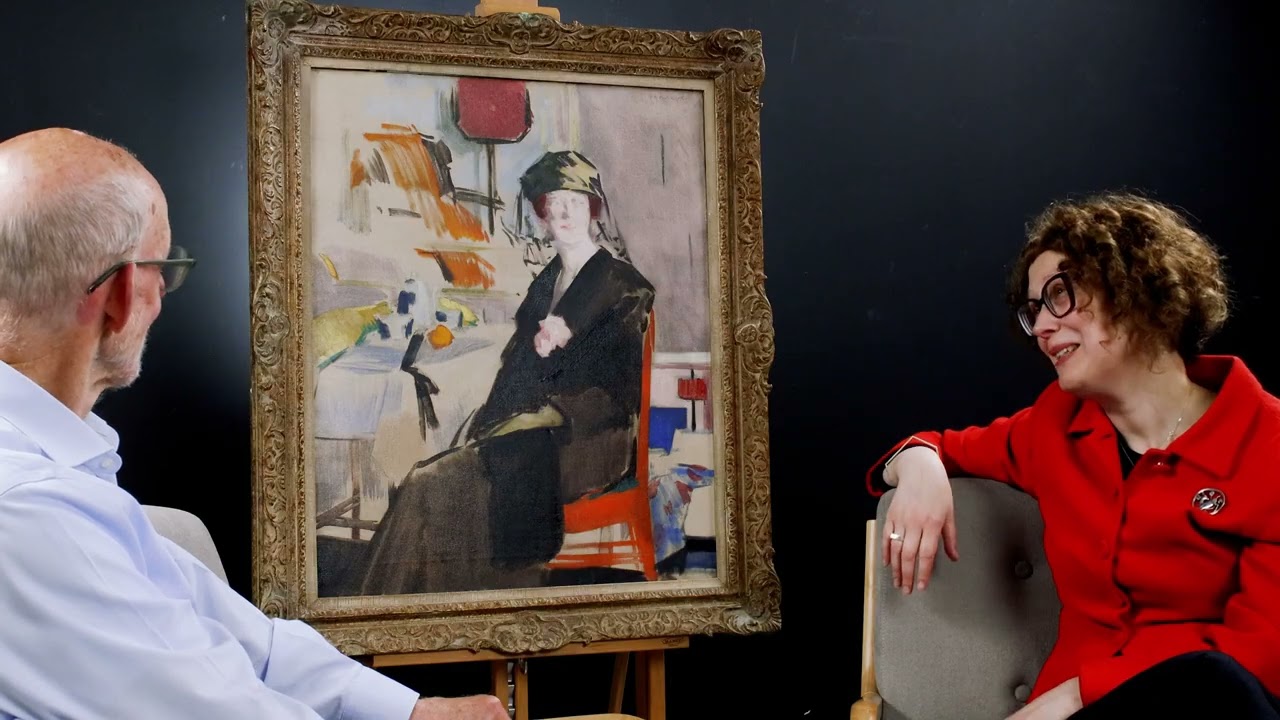
The experts know that in 1966, auction house Christie’s sold Interior: The Lady in Black for £21 (less than $500 in today). Somehow, it was in White Plains—a suburb north of New York City—months later.
“How the painting ended up in a charity shop in New York so soon afterwards is a mystery,” Strang tells PA Media. “But we are, as you can imagine, thrilled that this terrific Scottish Colorist work has returned to the city in which it was painted some 100 years later.”
Did you know? Thift-store statistics
Goodwill Industries said it earned more than $7 billion in revenue from its 3,400 thrift stores in 2025, report Kim Bhasin and Sophia June for the New York Times.
Last week, Lyon & Turnbull sold Interior at auction for £189,200—more than $250,000.
“We grew up with this on the wall. It was always there in the background,” Barry tells PA Media. “I remember playing American football in front of it with my brother, David, when we were young. It’s amazing it survived our childhood.”
“We were, as you can imagine, delighted and astounded when we found out the identity of the artist and of the model,” Barry added. “For mum, it was confirmation of her artistic eye and ability to recognize great talent.”
/https://tf-cmsv2-smithsonianmag-media.s3.amazonaws.com/accounts/headshot/Sonja_headshot.png)