
What Seeded Life on Earth? New Research Challenges the Longstanding Theory That Comets Brought the Ingredients to Our Planet
Computer simulations suggest comets carrying a key precursor to many of life’s building blocks would have rarely—if ever—successfully reached Earth’s surface. And even if they did, only specific landing conditions would have allowed the precursor molecule to drive biologically relevant reactions

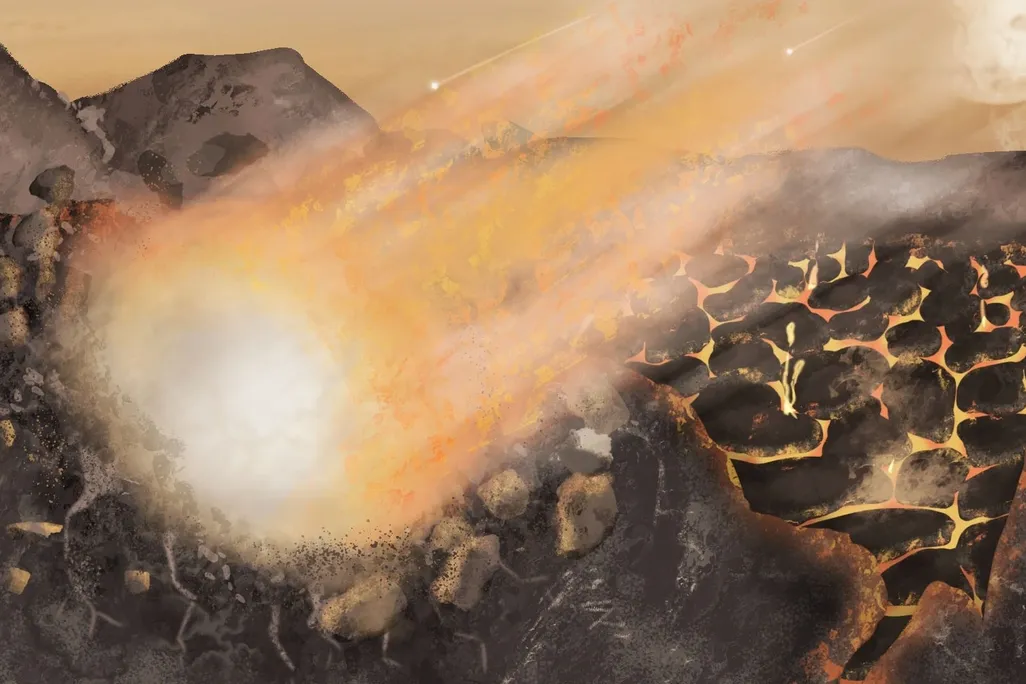
The question of how life started on Earth has proven to be almost as enigmatic as finding organisms on alien worlds. A longstanding theory posits that comets delivered the molecular ingredients that kickstarted life when they smacked into our planet during its youth. But new research suggests that this popular scenario is extremely unlikely.
In a study published October 28 in the journal Scientific Reports, researchers ran computer simulations of the celestial mail service and found that successful deliveries would have been rare, if not impossible. While the findings reorient discussions on the origin of life on Earth, they also posit a slightly more likely place where comets could’ve brought biologically useful organic molecules: our next-door neighbor, Mars.
The team investigated the potential delivery of hydrogen cyanide (HCN), a molecule with hydrogen, carbon and nitrogen, that would’ve been made with leftovers from the solar system’s formation 4.6 billion years ago. It has been detected on many comets and can be a precursor for many of life’s essential building blocks, including lipids, sugars and nucleotides. That’s because the carbon-containing, or organic, molecule has an extremely strong chemical bond that can drive subsequent reactions. The bond also makes it very stable, and thus more likely than other organics to survive an impact.
“So, if things look bad for hydrogen cyanide, then we think it’s going to be much harder for other, more complicated molecules that are more likely to be broken down during these impacts,” lead author Richard Anslow, a planetary scientist who conducted the research at the University of Cambridge in England, tells Science News’ Skyler Ware.
Need to know: What is a comet?
Comets, sometimes dubbed “dirty snowballs,” are masses of frozen gases, rock and dust located primarily in the outer solar system. When their orbit brings them closer to the sun, their materials get heated up and form a glowing head, as well as a tail that streaks across the sky.
And things did indeed look bad. Anslow and colleagues analyzed comet impact simulations, interactions between the atmosphere and comets, and models of the origin and evolution of comets. They found that comets likely wouldn’t have been able to supply enough HCN needed to seed life on Earth.
For starters, the rate at which the so-called dirty snowballs crashed into our planet quickly dwindled during its first 500 million years, so there were few opportunities for one carrying HCN to have landed here. Most of their simulations—54 percent—resulted in zero impacts. The remainder provided at least one collision, though only a “tiny minority” resulted in up to three collisions, Anslow tells CNN’s Jacopo Prisco.
What’s more, when comet strikes did take place, most dirty snowballs traveled too fast and at too sharp an angle relative to Earth’s atmosphere; impact likely would have vaporized any hitchhiking HCN. And even if some molecules survived but landed in the ocean, they would have diluted quickly, probably before any life-related chemistry could take place. “It’s really this sort of high-temperature pressure chemistry happening immediately post impact” that makes HCN less beneficial for prebiotic chemistry, Anslow tells Chemical & Engineering News’ Ana Georgescu.
Still, “we can’t rule out confidently that there was never a successful impact—there could have been one of these fluke impacts,” he tells CNN. But there are also other post-impact criteria that would have had to be met, such as the presence of liquid water nearby and other life-supporting chemicals, he adds.
While this alignment of conditions seems practically impossible on our planet, the researchers suggest it could have been more likely on Mars. Their simulations show that comets had a greater chance of successfully reaching the Red Planet’s surface—due to the planet’s smaller size and thinner atmosphere—when the solar system was young.
“This is not to say it definitely happened on Mars, of course, but suggests it would be unlikely if it happened on Earth and didn’t happen on Mars,” Anslow says in a statement. “Or the other, perhaps more likely, alternative is that it didn’t happen on either planet.”
However, the team did not consider the possibility of HCN undergoing chemical reactions on the comets themselves to produce sturdier biologically relevant compounds before they plunged into Earth’s atmosphere, Queenie Hoi Shan Chan, a planetary scientist at the Royal Holloway University of London who did not participate in the study, tells CNN.
Either way, something must have happened to kickstart the incredibly diverse life forms that now populate our planet. Anslow and his colleagues point to other possibilities, such as asteroids—which were more frequent terrestrial visitors—or precursors simply taking shape on Earth without extraterrestrial support.
