
Watch an Elusive and Ethereal Bigfin Squid Float Above the Seafloor Off Central California
This marks the first time the mysterious creature has been seen alive in the northeastern Pacific Ocean. It was spotted last month by scientists on an expedition to study marine life near underwater mountains
/https://tf-cmsv2-smithsonianmag-media.s3.amazonaws.com/accounts/headshot/SarahKuta.png)
/https://tf-cmsv2-smithsonianmag-media.s3.amazonaws.com/filer_public/b1/80/b180ba86-f7df-4b9b-8a16-bb7da22ea355/mbari_bigfinsquid_d1510_01_1920.png)
Olívia Soares Pereira was watching a live feed from an underwater drone in the Pacific Ocean when what appeared to be tentacles drifted into the frame. At first, she thought she was looking at a “cool” jellyfish, she says in a statement. But as she watched the creature float through the water, she realized it was something even more special—a rare bigfin squid.
Pereira is an ecologist with the Monterey Bay Aquarium Research Institute (MBARI), and she spotted the elusive deep-sea animal on August 7 while aboard the David Packard, the institute’s flagship research vessel. The footage was captured by the remotely operated vehicle (ROV) Doc Ricketts around two miles below the surface and about 80 miles southwest of Monterey, California.
The sighting, announced September 2, marks the first time anyone has spotted a live bigfin squid, which belongs to the Magnapinna genus, in the northeastern Pacific Ocean. It adds to the roughly 70 total observations or collections of the ethereal species.
“It was spectacular to see,” Andrew DeVogelaere, an ecologist with the National Oceanic and Atmospheric Administration’s (NOAA) Monterey Bay National Marine Sanctuary who was also on the expedition, tells SFGate’s Anna FitzGerald Guth. “These seasoned marine scientists were all of a sudden acting like kids again, and Magnapinna has that effect on people.”

Scientists observed the squid while surveying the seafloor near Davidson Seamount—an underwater mountain—during the ten-day Seamount Hotspots expedition. The project, led by MBARI and NOAA, aims to help researchers better understand the diverse organisms that live on submerged mountains. Seamounts support thriving ecosystems by deflecting ocean currents and concentrating nutrient-rich water, creating feeding grounds for a wide range of marine life. Davidson Seamount, in particular, is home to ancient corals and an octopus nursery.
One question that scientists hoped to answer during the expedition was whether mysterious furrows on the seafloor near the Davidson Seamount were created by deep-diving beaked whales foraging for cephalopods and fish. They first spotted the unusual scars in 2020 and were immediately intrigued because, despite decades of seafloor observations, only a handful of the gouges had ever been spotted. At the time, they hypothesized that the whales were taking advantage of the abundant prey near the seamount.
During the most recent expedition, the team collected data—including video footage, sediment samples and water samples from which they hope to extract genetic material left behind by organisms—at two study sites near Davidson Seamount and two control sites located farther north. They also deployed hydrophones, or underwater microphones, at each site that will continuously capture any sound within a one- to two-mile radius for the next year.
Early results suggest beaked whales are more active near the Davidson Seamount, but the scientists say they won’t know for certain until they analyze the audio recordings.
/https://tf-cmsv2-smithsonianmag-media.s3.amazonaws.com/filer_public/d8/87/d8871c8a-3ff5-4a21-ba9d-3c3a83370713/seamounthotspotsexpedition_magnapinnasighting_01_stevelitvin_1150-768x576.jpg)
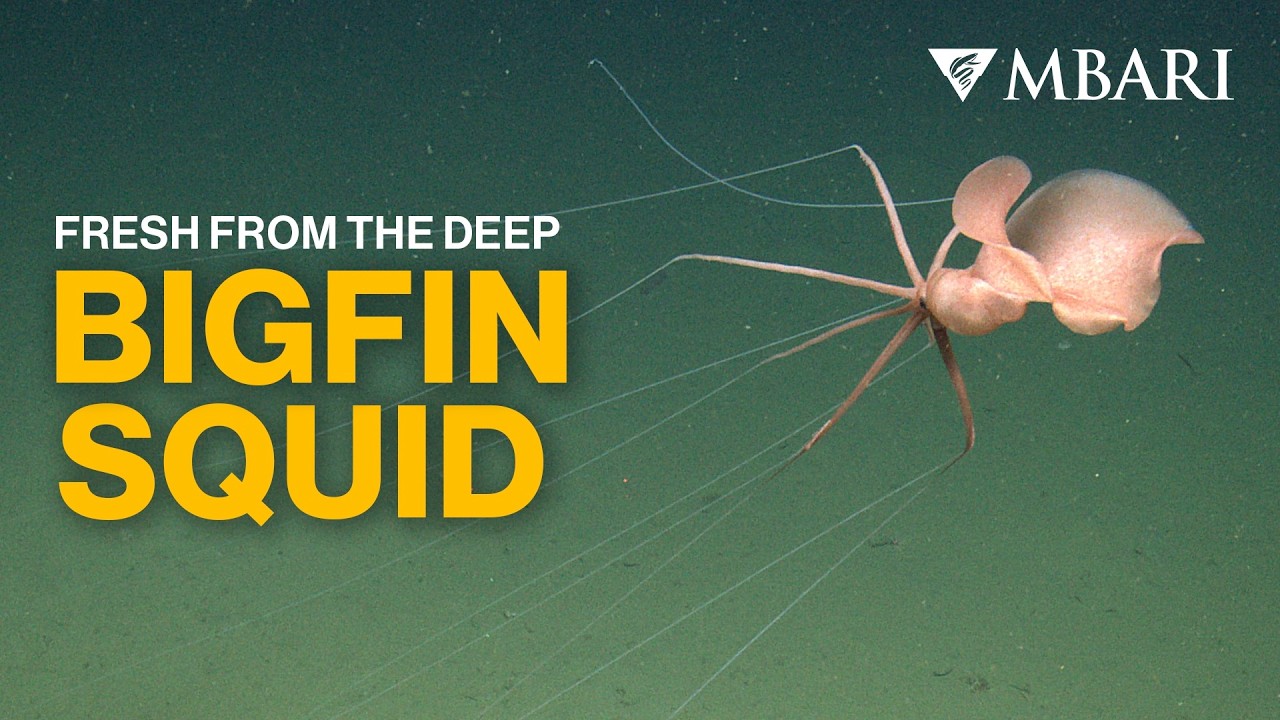
In the meantime, they’re still riding high from their unexpected bigfin squid sighting. The pinkish-colored creature was floating a few feet above the seafloor, with its two fins, eight arms, two tentacles and elongated teardrop-shaped body in full view of the ROV’s camera.
DeVogelaere was watching the underwater drone’s live feed in the ship’s control room and “thinking about the whale pits” when the ethereal creature came into view.
“I was just kind of mesmerized looking at it,” DeVogelaere tells the Los Angeles Times’ Fedor Zarkhin.
Using the ROV’s laser system, the scientists estimated that the squid measured roughly four feet from the top of its body to the ends of its spaghetti-like arms, making it a relatively small individual. The largest bigfin squid ever recorded measured 21 feet long, with most of that length—20 feet—coming from its long arms and tentacles.
The recently sighted squid was in what scientists call the “elbow pose,” with its gangly appendages—which are covered in itty bitty suckers—bent at a 90-degree angle.
“Based on the behavior of other deep-sea squids, we believe this pose could be a part of their feeding tactics,” Pereira tells Live Science’s Patrick Pester. “The arms and tentacles are extended so they do not get tangled up and passively capture prey that sticks to them.”
Did you know? Whale graveyard
Scientists recently discovered the world’s largest, deepest “whale graveyard,” with remains dating back more than five million years.
With so few sightings to draw on, much about the bigfin squid remains a mystery. The first specimen was collected in 1883, but scientists didn’t describe the creature until 1998. The only bigfin squid specimens ever collected have been damaged juveniles. That makes every sighting and video recording valuable for understanding these elusive creatures.
Scientists do know that paralarvae—newly hatched bigfin squid—live near the surface, while adults have been found at depths of 20,380 feet, or nearly four miles, in the Philippine Trench in the western Pacific Ocean. The species is the deepest-dwelling squid known to science.
The researchers didn’t expect to see a bigfin squid during the expedition. But seeing one “reminds us that we still have so much to learn,” DeVogelaere tells SFGate.
/https://tf-cmsv2-smithsonianmag-media.s3.amazonaws.com/accounts/headshot/SarahKuta.png)