
This Tiny Celestial Body Past Pluto Shouldn’t Have an Atmosphere—but Astronomers Say They May Have Detected One
Worlds this small and distant are thought to be too cold and have too little surface gravity to hold onto gases. But the findings suggest that icy, rocky objects in the solar system’s outer reaches are more dynamic than we thought
/https://tf-cmsv2-smithsonianmag-media.s3.amazonaws.com/accounts/headshot/Margherita_Bassi.png)
/https://tf-cmsv2-smithsonianmag-media.s3.amazonaws.com/filer_public/51/e6/51e659c2-d7ff-4f82-9d48-25ebaea352d5/20260505-prc-fig.jpg)
A tiny, icy celestial body farther from the sun than Pluto seems to have something it shouldn’t: an atmosphere. Researchers don’t expect such a minuscule, distant world to cling to gases. So, the findings, described in a study published May 4 in the journal Nature Astronomy, challenge standard assumptions about these astronomical objects.
“This discovery suggests that small icy worlds beyond Neptune may not be as inactive or unchanging as we often assumed,” study co-author Ko Arimatsu, an astronomer at the National Astronomical Observatory of Japan, tells Science News’ Lisa Grossman.
The little world in question is called 2002 XV93. It’s one of the thousands of bodies called trans-Neptunian objects (TNOs) orbiting the sun within the rock- and ice-filled Kuiper Belt. The dwarf planet Pluto is perhaps the most famous TNO, and it’s the only one known to have an atmosphere. But most of these bodies are so cold and have such weak surface gravity that they shouldn’t be able to hold onto a protective layer of gases.
Fun fact: A mini Pluto?
2002 XV93 is technically a “plutino,” a type of TNO that orbits the sun twice in the time it takes Neptune to loop around the sun three times.
Still, Arimatsu and his colleagues—including amateur astronomers—investigated whether 2002 XV93 might host an undetected atmosphere. They took advantage of an astronomical alignment on January 10, 2024. On that day, 2002 XV93 passed directly in front of a far-off star from Earth’s perspective, and instruments at three sites in Japan recorded data on the eclipse.
The way the icy, rocky body blocked the star’s light hinted at whether it was shrouded in gases. If the glow suddenly disappeared and then reappeared, that meant that the object lacked an atmosphere. But a slow fade would indicate it had one. Much to their surprise, the researchers saw the latter.
“The observation data showed a smooth change of the star’s brightness near the edge of the shadow, lasting about 1.5 seconds,” Arimatsu tells CNN’s Ashley Strickland. “This kind of smooth brightness change is naturally explained if the starlight was bent by a very thin atmosphere around the object.”
This atmosphere is probably unlike the one protecting our home planet, though. The researchers calculated that 2002 XV93’s potential atmosphere is about 5 million to 10 million times thinner than Earth’s.
“You could not breathe it, feel wind from it, or see anything like Earth’s sky,” Arimatsu tells New Scientist’s James Woodford. “But it is not negligible scientifically, because even such a thin atmosphere can measurably bend starlight, and it tells us that volatile gases are present or being supplied around a very small icy body.”

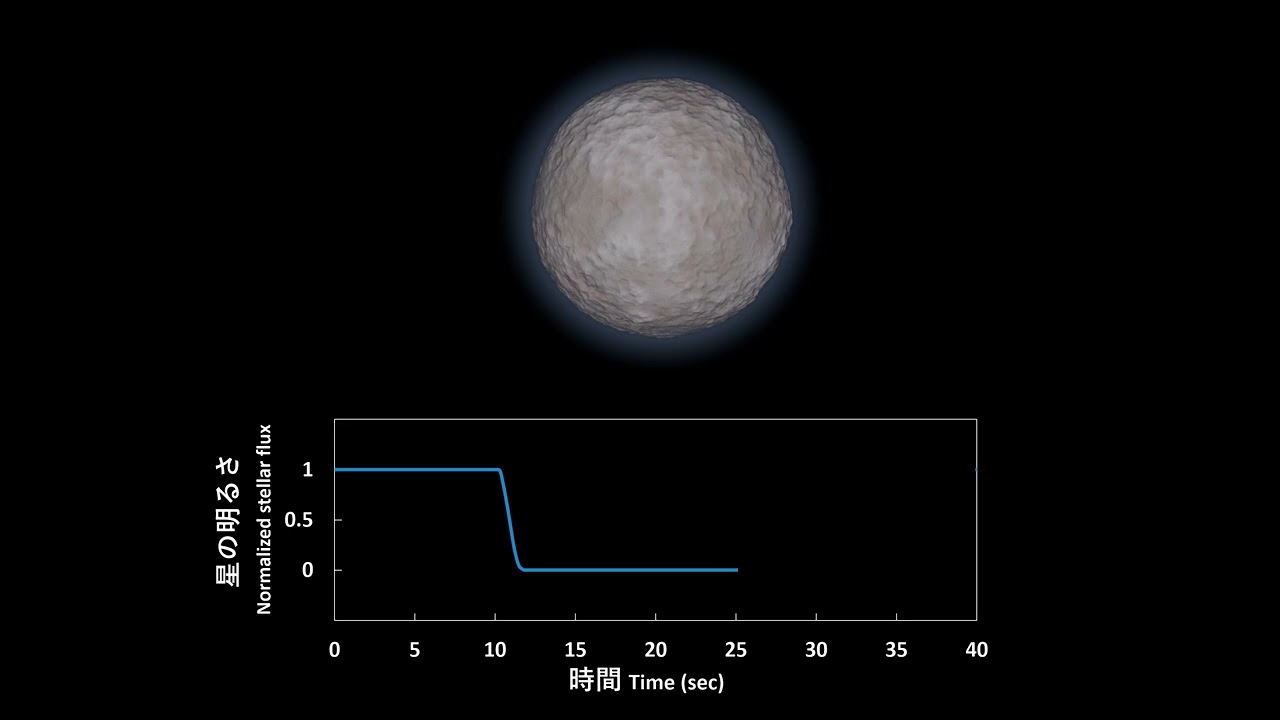
Additionally, the team refined 2002 XV93’s estimated width to about 292 miles. For comparison, Pluto has a diameter of 1,477 miles. Given 2002 XV93’s diminutive size and resulting weak gravity, the team expects its atmosphere to stick around for less than 1,000 years, unless it’s replenished. They also suspect that it was recently created or resupplied.
But how?
Recent observations by the James Webb Space Telescope haven’t found evidence of frozen gases on the object’s surface that might sublimate to form an atmosphere. Perhaps icy volcanoes released gases from deep within 2002 XV93, or another icy space rock collided with it and released gases, the researchers speculate.
“If the atmosphere was impact-generated, it may decline over the next several years or decades. If it persists or varies seasonally, that would favor ongoing internal supply,” Arimatsu tells Reuters’ Will Dunham.
Still, researchers need to gather additional observations, especially to confirm the study’s findings.
“This is an amazing development, but it sorely needs independent verification,” Alan Stern, a planetary scientist at the Southwest Research Institute who did not participate in the study, tells the Associated Press’ Marcia Dunn. “The implications are profound if verified.”
/https://tf-cmsv2-smithsonianmag-media.s3.amazonaws.com/accounts/headshot/Margherita_Bassi.png)