
This Pacific Island Disappeared Under Rising Seas. A New Sculpture Marking the Spot Will Morph Into a Home for Seabirds, Coral and Marine Life
“The Solomon Siren” remembers Kale Island, submerged a decade ago in the Solomon Islands
/https://tf-cmsv2-smithsonianmag-media.s3.amazonaws.com/accounts/headshot/ChristianThorsberg_Headshot.png)
/https://tf-cmsv2-smithsonianmag-media.s3.amazonaws.com/filer_public/23/1f/231f084b-5f01-4ff1-bd35-e430fcf3c20c/22soloman_siren_by_jason_decaires_taylor_sculpture.jpg)
A decade ago, rising tides in the Pacific Ocean submerged Kale, a 50,000-square-meter island in the Solomon Islands archipelago.
Once home to a small community, Kale was one of the first documented islands in the world to be lost to sea-level rise, which continues to threaten the Solomon Islands. Since 2008, more than 26,000 people across the island chain have been forced to relocate from their homes due to the encroaching ocean and extreme weather, Nicola Smith and Charley Piringi reported for the Telegraph in 2023.
“With its white sandy beaches, clear waters and lush forests, Kale was a jewel between the ocean and the sky,” wrote climate activist Gladys Habu Bartlett, who grew up on the Solomon Islands, in a 2020 guest blog for the International Institute for Environment and Development. “It was a much-loved spot for people living on the northwest of the Solomon Islands’ Isabel Province and a significant part of our cultural heritage.”
/https://tf-cmsv2-smithsonianmag-media.s3.amazonaws.com/filer_public/b6/38/b638787e-609c-4bab-a054-51ac9edaf77c/34soloman_siren_by_jason_decaires_taylor_sculpture.jpg)
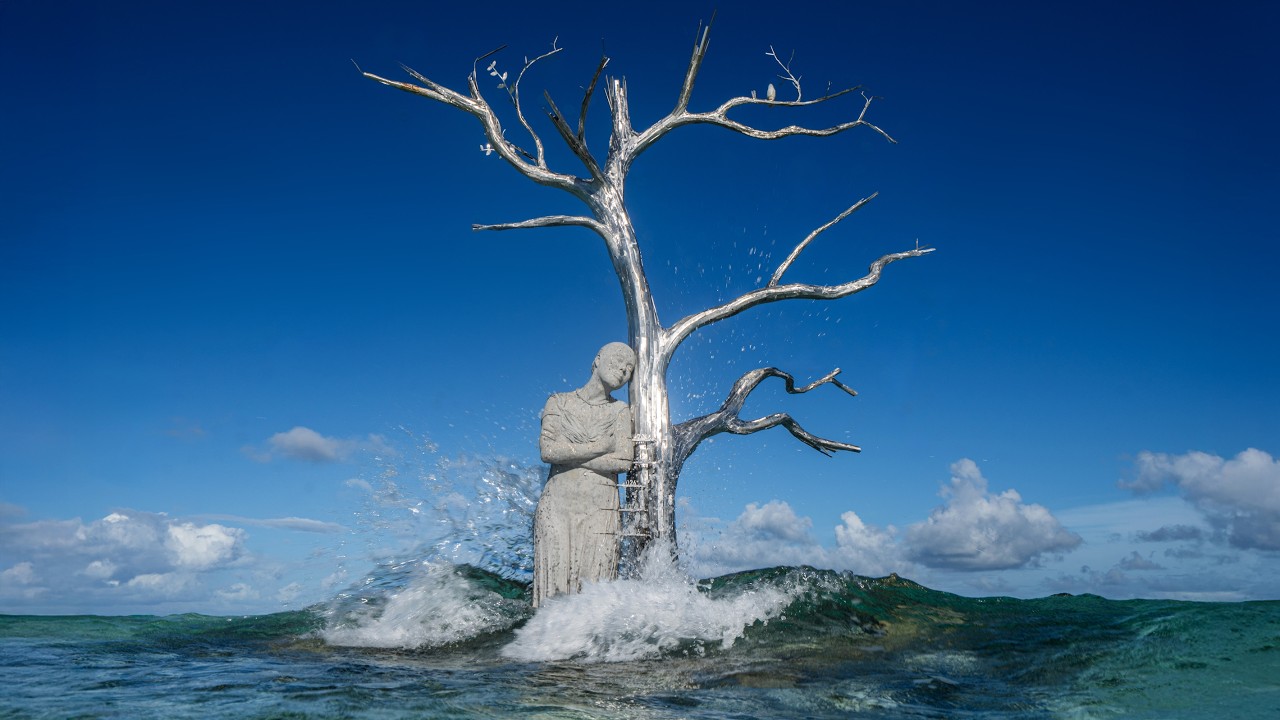
Now, to commemorate ten years since Kale was officially lost, a marine artist installed a new sculpture in the intertidal zone where sand intermittently peeks above the waves. The Solomon Siren by British artist Jason deCaires Taylor pays homage to a lost home while also celebrating Bartlett’s environmental activism.
“Modeled on Gladys, the sculpture stands as a memorial to a lost landscape and a powerful reminder of the communities already living with the impacts of climate change,” Taylor writes in an Instagram post.
/https://tf-cmsv2-smithsonianmag-media.s3.amazonaws.com/filer_public/de/3a/de3a7b22-e715-47f8-9e08-684025dddeb8/62soloman_siren_by_jason_decaires_taylor_sculpture.jpg)
The sculpture portrays a life-size figure of Bartlett—who has been recognized internationally for her work to advance gender equity and environmental awareness in the Pacific—resting against a tree that represents the former island’s diverse vegetation and natural resources.
The artwork is made from pH-neutral cement and biochar, which creates a porous surface “suitable for marine colonization” by algae, corals and invertebrates, My Modern Met’s Sage Helene reports. Meanwhile, the tree’s branches offer a resting place for seabirds.
The sculpture has markings tracking sea level rise in the area in 2006, 2016 and 2026, as well as projected marks for 2036 and 2046 based on climate models. Per a recent United Nations report, global sea levels are rising today at twice the rate of a decade ago.
“Year after year, we watched the sea rise. We watched our homeland disappear,” Bartlett says in a video accompanying the sculpture’s debut. “I chose to share our story, and this sculpture is a deeply meaningful part of it. What happened is a warning, not only for us, but for the world.”

Key takeaway: Rising seas
Today’s sea level is an average of five to eight inches higher than it was in 1900.The sculpture is the latest in Taylor’s ongoing “Siren” series responding to marine ecosystems.
His Sirens of Sewage sculpture in Whitstable, England, sought to raise awareness about water companies’ release of untreated sewage along the coast. And his Ocean Siren sculpture off the coast of Australia changes color to reflect the real-time temperature of the Great Barrier Reef, where warming water leads to coral bleaching.
/https://tf-cmsv2-smithsonianmag-media.s3.amazonaws.com/filer_public/52/a5/52a5d6a6-4bf2-485b-aee2-8887c7a958e2/8soloman_siren_by_jason_decaires_taylor_sculpture.png)
Taylor’s artworks are not only about grief and remembrance, but are also a call to action on environmental issues.
“Like the mythic sirens that warned sailors of hidden dangers, Taylor’s sculpture issues a quiet but urgent call: a reminder of a place that once existed and of the coastlines around the world that may follow,” an artist’s statement on his website reads.
/https://tf-cmsv2-smithsonianmag-media.s3.amazonaws.com/accounts/headshot/ChristianThorsberg_Headshot.png)