
This Newly Discovered Spider Builds a Unique Web That Catapults Ants Through the Air
Flung prey can reach speeds of up to 14.4 feet per second, or a little less than ten miles per hour. An insect will land in the spider’s main web about a foot above the spring-loaded trap
/https://tf-cmsv2-smithsonianmag-media.s3.amazonaws.com/accounts/headshot/SarahKuta.png)
/https://tf-cmsv2-smithsonianmag-media.s3.amazonaws.com/filer_public/af/17/af17f21b-fd01-4240-a76b-486695883be9/csm_ballista-spinne_beim_bau_der_falle__copyright_ajay-narendra_ae438820af.jpg)
A newfound type of spider in Australia builds an elaborate spring-loaded snare to catapult prey into its web.
Researchers have nicknamed the ingenious creatures “ballista spiders” after the large crossbow-like weapons used by Roman soldiers to launch heavy projectiles during sieges. The innovative arachnids, described on June 22 in the journal Current Biology, belong to the genus Propostira but have yet to receive a species name.
The spiders were first observed in 2022 by study co-author Greg Anderson, a metabolism researcher formerly at the QIMR Berghofer Medical Research Institute in Australia. He was in a remote rainforest in northern Queensland when he saw a green tree ant get flung into the air at top speed and become ensnared in a spider web.
Anderson contacted the study’s co-authors, who agreed the spectacle was unusual and warranted further investigation. In early 2023, two of them, Ajay Narendra and Pranav Joshi, both biologists at Macquarie University in Australia, headed into the tropical rainforests of Queensland’s Cape York Peninsula with high-speed cameras to record the nocturnal spiders’ clever hunting technique in action.
Their observations and video, captured over the course of ten days, revealed that the spiders hide on the undersides of leaves during the day. As the sun begins to set, however, they emerge and start spinning their complex webs, which can take up to four hours, from start to finish.

The spiders descend about a foot-and-a-half from their main web and attach 15 to 60 tension lines of silk to a lower anchor point, such as a leaf, a branch or the forest floor. Then, they spin and bundle the lines to make a tall, taut, conical structure, which they wrap with thinner threads of silk. Once this work is finished, the scientists suspect the spiders add to the silk wrapping pheromones that attract green tree ants, but not other species. Then, the spiders retreat upward to the main web to wait.
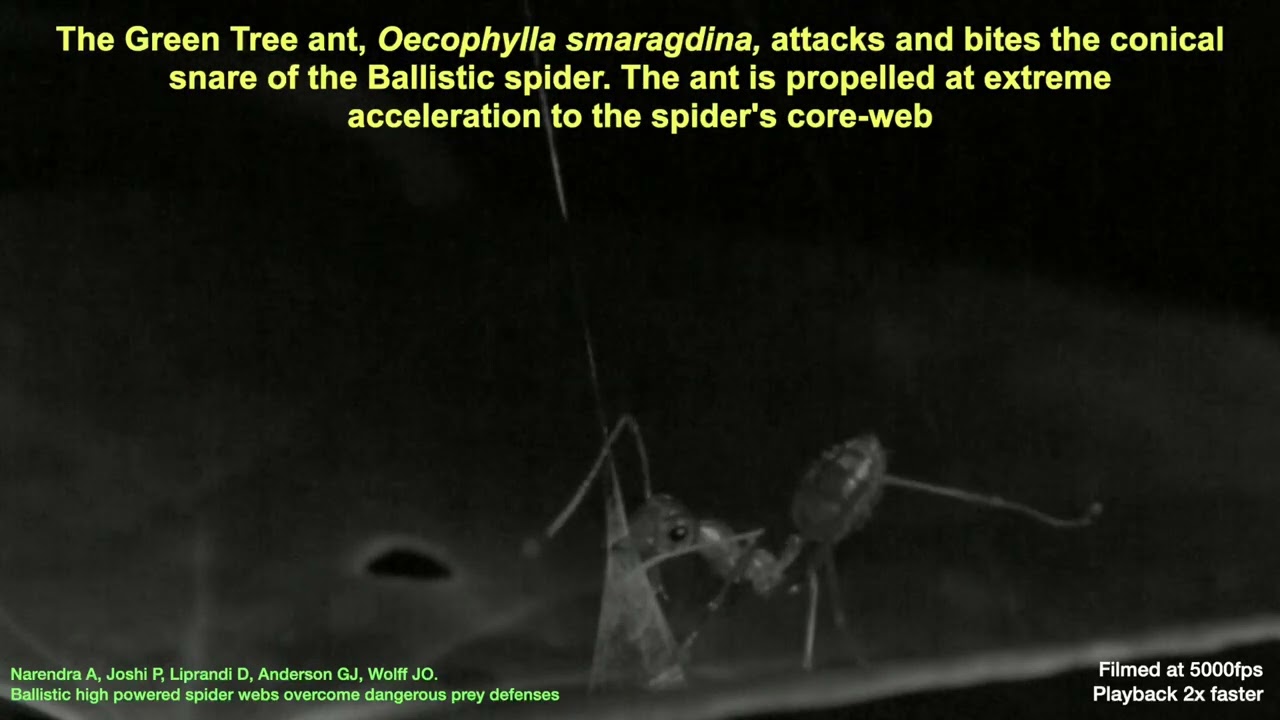
Within seconds, a green tree ant arrives to investigate. It begins biting the cone, not realizing it’s about to meet its doom.
“I suspect that there is a lot of stickiness in the silk,” Narendra tells New Scientist’s James Woodford. “The [ant’s] mandibles are not … actually able to open up and let it go and release; they are glued stuck.”
Eventually, as the ant struggles to free itself, the cone-shaped web detaches from the anchor point. In the researchers’ observations, that happened within about 42 milliseconds. The detachment releases the trap’s tension, sending the ant flying nearly a foot into the air, where it lands in the main web.
/https://tf-cmsv2-smithsonianmag-media.s3.amazonaws.com/filer_public/7a/43/7a43c370-85ce-48b0-8156-1ef4ba785bb9/capture_cone_ant_spider.jpeg)
Launched ants can reach speeds of up to 14.4 feet per second, or a little less than ten miles per hour. The insects accelerate at up to 4,485 feet per second squared, which is equal to around 140 times the acceleration due to gravity. It’s also about 15 times the highest g-forces endured by jet pilots.
According to the researchers’ calculations, a web that weighs 2.2 pounds would store 78 kilojoules of kinetic energy and, when triggered, would instantaneously exert 11.73 megawatts of power.
The ballista spider’s unique web design demonstrates “superior energy performance compared with other known silk-based catapult systems,” including those used by slingshot spiders, Narendra writes for the Conversation. “Gram for gram, the webs store more energy and exert more power than any known biological catapult.”
Why go to all that trouble to capture just one type of ant? The team suspects that the spiders have evolved this hyper-specialized, labor-intensive strategy because green tree ants are abundant—with up to five million workers in a single arboreal nest—and available year-round. But because the ants are also highly aggressive and territorial, the spiders must be a bit crafty. With the snare trap, scientists think they’re able to pick off individual ants without alerting—and, thus, potentially angering—the rest of the colony.
Did you know? Rare, specialized trap
The ballista spider’s snare is the only known web to have a strong preference for a single prey species, according to the study authors. They released members of three other nocturnal ant species near a spider trap, but none showed interest in biting the cone.
Leonardo Delgado-Santa, a biologist at the University of Quindío in Colombia who was not involved with the study, tells CNN’s Mindy Weisberger that the researchers have made a “remarkable discovery” because it combines “two aspects that are rarely seen together: extreme biomechanical performance and a high degree of ecological specialization.”
“Biologists have known for some time that certain spiders can use tensioned silk to amplify power and rapidly capture prey, but this study describes a system in which the trap is specifically tuned to exploit the defensive behavior of a particular ant species,” Delgado-Santa says. “The fact that the prey itself triggers the mechanism through its aggressive response makes the system especially elegant from an evolutionary perspective.”
/https://tf-cmsv2-smithsonianmag-media.s3.amazonaws.com/accounts/headshot/SarahKuta.png)