
This New Brain Map Shows Every Nerve Cell in an Adult Male Fruit Fly’s Central Nervous System. Here’s Why That Matters
The recently released “connectome” joins a previously completed map of an adult female fruit fly’s brain. The digital 3D diagrams allow scientists to trace precise neural paths in the bugs’ brains, which can unlock secrets about the organ in humans
/https://tf-cmsv2-smithsonianmag-media.s3.amazonaws.com/accounts/headshot/Margherita_Bassi.png)
/https://tf-cmsv2-smithsonianmag-media.s3.amazonaws.com/filer_public/a6/ce/a6cea92b-eaa2-4db6-8548-7259a539330c/connectome-nervous-system.webp)
Researchers have mapped an adult male fruit fly’s brain and nerve cord—the equivalent of our spinal cord—in unprecedented detail, charting 166,700 nerve cells in the insect’s central nervous system and millions of connections between them.
While the insect’s brain is only the size of a poppy seed, the new wiring diagram can provide gargantuan insights. It has already helped scientists trace neural paths between sensory inputs and behavioral outputs, explore how different genes affect brain circuits and look at sex differences between male and female flies. It can even help researchers better understand the brain wiring in humans.
The new central nervous system map and some of the discoveries it has led to were published in three studies in the journal Cell and another in the journal Current Biology on September 3.
Need to know: Central versus peripheral nervous systems
The central nervous system consists of the brain and spinal cord (or nerve cord in fruit flies). The peripheral nervous system is the network of nerves branching from the spinal cord. They help you sense the world around you. That information gets relayed to the brain, which then integrates it and sends commands back out to the peripheral nervous system, resulting in actions like movement.
Fruit flies—a colloquial name for bugs that belong to the Drosophila genus—previously made headlines two years ago when researchers released a map of an adult female fly’s brain. With almost 140,000 nerve cells, or neurons, it represented the most complete brain diagram of any organism ever made. This “connectome” also included more than 54.5 million synapses, the connections between neurons that allow them to communicate with one another. (Each neuron can send branching projections to multiple cells.) Earlier this year, the female fruit fly map was expanded to include the nerve cord.
Now, scientists have done it again. Like with the female brain, the adult male insect’s central nervous system was cut into extremely thin slices that were then scanned with a powerful electron microscope, which uses a beam of electrons to magnify objects. An artificial intelligence-based computer software then took the resulting millions of digital images and stitched them into a 3D replica. It captured each neuron and more than 300 million synapses. Human experts then checked and cleaned up the A.I.’s work—which has been revolutionary for cellular mapping projects.
“We did Drosophila with a team of 50 people,” Gerry Rubin, a biologist at the Howard Hughes Medical Institute’s Janelia Research Campus who worked on the research, tells Ars Technica’s John Timmer. “The hope is, by the time someone does a mouse, they’ll also need a team of 50 people, even though there are a thousand times more neurons in there. The people will never go away, but the people will not need to scale with the number of neurons, which would be economically not feasible.”
The new connectome has already enabled researchers to compare male and female fly brain circuitry, exploring differences between the sexes within one species, called sexual dimorphism. The team behind one of the Cell studies identified neural wiring that causes the same stimulus to trigger vastly different reactions in males and females. The scent of a male fly, for instance, causes other males to respond aggressively, but in females, the odor initiates courtship behavior, according to a statement.


“We were expecting to find differences, and we found them, and we’re excited by what we got,” Isabella Beckett, a neuroscientist at the Medical Research Council Laboratory of Molecular Biology in England who co-authored some of the studies, tells the BBC News’ Pallab Ghosh and Gwyndaf Hughes. She and her colleagues found that only about 5 percent of cell types differ between male and female fly brains, but that’s enough to cause notable differences in behavior, Beckett explains.
The Current Biology study also focused on sexual dimorphism, specifically the neural networks that influence differing male and female Drosophila social behaviors. Meanwhile, the other two Cell studies traced the fruit fly’s brain circuitry triggered by visual and taste inputs.
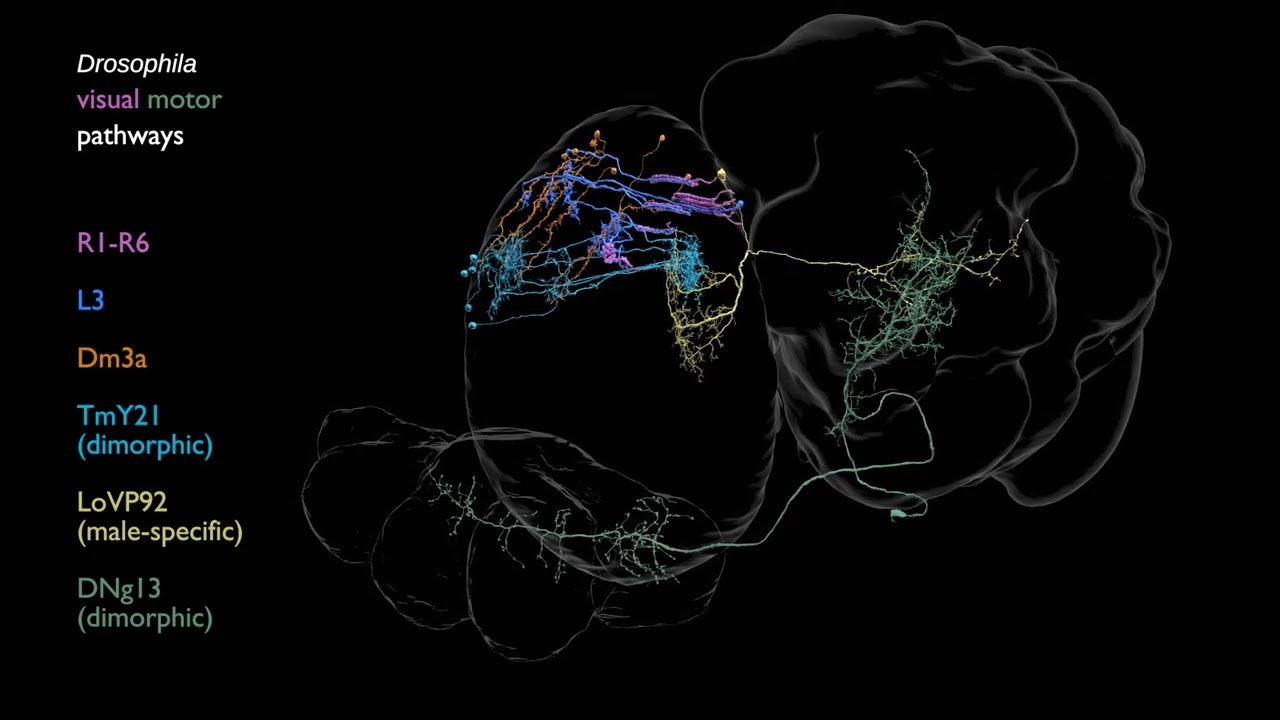
In the vision study, the team closely followed how signals travel from light-sensing neurons into the central brain. In the taste study, researchers pinpointed and categorized every taste receptor neuron throughout the fly’s body—in the mouth and throat, as well as the wings and legs. They examined how these sensory cells feed into pathways that control feeding, locomotion, hormone release and courtship.
“Taste often gets overlooked compared with vision or [smell], and its circuitry has remained far less well mapped,” says Carlos Ribeiro, a neuroscientist at the Champalimaud Foundation in Portugal who co-authored the research, in a separate statement. “But for an animal, deciding whether something should be eaten or avoided can be a matter of life or death. And for humans, understanding insect taste has implications for health and society, from disease transmission and agriculture to food security.”
While a fruit fly brain is quite different from a human brain—which contains some 86 billion neurons—the humble organ shares enough similarities to reveal some of the inner workings of our own.
“You might be asking why we should care about the brain of a fruit fly,” Sebastian Seung, a computer scientist and neuroscientist at Princeton University who was not involved in the new research, told the Guardian’s Ian Sample in 2024 when the female fruit fly brain map was published. “My simple answer is that if we can truly understand how any brain functions, it’s bound to tell us something about all brains.”
/https://tf-cmsv2-smithsonianmag-media.s3.amazonaws.com/accounts/headshot/Margherita_Bassi.png)