
This Greek Volcano Seemed Quiet for 100,000 Years. Then It Erupted Again. Should Scientists Take a Second Look at ‘Extinct’ Volcanoes?
By reconstructing a 700,000-year history of Methana volcano, geologists found a prehistoric phase when it appeared inactive on the surface, despite magma building up below ground
/https://tf-cmsv2-smithsonianmag-media.s3.amazonaws.com/filer_public/83/80/83801e5d-0c31-4e5a-89f8-938a7b4c538c/imageimageformatcarousel1867773365.jpg)
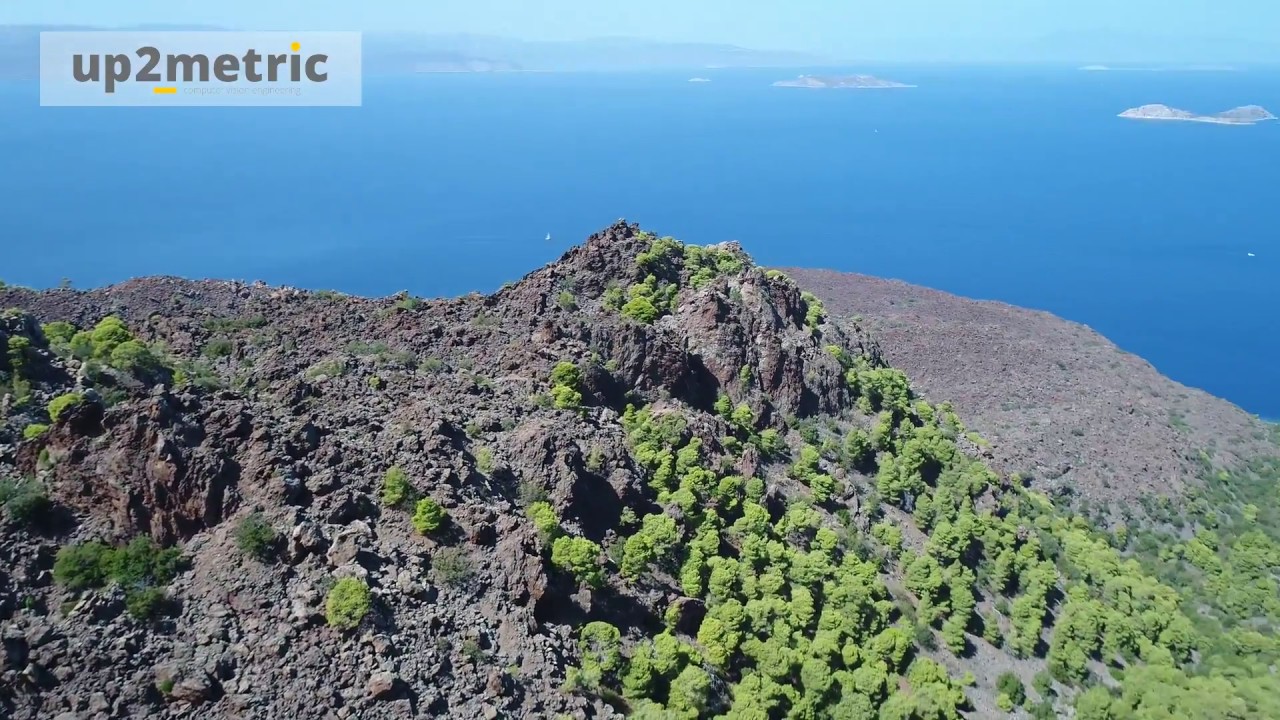
The last eruption of Greece’s Methana volcano was around 250 B.C.E. Ever since that event, which was recorded by the Greek historian Strabo, the mountain has lurked silently, just across the Saronic Gulf from Athens. But the volcano’s calm exterior could be masking a tumultuous—and potentially dangerous—inner life.
“It’s important for our society to understand that for volcanoes, quiet doesn’t always mean safe,” Razvan-Gabriel Popa, a volcanologist at ETH Zurich in Switzerland, tells Reuters’ Marta Serafinko.
In a study published April 22 in the journal Science Advances, Popa and a team of geologists documented the past 700,000 years of the Methana volcano’s history, which included 31 eruptions. Given the eruption around 250 B.C.E.—which is relatively recent on the grand scale of geologic history—Methana is considered an active volcano, not an extinct one. But its newly detailed past reveals that scientists might need to rethink the classification of some volcanoes that are currently considered extinct, because they could have hidden activity.
Typically, in volcanoes like Methana, just 10,000 years of quiescence is long enough for geologists to declare them extinct, never to erupt again. But the new analysis revealed that Methana underwent a roughly 100,000-year period—between about 168,000 and 280,000 years ago—when it didn’t erupt at all. Then, it began belching out lava once more.
The prospect that volcanoes might lie dormant for tens of thousands of years before erupting means scientists need to reevaluate the hazards some of them may pose.
“Part of that calculation is how recently they have erupted,” says Adam Kent, a volcanologist at Oregon State University who was not involved in the study, to Science News’ Skyler Ware. “In that sense, there are probably volcanoes out there that are threatening but not evaluated as such because they haven’t erupted for a while.”
Quick fact: Hayli Gubbi
In November 2025, the Hayli Gubbi volcano in Ethiopia erupted for the first time in nearly 12,000 years of records, although it’s possible some eruptions went unrecorded during that period.
/https://tf-cmsv2-smithsonianmag-media.s3.amazonaws.com/filer_public/f8/c6/f8c657a1-0828-4b0c-8fb6-dca6b6c32812/imageimageformat12861920840479.jpg)
To uncover Methana’s history, Popa and his team collected and analyzed more than 1,250 crystals of the mineral zircon from the volcano’s ancient lava flows. Zircon crystals are incredibly durable and form as magma cools, locking in small amounts of radioactive uranium. By calculating the amount of uranium that has decayed, geologists can determine how old each crystal is and when it formed in relation to the lava flow they found it in.
“We wanted to study Methana, because this volcano has a huge advantage: The different lava flows are not piled up and don’t bury each other,” Popa tells Nautilus’ Kristen French. The flows are spread across a large area, with “each eruption forming its own hill” so that geologists can easily access rocks of different ages.
To their surprise, Methana’s peak in zircon generation was during the 100,000-year gap between eruptions. This means that magma was actively accumulating beneath the volcano, even when it appeared dormant from above.
The reason, they realized, was the chemistry of the magma. Methana is above a subduction zone, where one tectonic plate is sliding under another, so its magma comes from melting pieces of the ocean floor that have sunk beneath the Earth’s crust. That ocean floor is saturated with water, making the magma water-rich, or “superhydrous.”
Deep in the Earth’s crust, where the rock above exerts enormous pressure, water helps superhydrous magma stay molten. But as it rises toward the surface, the pressure slackens and the water molecules start to escape from the magma.
“They ascend through the crust, they start bubbling like a fizzy drink,” Popa tells Reuters. “This gas bubbling triggers crystallization, making the magma sticky and viscous, and it slows down a lot—by a factor of 100 to 1,000—and becomes so lazy ... it can’t continue towards the surface.”
The result is that magma accumulates quietly below ground, creating a large and potentially more dangerous reservoir.

This discovery could be worrying for people living near subduction zone volcanoes thought to be extinct. Subduction zones occur around the edge of the Pacific Ocean as well as in the Caribbean and Mediterranean seas.
Olivier Bachmann, a volcanologist at ETH Zurich and co-author of the study, says in a statement that the research has implications for volcano authorities all over the world, from Europe to Japan, Southeast Asia and the Americas. “This means re-evaluating the threat level of volcanoes that have been quiet for tens of thousands of years but show periodic signs of magmatic unrest.”