
This Giant Planet May Have Survived the Death of Its Star. The James Webb Space Telescope Just Found Its Atmosphere
New observations of WD 1856 b, a gas giant closely orbiting a white dwarf, offer a preview of what could happen to Jupiter and Saturn after the sun dies in about five billion years.
/https://tf-cmsv2-smithsonianmag-media.s3.amazonaws.com/accounts/headshot/IMG_0629-edit.png)
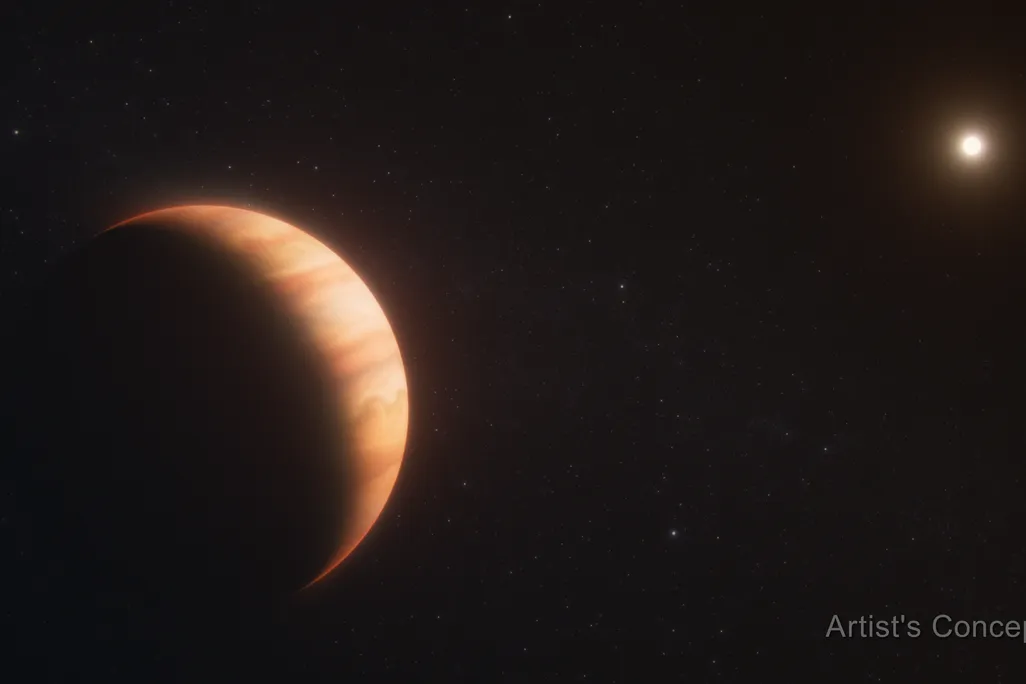
When astronomers discovered the planet WD 1856 b in 2020, the gas giant seemed to defy their expectations of what happens to objects orbiting a dead star. The Jupiter-sized planet circles a white dwarf—the burned-out core of a dead star—in an orbit 50 times closer than the orbit of the Earth around the sun. Billions of years ago, the long-dead star swelled into a red giant and engulfed nearby objects. By all rights, WD 1856 b should have been destroyed.
Using the James Webb Space Telescope, researchers measured the mass and temperature of WD 1856 b as it passed in front of its star. Shockingly, they detected an atmosphere on the planet. This is the first time scientists have observed one on a planet transiting a dead star. The findings, published July 1 in the journal Nature, suggest the planet is oddly warm and may have moved to its current position well after the demise of its star.
“This is one of the most bizarre planetary systems we know of,” study co-author Christopher O'Connor, an astrophysicist at Northwestern University, tells CNN's Ashley Strickland.


Around 80 light-years from Earth, WD 1856 b circles its gloomy host star once every 34 hours at a distance of less than two million miles. And in a striking flip of the standard celestial hierarchy, the planet is seven times larger than the roughly Earth-sized white dwarf it circles.
Even for the JWST, observing WD 1856 b was a difficult task. White dwarfs are much dimmer than the stars astronomers typically study, and the planet is only detectable when it crosses in front of the dim star for a mere eight minutes. As study co-author Victoria Boehm, an astronomer at Cornell University, puts it in a statement, “If you blink you miss it.”
Fortunately, the telescope didn’t blink. By examining the planet during its stellar transits, the team determined that WD 1856 b is between 4 and 11 times the mass of Jupiter, and that its atmosphere contains aerosols and organic compounds, likely including methane. Especially surprising was the planet’s temperature: roughly 260 degrees Fahrenheit, about 240 degrees hotter than the faint light of the white dwarf could account for.
That excess heat became the best clue for understanding the planet’s curious history. Researchers had two theories as to how WD 1856 b reached its remarkably tight orbit: the planet was engulfed by the star, or gravitational bumps from other nearby objects dragged it inward well after the danger had already passed. To O'Connor, a strange object sitting where it “shouldn't be” felt like “an invitation from the universe to get creative,” as he tells CNN.
By combining the new measurements with existing models of how large planets cool over time, the team tracked the planet’s thermal clock. Their data suggest WD 1856 b heated up around one billion years ago, long after its host star had died. This favors the gravitational migration scenario—it is also supported by the abundant methane on the planet, which would have been diluted if the planet had been engulfed by its star.
Still, some astronomers are skeptical of this neat account. Caroline Morley, an astronomer at the University of Texas at Austin who was not involved in the study, co-authored earlier research that suggested the planet was much cooler. “There are reasons to be skeptical about the result that the planet was “reheated,’” she tells CNN, though she notes that the data on its atmospheric contents are plausible. Ian Crossfield, an astronomer at the University of Kansas who helped discover WD 1856 b but did not participate in the new research, calls the conclusions about migration “provocative” and says more study is likely needed, per CNN.
The team is already probing the atmosphere of WD 1856 b in more detail by observing four more transits with the JWST. This planetary system may offer a glimpse of Earth’s far-off future. In about five billion years, the sun will balloon into a red giant, destroying Mercury, Venus, and possibly Earth before collapsing into a white dwarf. But it now seems that the outer gas giants may carry on.
“Jupiter has a long life ahead of it,” lead author Ryan MacDonald, an astrophysicist at the University of St. Andrews in Scotland, tells Scientific American's Sam Macdonald. As he says in a statement: “Our results show that stellar death is not the end.”
/https://tf-cmsv2-smithsonianmag-media.s3.amazonaws.com/accounts/headshot/IMG_0629-edit.png)