
This Sailor From the Franklin Expedition Died in the Arctic in a Uniform That Didn’t Belong to Him. Now, DNA Has Revealed His Identity
New research has identified four members of the doomed 1845 search for the Northwest Passage, including the owner of a paper-stuffed wallet that has long mystified historians
/https://tf-cmsv2-smithsonianmag-media.s3.amazonaws.com/accounts/headshot/meilan_headshot2.png)
/https://tf-cmsv2-smithsonianmag-media.s3.amazonaws.com/filer_public/86/57/8657fc18-096f-4d55-93a8-576ab0657a58/erebus.png)
In 1859, a search party looking for traces of the lost Franklin expedition to the Arctic stumbled upon the skeleton of a man “slightly built, and perhaps above the common height.”
Nearby, they found a clothes brush; a comb; and a wallet containing several papers, including a seaman’s certificate for Henry Peglar, captain of the foretop on HMS Terror, one of the two ships involved in the ill-fated expedition. Curiously, the man’s clothing was more typical of a Royal Navy steward or officer’s servant—ranks far below Peglar’s senior status. Adding to the mystery was the fact that the pages stashed in the wallet were written backward, their meaning still largely inscrutable to this day.
Scholars have long argued that the skeleton belongs to a sailor of lower rank than Peglar, perhaps a friend entrusted with his belongings after his death. But a new DNA analysis published in the journal Polar Record confirms that the remains found on King William Island are indeed Peglar’s.
/https://tf-cmsv2-smithsonianmag-media.s3.amazonaws.com/filer_public/7e/af/7eafdd46-a0f3-45d0-b49b-dd6409104b69/screenshot_2026-05-07_at_30258pm.png)
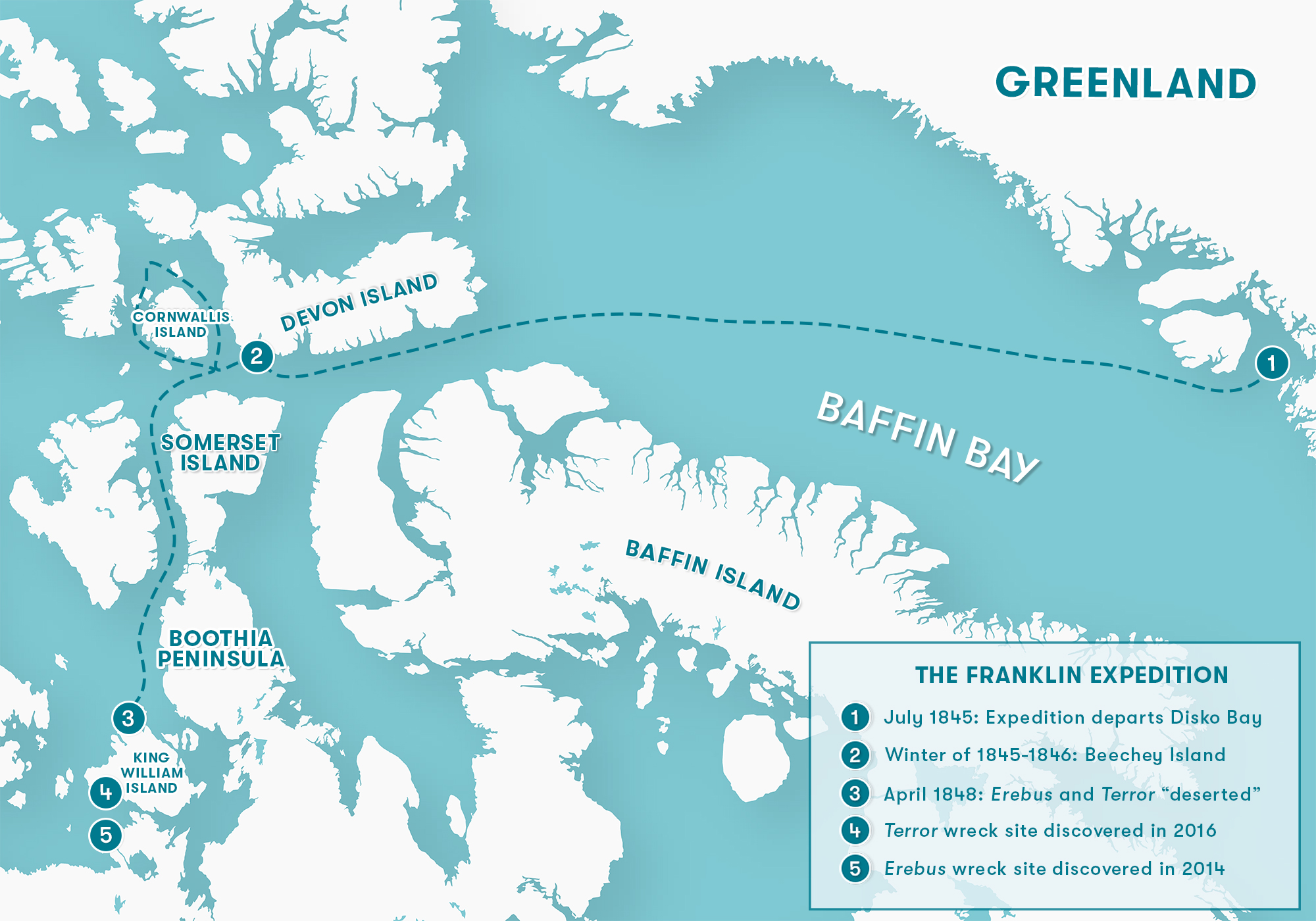
English explorer and Rear Admiral John Franklin set out with two ships, Terror and HMS Erebus, on an expedition to discover the Northwest Passage in May 1845, only to vanish in the Arctic Archipelago. The 129 men carried with them enough supplies to last three years in the inhospitable environment, or even longer if rationed—but none survived. Written evidence of the expedition’s fate is limited mainly to the Victory Point Note, a piece of paper found in a cairn on King William Island in 1859, but Inuit testimony and archaeological evidence have also helped historians piece together the likely sequence of events.
These sources suggest that the crew spent its first winter on Beechey Island, in what is now Nunavut, Canada, losing three men between January and April 1846. According to the Victory Point Note, which consists of two handwritten messages scrawled in the margins of a preprinted form, Franklin himself died in June 1847.
By April 1848, the expedition’s losses had reached 9 officers and 15 crew members. “Had rescue come at this time, the expedition would still have had the dubious honor of possessing the highest death rate in the history of British Arctic exploration,” historian David C. Woodman wrote in Unraveling the Franklin Mystery: Inuit Testimony. The other 105 men would soon meet the same fate.
When the search party came across the solitary skeleton 11 years later, they theorized that the sailor had decided to walk along a ridgetop to conserve energy, only to fall “upon his face in the position in which we found him,” succumbing to exhaustion and exposure.
Given the mismatch between the skeleton’s clothing and Peglar’s rank, experts previously suggested that the remains belonged to gunroom steward Thomas Armitage, who’d served alongside Peglar on an earlier expedition. As Woodman wrote, “The captain of the foretop would not have been caught, even dead, with a steward’s bow-knot.” The newly announced identification offers a surprising answer to this enduring mystery.
“There’s a lot of pieces to that puzzle, but once and for all, about 166 years later, we finally put that one to rest,” lead author Douglas Stenton, an archaeologist at the University of Waterloo in Canada, tells the Canadian Press’ Jordan Omstead. In a blog post, Russell A. Potter, author of Finding Franklin: The Untold Story of a 165-Year Search, speculates, “Perhaps, given that [Peglar] was close to at least one if not two men serving as stewards, he deliberately wore his dead shipmate’s coat.”
/https://tf-cmsv2-smithsonianmag-media.s3.amazonaws.com/filer_public/c1/85/c18544a2-7235-439a-b100-3294f9a8acae/david-young.png)
Peglar is now the sixth member of the Franklin expedition whose remains have been identified through DNA. The authors of the Polar Record paper announced three other identifications in a separate study published in the Journal of Archaeological Science: Reports earlier this week. Found roughly 80 miles away from Peglar’s skeleton, the remains belong to William Orren, David Young and John Bridgens, all crew members on Terror’s sister ship, HMS Erebus.
Stenton and his colleagues started studying skeletons associated with the Franklin expedition in 2013, extracting DNA from the bones in hopes of comparing the profiles with samples provided by the men’s descendants.
“We didn’t know exactly what we were going to find,” Stenton tells the Globe and Mail’s Ivan Semeniuk. “We thought pinpointing where some of these men died might shed light on events that took place on the expedition.”
Traditional accounts of the expedition posited that the men set out on an overland journey south, dragging heavy sledges loaded with supplies as they marched in hopes of finding rescue, only to die along the way not long after.
But more recent research contradicts this explanation. As Woodman told Smithsonian magazine in 2025, “There is so much evidence, including in my book, but others have done the same, that proves that could not possibly be right.”
Need to know: John Rae’s 1854 report
- The first major piece of evidence regarding the Franklin expedition’s fate dates to 1854, when Scottish explorer John Rae published a report based on interviews with Inuit people who lived in the Arctic Archipelago, as well as salvaged artifacts.
- Rae wrote that “a portion, if not all, of the then-survivors of the long-lost and unfortunate party under Sir John Franklin had met with a fate as melancholy and dreadful as it is possible to imagine”—a roundabout reference to cannibalism.
Based on Inuit oral histories and the locations of the Erebus and Terror shipwrecks—discovered in 2014 and 2016, respectively—Woodman proposes that the abandonment mentioned in the Victory Point Note was temporary, with the survivors returning to the ships and remanning at least one to sail farther south. From there, he suggests they splintered into groups, each pursuing a different strategy in the fight for survival.
The exact circumstances of the men’s final days remain unclear, but starvation, exposure, physical exhaustion, scurvy and other diseases likely contributed to the expedition’s unprecedented death rate. Marks seen on some of the sailors’ bones corroborate Inuit testimony that describes the men engaging in cannibalism.
In 2024, Stenton and two of his co-authors on the new studies, anthropologist Robert W. Park and technician Stephen Fratpietro, published a paper identifying the owner of a jawbone etched with cut marks as James Fitzjames, captain of Erebus and one of the highest-ranking members of the expedition. The fact that Fitzjames’ remains were subjected to cannibalism indicated that “neither rank nor status was the governing principle in the final desperate days of the expedition as [the men] strove to save themselves,” Stenton said in a statement at the time. (None of the newly identified remains show signs of cannibalism.)
/https://tf-cmsv2-smithsonianmag-media.s3.amazonaws.com/filer_public/32/6d/326d3b6c-46ba-48b2-81a5-30b2cead42ee/1920px-l23402-c8qmb-t3-05-rx.jpg)
Dozens of Fitzjames’ letters home, written on the eve of the expedition, survive today, offering a glimpse into his personality. Comparatively, Potter points out that “relatively few letters” by the four newly identified crew members survive. “Fewer may have been written, and they were less likely to be preserved and archived,” he writes on his blog. “But the testimony of a bone, unlike that of a letter, is absolute: Here, there was a man, and these his remains.”
In a statement, Park highlights Peglar’s identification as particularly noteworthy, adding, “It was interesting to conclusively identify this sailor because the body was found with almost the only written documents from the expedition ever found.” Although the so-called Peglar Papers are indeed some of the only records of their kind, their contents failed to shed much light on their “unfortunate owner and the calamitous march of the lost crews,” as the searchers who found the pages had originally hoped. Instead, the few sections that are readable appear to center on the author’s memories of more mild climates.
“Occasionally he seems to refer to the present, but most of it is reminiscences about being in warmer places,” Potter told Smithsonian in 2025. “It’s the kind of stuff you would write if you were freezing.”
/https://tf-cmsv2-smithsonianmag-media.s3.amazonaws.com/accounts/headshot/meilan_headshot2.png)