
This Four-Person NASA Crew Spent Over a Year on ‘Mars.’ Here’s What They Did for 378 Days in a Simulated Martian Habitat
An intense selection process and long preparation helped set the crew up for cohabitation in a 3D-printed replication of the Red Planet’s environment in Houston. There, they practiced Marswalks, disrupted communications with people on Earth and food cultivation

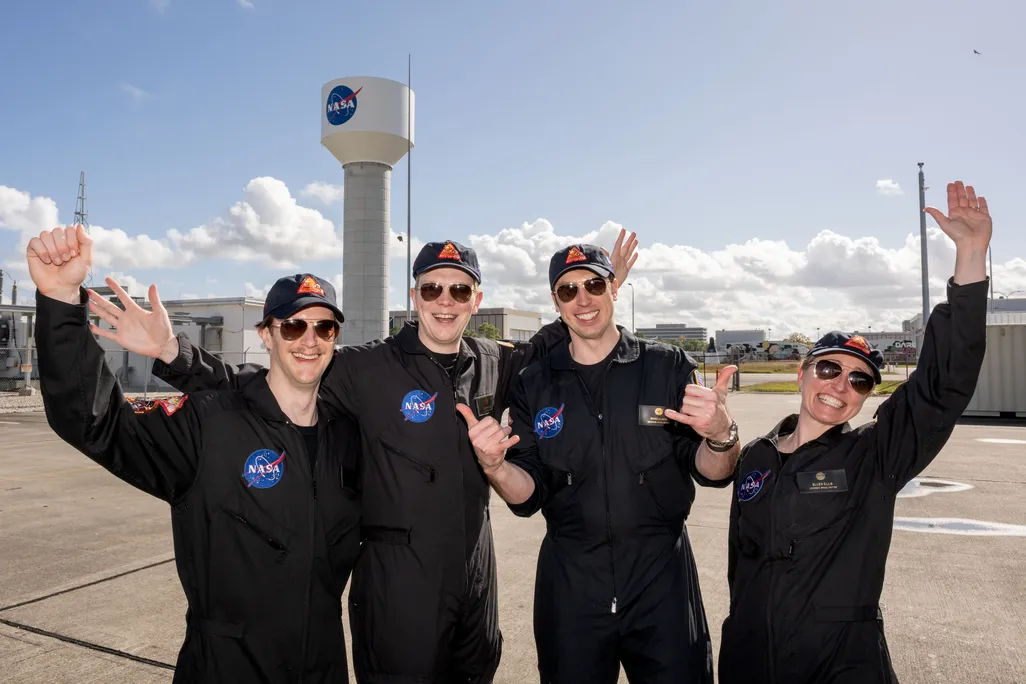
On October 31, four NASA crewmembers returned from “Mars.” Not the actual Red Planet, of course, but a 3D-printed Mars habitat in Houston where the three men and one woman lived for 378 days.
Now, the Mars analog astronauts—Ross Elder, Ellen Ellis, James Spicer and Matthew Montgomery—have started telling the world what took place after they disappeared into NASA’s Mars Dune Alpha habitat at the Johnson Space Center on October 19, 2025, for the agency’s second Crew Health and Performance Exploration Analog (CHAPEA) mission.
The mission aimed to test the kinds of physical and mental conditions that a team of Mars explorers would endure on the Red Planet, including long-term isolation, disrupted communication with people on Earth and food cultivation. The habitat includes both a base and a mock outdoor environment, so the crew could practice Marswalks.
“For more than a year, they have lived in an isolated environment, conducting critical research and helping us better understand what it will take to send humans to Mars,” Vanessa Wyche, director of NASA’s Johnson Space Center, said during a livestream, just before the crew emerged. “Inside just 1,700 square feet, they managed to live with limited resources. They maintained their habitat. They grew crops, and they carried out simulated Mars operations.”
After the speech, NASA astronaut Jack Hathaway, who had just completed a mission at the International Space Station, knocked on the door to the Mars habitat, called out “trick or treat” and opened it to reveal the crew’s smiling faces. Since then, the analog astronauts have been participating in post-mission evaluations and debriefs that, along with the data collected during their year in the simulated environment, will help inform future missions to Mars and those closer to home, per a NASA statement.


So, what did they do for all that time?
“Most days, we had things that were scheduled, from maintenance and science and engineering activities and some operational activities. So, we often do extravehicular activities, also known as EVAs or spacewalks,” Elder, who was the mission’s commander and test pilot, tells CNN News Central. “We would do drone and rover operations where we control certain equipment outside of the habitat, and we would practice additional data collection for both human health and behavioral sciences.”
Each team member brought unique expertise to the mission. Elder was an experimental test pilot at the U.S. Air Force. Ellis, the mission’s medical officer and tactical thinker, is a U.S. Space Force officer. Spicer was the flight engineer and systems specialist, and he has experience in satellite communications and spacecraft development. Montgomery’s diverse background in hardware engineering, robotics, technology startups and independent films made him the “Swiss Army knife of crewmates;” he served as the mission’s science officer and versatile engineer.
Quick fact: When was the first CHAPEA mission?
The first mission of this kind also lasted 378 days, during which crewmembers Kelly Haston, Ross Brockwell, Nathan Jones and Anca Selariu entered the Mars Dune Alpha habitat on June 25, 2023, and emerged on July 6, 2024.
Elder tells Fox News that combining their skills created “magic.” But that didn’t happen by accident; the selection process lasted about a year and a half and included personality evaluations by NASA psychologists, Montgomery tells the outlet. What’s more, they got to practice before entering the habitat.
“The crew spent a lot of time together prior to the mission, so we got to work on our teamwork and build relationships,” Montgomery tells Nature’s Kaia Glickman, including during a winter camping expedition that overlapped with a blizzard. “These high-pressure scenarios set a nice foundation for pre-training, where we spent five weeks together before going into isolation. Through all of those tools that we built, we had a really good dynamic as a team inside of the habitat, and conflict was very minimal.”
Montgomery and his crewmates could still speak with mission control, but the communication system intentionally mimicked delays that would occur on a real Mars mission. That meant messages could take up to 22 minutes to deliver, and the team even had to deal with a planned two-week communication blackout. Future travelers to Mars will experience this communications barrier when Earth and the Red Planet are temporarily on opposite sides of the sun, blocking radio signals from traveling between the planets, according to Nature.
“Over the next several years,” Spicer tells Fox News, “the NASA researchers will be going through the data from our mission, as well as the previous CHAPEA mission, to figure out how well we did and what they still need to work on in the coming years to get real people to Mars.”
