
This Ancient Monolith That Archaeologists Unearthed in Mexico May Depict People Receiving ‘Divine Liquid’ in a Ritual
The stela was found with a large, decorated platform and remnants of offerings in the state of Veracruz
/https://tf-cmsv2-smithsonianmag-media.s3.amazonaws.com/accounts/headshot/Sonja_headshot.png)
/https://tf-cmsv2-smithsonianmag-media.s3.amazonaws.com/filer_public/9a/dd/9add0478-aa68-4cfe-89a7-c0f469ec83d2/the_discovery_of_a_monolithic_sculpture_measuring_188_meters_-3b62662ebc2ab9298527503389088b56.jpeg)
Archaeologists in Mexico discovered a mysterious Indigenous settlement dating back some 1,400 years. While excavating in Veracruz, they found the remains of a massive stone platform, an unusual stela and ritualistic offerings like charred corn.
The site is located in Coatepec, near Mexico’s east coast, according to a translated statement from Mexico’s National Institute of Anthropology and History (INAH). The region is beyond the Maya’s primary ancient territory on the Yucatan Peninsula during its Classic Period between about 250 and 900 C.E. But researchers say the newly discovered artifacts are reminiscent of Maya culture.
“It’s a unique, unprecedented finding,” INAH archaeologist Lino Espinoza Garcia tells Agence France-Presse.
/https://tf-cmsv2-smithsonianmag-media.s3.amazonaws.com/filer_public/1c/ab/1cabec0a-f0f6-42a3-b8ed-6cda9658809c/the_structure_is_built_with_flagstones_and_white-faced_limestone_photo-_omar_ramirez.jpeg)
Nearby is the archaeological site Campo Viejo, a group of large plazas composed of ceremonial platforms built some 2,000 years ago.
“Campo Viejo was the main settlement of its time in a densely populated region around present-day Xalapa with a clear settlement hierarchy,” Annick Daneels, an archaeologist at the National Autonomous University of Mexico, tells the Art Newspaper’s Constanza Ontiveros Valdés. “It lies near one of the routes connecting the Gulf Coast and the Central Highlands, which served as axes of interaction from the Preclassic period onward.”
The newly discovered platform is nearly 100 feet long and 40 feet wide and composed of flagstones and gypsum-like limestone that the builders likely heated. Per the statement, the platform is decorated with lines and squarish shapes, as well as two circular stones.
It's “a very particular structure,” INAH archaeologist Alberto Vázquez Domínguez tells the AFP. “We don't have any records so far of a correlation with other (ancient) sites.”
/https://tf-cmsv2-smithsonianmag-media.s3.amazonaws.com/filer_public/c2/78/c2787900-aff1-476e-b568-c0dfaaf9bb44/view_of_the_stela_at_the_site_of_its_discovery_photo-_inah.jpeg)
Near the raised platform, researchers found a sculpted slab measuring about six feet tall by five feet wide, and 10 inches thick. This type of artifact is known as a stela, a monument carved with hieroglyphs and life-size portraits of elites. “The stela was placed face down, and structures were built on top of it,” says INAH archaeologist Mireya Moreno Aguirre in a video from the institute, per the Art Newspaper.
The stela might depict a ritual and features two elaborately dressed figures. “They have a bowl and are receiving something; we think it’s a liquid,” Espinoza Garcia tells the AFP. “Obviously, in that context, it’s a divine liquid; we think it would be water.” The engraving may memorialize a period of drought.
Did you know? Farming cultures
The Maya, along with other Indigenous peoples of Central America, were practiced farmers. They cultivated cacao beans, squash and maize—relying heavily on water and agricultural channeling. The Maya survived many droughts, but researchers have posited it was a 13-year dry-up that spurred the civilization’s collapse in the ninth and tenth centuries./https://tf-cmsv2-smithsonianmag-media.s3.amazonaws.com/filer_public/59/66/5966164e-0198-4bac-a650-f04dcddcf796/preliminary_drawing_of_stela_2_courtesy_of_lino_espinoza.jpeg)
Whatever the figures are up to, the engraving itself is unique in the region. “What is unusual for central Veracruz is a composition featuring two seated figures facing one another,” Daneels tells the Art Newspaper.
On the site, the researchers also excavated fragments of burnt maize—which may have been deposited as an offering to higher powers—as well as buried vessels and a broken greenstone bead. Each piece will be analyzed in a laboratory, per the statement.

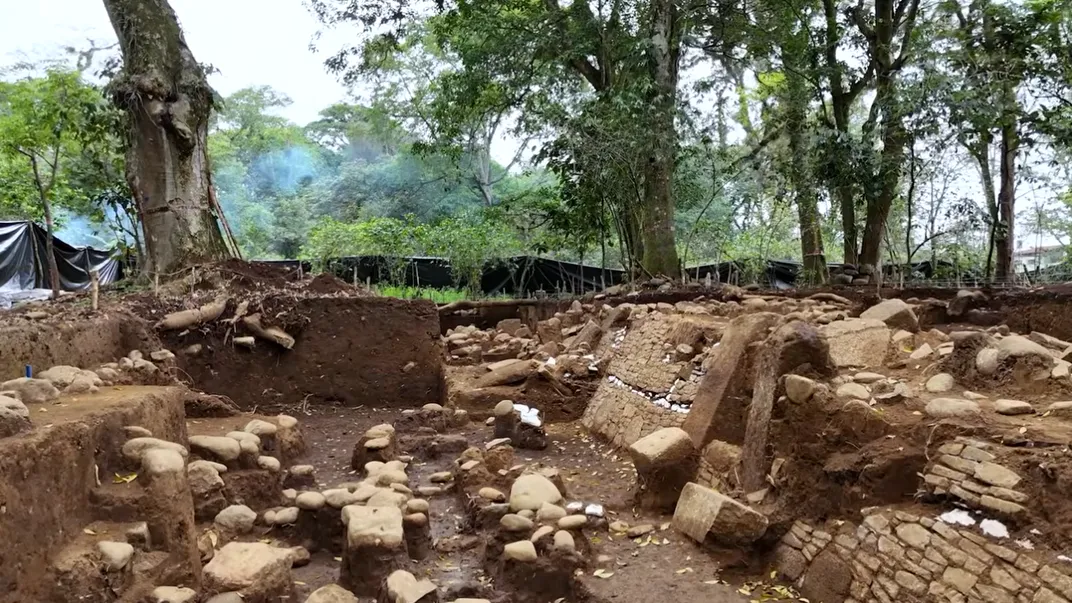
The researchers aren’t sure exactly who inhabited the site. Somewhat nearby is the territory of the Totonac, but there’s no evidence that the Totonac lived in Coatepec. Experts posit the newly discovered platform belonged to a local culture, separate from the Totonac and Maya, which had attributes similar to other ancient coastal groups.
Mexico’s secretary of culture, Claudia Curiel de Icaza, says in the statement that every structure and object uncovered by archaeological research in Mexico is a reminder of its deep and diverse cultural heritage. She adds that the recent discovery illuminates Mexico’s past and affirms the importance of protecting its history.
/https://tf-cmsv2-smithsonianmag-media.s3.amazonaws.com/accounts/headshot/Sonja_headshot.png)