
This American Pilot Downed 40 Enemy Aircraft During World War II. Researchers Discovered the Wreck of His Plane in a Pacific Jungle and Brought a Wing Back to His Home State
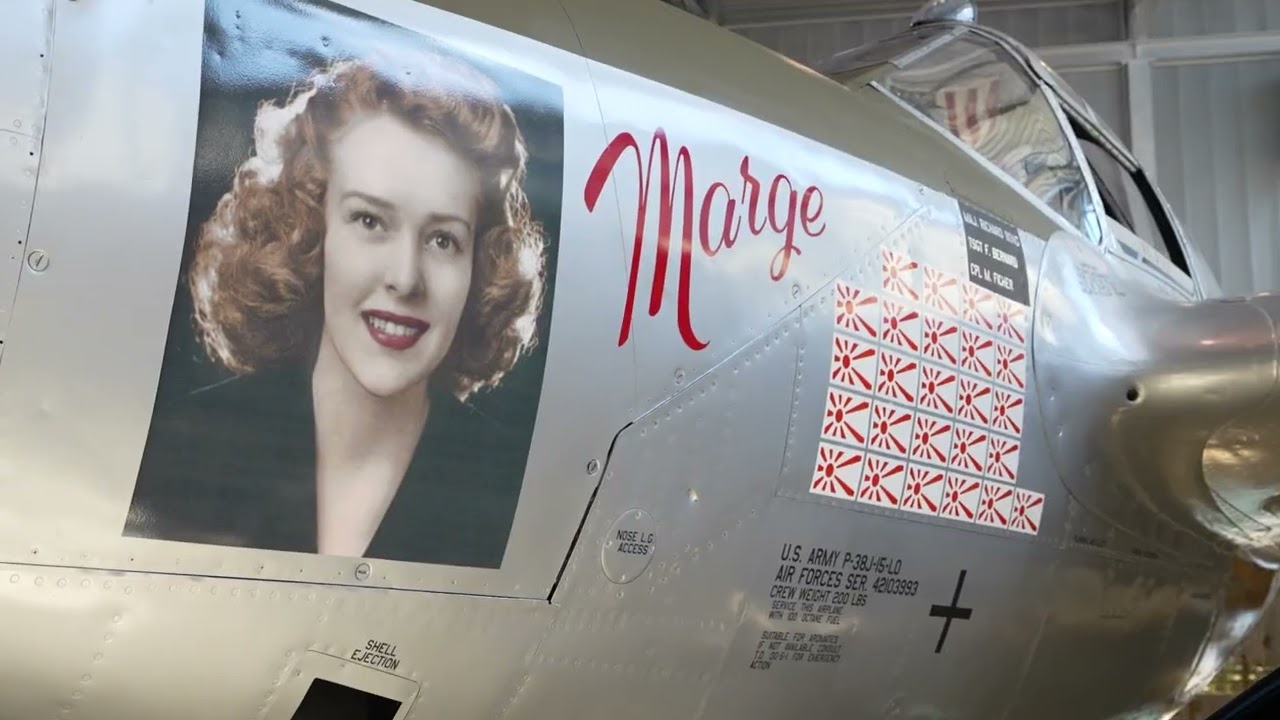
Richard I. Bong, flying a plane decorated with a portrait of his future wife, Marge, became America’s highest-scoring “ace” and received a Medal of Honor
/https://tf-cmsv2-smithsonianmag-media.s3.amazonaws.com/accounts/headshot/Sonja_headshot.png)
/https://tf-cmsv2-smithsonianmag-media.s3.amazonaws.com/filer_public/f0/ef/f0ef846a-b1d4-4b29-acb2-dc837c845e76/pacific_wrecks_marge_2026-still_16.jpeg)
An iconic fighter plane known as “Marge”—once flown by World War II “Ace of Aces” Richard I. Bong—was discovered a couple years ago at its crash site in the jungles of Papua New Guinea. Now, in honor of its pilot, who shot down more enemy planes than any other American, one of the broken aircraft’s wingtips has been brought to Wisconsin, Bong’s home state.
A team from “Mission Marge”—a collaborative effort by Pacific Wrecks, the Papua New Guinea National Museum and Art Gallery, the Wisconsin Air National Guard, and the Richard I. Bong Veterans Historical Center—went to look for Bong’s plane in May 2024. They discovered the wreckage of a P-38 airplane and confirmed it was Marge via a serial number printed on the wing. This summer, following a lot of paperwork, the Mission Marge team returned to the crash site to extract a wingtip—this time with Bong’s nephews Jim Bong and Mitchell Erickson.
/https://tf-cmsv2-smithsonianmag-media.s3.amazonaws.com/filer_public/fa/a3/faa3d5f9-979c-4ddb-a1c9-9c61f618e844/pacific_wrecks_marge_2026-still_20.jpeg)
“To be the first family members to actually be at the crash site of that airplane, and touching it, was kind of surreal,” Jim Bong tells Wisconsin Public Radio’s Danielle Kaeding. “I was thinking about my uncle and my aunt, whose face was on the plane, and my dad and aunts and uncles who have all now passed away, wishing they could be here.”
/https://tf-cmsv2-smithsonianmag-media.s3.amazonaws.com/filer_public/61/ce/61ced047-4811-4953-9147-31bde15394e2/pacific_wrecks_marge_2026-still_03.jpeg)
Bong, a native of Poplar, Wisconsin, was sent to the Pacific in 1942 as a young Air Force pilot. He flew a Lockheed P-38 Lightning with incredible skill. (He said he flew as close to enemy planes as possible, so as not to miss.)
“He loved to fly,” Bong’s late sister Jerry Fechtelkotter told WPR’s Kaeding in 2024. “When he found out that our country was going to go to war, he said ‘Mom, I don’t want to be on the ground.’”
/https://tf-cmsv2-smithsonianmag-media.s3.amazonaws.com/filer_public/f9/ec/f9ecac71-6e61-496d-9598-811bb5151e53/captain_richard_i_bong_watches_his_crew_chief_paint_a_japanese_flag_on_p-38j_marge_42-103993.jpeg)
In 1943, Bong fell in love with Marjorie Vattendahl while on leave in Wisconsin, and in early 1944 after he returned to war, he changed the name of his plane to “Marge.” He also painted its wingtips red and decorated its nose with a huge photo of his girlfriend, whom he later married.
Marge took off for the last time, piloted by Thomas E. Malone, in 1944. Its propeller and electrical system failed, Malone bailed out, and the plane crashed.
/https://tf-cmsv2-smithsonianmag-media.s3.amazonaws.com/filer_public/bc/ed/bcedc66c-cb43-46dc-9df0-8e36a3804958/pacific_wrecks_marge_2026-still_07.jpeg)
Did you know? Airplane inventory
By the end of World War II, the U.S. military had about 300,000 airplanes.After Marge’s demise, Bong gave a second P-38 the same nickname. It didn’t get the same paint job, but he did glue an enlarged photo of his beloved to the left gun cover (several times, as it kept falling off in flight). By the war’s end, Bong had shot down 40 enemy aircraft, a record that remains unbroken among American pilots.
In December 1944, General Douglas MacArthur awarded Bong the Medal of Honor. The ace died less than a year later, while testing a plane in California.
/https://tf-cmsv2-smithsonianmag-media.s3.amazonaws.com/filer_public/79/e0/79e0b9e8-e439-4151-94a1-3823691b680d/gen_douglas_macarthur_presents_the_medal_of_honor_to_maj_ric-7c88bbcfc523df532f553461fc791a0a.jpeg)
For more than 80 years, the debris of the original Marge remained undisturbed in the jungle—until this June, when Mission Marge extracted its wingtip. As WPR reports, the team tied the wingtip to long poles, which local landowners helped hoist and carry. The Papua New Guinea Defense Force flew the wingtip to the country’s capital and handed it off to the Wisconsin Air National Guard, who transported it to the States, by way of Guam and Hawaii, according to a statement from the U.S. federal government.
“Seeing a piece of your history come through, especially the aircraft of the ‘Ace of Aces,’ is significant for airmen today,” Erickson told an audience at the Andersen Air Force Base in Guam, per the statement.

The wingtip is now part of the collection of the Richard I. Bong Veterans Historical Center. As curator Briana Fiandt says in a statement, the wingtip will be exhibited in the museum.
Jim Bong hopes visitors to the museum will appreciate the additional artifact from Bong’s service. “To actually have something tangible right in front of you—that is a part of what he flew in combat and got some of his aerial victories with—that airplane, I hope it adds a little bit more attractiveness and [awe] to it, and also inspires people [who want] to go see it and learn about history,” he tells WPR.
/https://tf-cmsv2-smithsonianmag-media.s3.amazonaws.com/accounts/headshot/Sonja_headshot.png)