
These South American Birds Can Match a Jackhammer’s Ear-Splitting Volume, Making Them Some of the World’s Loudest Known Avians
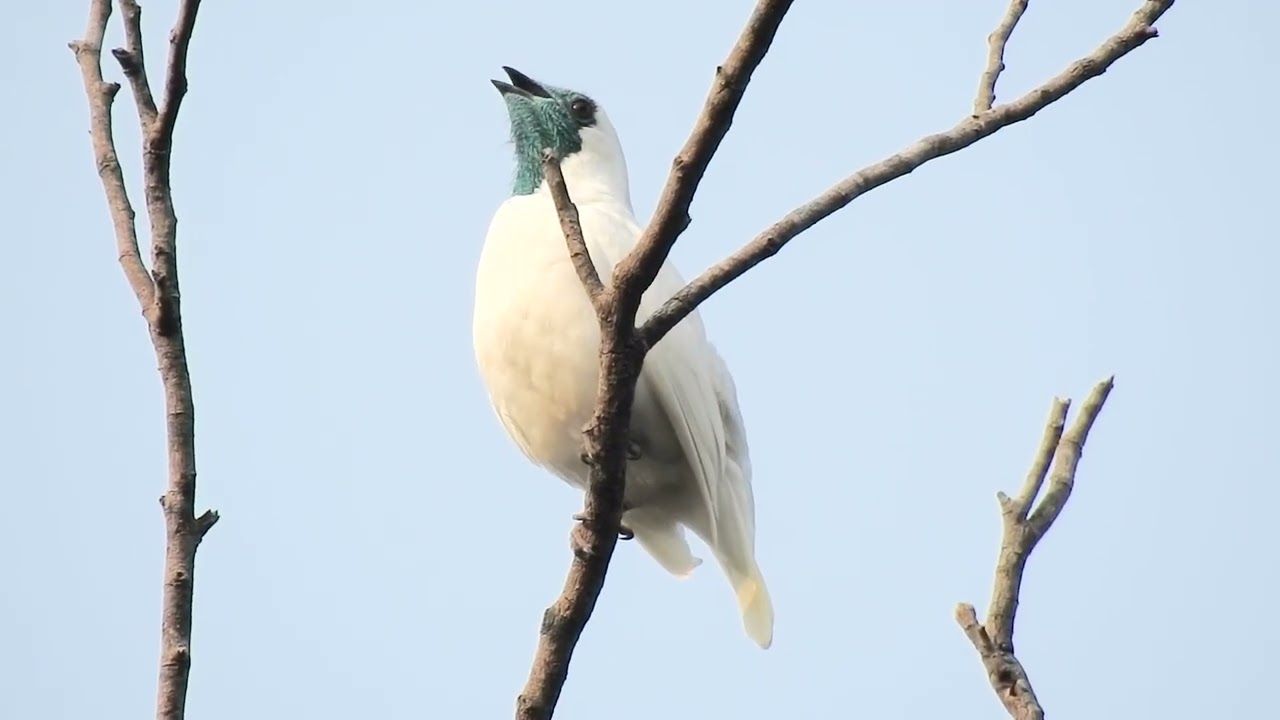
The bare-throated bellbird and the red-legged seriema can produce sounds at amplitudes that exceed 120 decibels, which puts them on par with a trumpeting elephant or a chainsaw
/https://tf-cmsv2-smithsonianmag-media.s3.amazonaws.com/accounts/headshot/SarahKuta.png)
/https://tf-cmsv2-smithsonianmag-media.s3.amazonaws.com/filer_public/19/ab/19abaa5d-7c15-46fa-8349-a5a9b9e6cc36/bare_throated_bellbird.jpg)
From soft peeps to piercing calls, birds produce a wide range of sounds. But scientists recently discovered that two South American species take their calls to ear-splitting extremes, making deafening vocalizations on par with a jackhammer.
The bare-throated bellbird and the red-legged seriema can produce sounds at amplitudes that exceed 120 decibels, according to a study published September 29 in the journal Evolution. They’re now among the ranks of the white bellbird, another South American species, for the loudest known birds on the planet.
Researchers behind the new work didn’t specifically set out to find the world’s noisiest birds. Rather, they wanted to take advantage of recent technological advancements that have made it easier to measure vocal amplitude, the height of a sound wave and a key element of loudness.
“Until recently, it was very impractical to go out into the field and measure amplitude,” lead author João Menezes, an evolutionary biologist who conducted the research while at the University of Massachusetts Amherst, tells the New York Times’ Taylor Mitchell Brown. “It’s kind of stepping into a whole new world.”


The researchers started the project in Amherst, Massachusetts, during the Covid-19 lockdowns, when the unusually quiet circumstances made it easier to isolate and record bird song. They used a laser rangefinder to measure their distance from a specific bird, as well as a sound level meter, which allowed them to isolate that bird’s call from other noises.
“Even recording from my window or from the backyard, almost always that would be [the amplitude of] a new species,” Menezes tells the Washington Post’s Meghan Bartels. “It’s not often that you get to do this kind of exploratory science where you just go out into the field and document things for the first time, especially with birds.”
From Massachusetts, they headed next to Brazil, where they recorded birds in several different habitats. The scientists ultimately collected amplitude data on 123 bird species between December 2018 and January 2025, filling a major gap in scientists’ understanding of how loud birds can sing. Previously, scientists only had amplitude data for ten of those species—even the ubiquitous Canada goose had never been measured.
“We’ve been able to vastly increase the number of species for which there is amplitude data,” study co-author Jeffrey Podos, also an evolutionary biologist at the University of Massachusetts Amherst, says in a statement. “This is basic, foundational research that no one else has managed to do on this scale.”
/https://tf-cmsv2-smithsonianmag-media.s3.amazonaws.com/filer_public/b5/ae/b5ae9fc9-5856-49f6-a0db-88c805c48e21/red-legged_seriema.png)
Their amplitude database captures the impressive range of bird vocalization volumes. At the low end, they documented the dusky-throated hermit, a hummingbird that buzzes at a modest 64 decibels, about the same volume as a normal conversation. At the high end, the bare-throated bellbird and red-legged seriema are both about as loud as a trumpeting elephant or a chainsaw.
Comparing the amplitude data with the birds’ anatomy revealed that species with bigger bodies and wider mouth openings also tended to be the loudest. This is probably because “bigger birds have bulkier muscles, which are capable of creating greater internal pressures, which ultimately generate louder sounds, and then broader mouths allow more energy to radiate into the environment,” Menezes tells CNN’s Amarachi Orie.
Still, the researchers have many unanswered questions. The big one: Why are some birds so much louder than others? The researchers hypothesized that the loudest birds evolved their high-volume calls to attract numerous mates, or to communicate through dense vegetation. But those explanations don’t hold up for the red-legged seriema, so there must be some other factor driving the evolution of its loud vocalizations.
“The seriema is the opposite of those two things,” Menezes tells WBUR’s Barbara Moran. “It’s a super open-habitat bird, like pasture, and it’s strictly monogamous. So, it forms a pair for the breeding season, and that’s it.”
Did you know? Loudness is subjective
There’s no single answer to the question of which species holds the title of “world’s loudest bird”—it depends on how researchers define loudness. The bare-throated bellbird, for example, produced the loudest individual call, reaching nearly 131 decibels, per CNN. But when researchers averaged the loudest calls across individual birds, the red-legged seriema came out on top at nearly 121 decibels. Averaging the vocalizations’ peak volumes, on the other hand, allowed the white bellbird to take the lead at 127 decibels.
Scientists are still unraveling the evolutionary underpinnings of super loud birdsong. But in the meantime, their work could have important implications for conservation. For example, reliable amplitude data could help researchers use audio recordings to determine not just whether a species is present, but also how close those birds might be and how many individuals are nearby, Connor Wood, an ornithologist at Cornell University who wasn’t involved in the study, tells the Washington Post.
The findings could also help scientists better understand how birds may adapt to a changing world.
“Amplitude is so critical to the ability of birds to communicate with each other, that it is really important for us to understand exactly how that might be able to change,” Nathan Senner, an ornithologist at the University of Massachusetts Amherst who also wasn’t involved with the study, tells WBUR. “How they evolve is really fundamental to our understanding of how they might continue to evolve as our world changes.”
/https://tf-cmsv2-smithsonianmag-media.s3.amazonaws.com/accounts/headshot/SarahKuta.png)