
These Snakes Can Cartwheel Away From Danger. Scientists Just Uncovered How the Slithering Creatures Perform Their Acrobatic Rolls
When they’re rolling, some snakes belonging to the Pseudorabdion genus can reach top speeds of 3.8 to 8.3 miles per hour, according to a new study

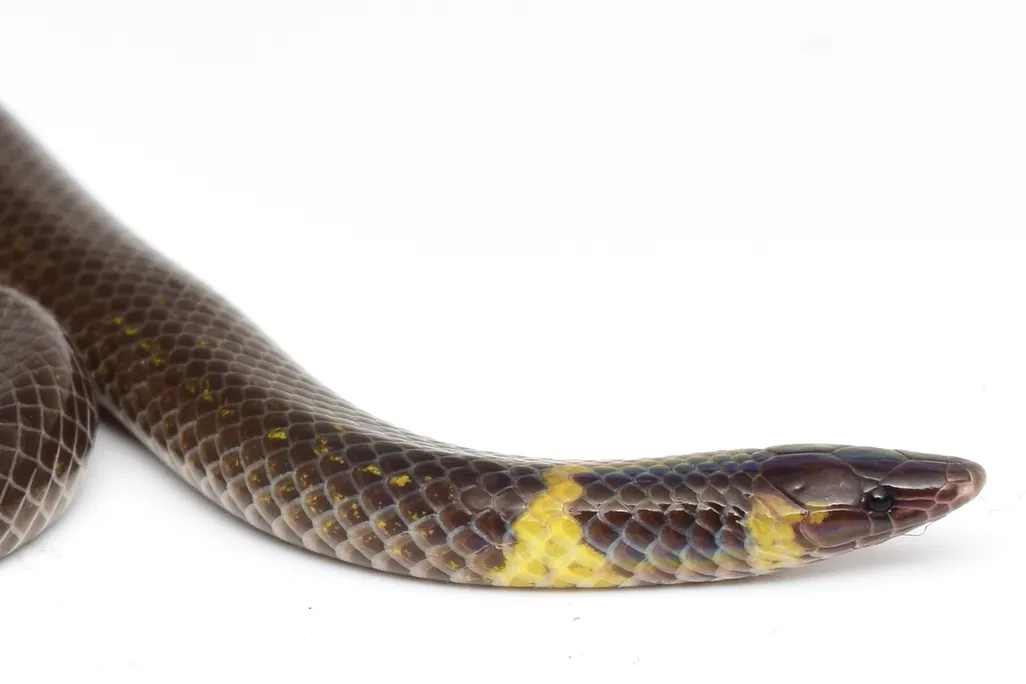
Dwarf reed snakes spend much of their time hiding under rocks, logs or leaf litter, trying to avoid being eaten. But when these small, slithering creatures feel threatened, they’ve perfected a unique method of fleeing from danger: cartwheeling.
Scientists first described this roly-poly behavior several years ago, based on observations of a snake spotted wheeling itself down a road in northwest Malaysia. Now, a different team of researchers says they have figured out how these diminutive snakes pull off the acrobatic feat. Their findings were described in a study published on October 19 in the journal Current Biology.
Dwarf reed snakes (Pseudorabdion longiceps) are short, slender, nocturnal snakes that live in Southeast Asia. They grow to a maximum length of nine inches. Despite their petite stature and penchant for hiding, they’re still vulnerable to predation from birds and other snakes, including the striped coral snake.
Researchers had heard anecdotal tales of dwarf reed snakes cartwheeling away from danger. In August 2019, they finally caught the unusual behavior on camera. A group of scientists was conducting surveys for other species when they stumbled upon a dwarf reed snake crossing a road. They apparently startled the creature, because it curled its body into a coil and began rolling downhill away from them.
Intrigued, the researchers carefully caught the snake, placed it on a flat area and brought out a camera. Once again, the snake rolled away—this time without the help of gravity. Scientists described that encounter in the journal Biotropica in 2023, marking the first time cartwheeling had been formally observed in any snake or reptile more broadly.


Ecologist Yosuke Kojima of Toho University in Japan heard about this strange behavior seven years ago from a colleague in Malaysia, reports Science News’ Maria Temming. And after seeing it for himself, Kojima was “amazed by the dynamic movement and immediately wanted to learn more about it,” he tells Defector’s Sabrina Imbler.
So, Kojima and colleagues went to Malaysia’s Kubah National Park and gathered several snakes belonging to the Pseudorabdion genus: one P. longiceps, one P. collaris and 11 P. saravacense. They also wrangled six reed snakes of the Calamaria genus for comparison.
The researchers brought the slithering creatures back to their laboratory, where they had constructed a snake-size racetrack equipped with cameras. One at a time, they placed the snakes at one end of the track, then gently tapped them to see if they would roll.
None of the Calamaria reed snakes cartwheeled—they simply slithered down the track like normal. But all 13 members of the Pseudorabdion genus exhibited the rolling locomotion, reaching top speeds of 3.8 to 8.3 miles per hour.
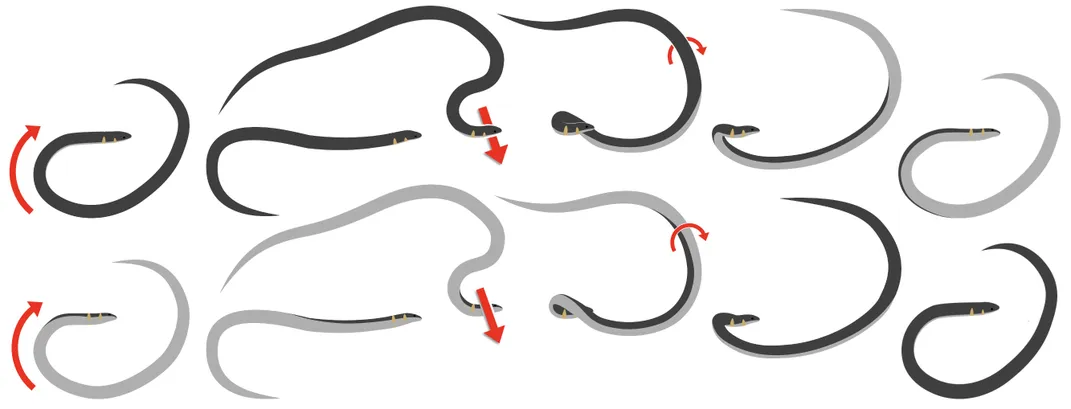
When the researchers analyzed the footage, they were able to see exactly how the Pseudorabdion snakes performed their dexterous dance moves. After breaking down the biomechanics, Kojima was “even more amazed by how complex the movement actually was,” he tells the Defector.
A snake starts by curling its body into a tight curve, with its head lifted off the ground facing the direction of travel. As the snake rolls along the ground like a wheel, its body begins to straighten out and the point where it touches the ground shifts toward its tail. The animal then pushes off the ground with its tail, launching itself into the air. While briefly airborne, the creature twists into an S-shape, forming an arch above its head. It then swings this arch forward and down past one side of its head until that side of its body hits the ground. That contact starts the next cartwheel, allowing the snake to keep rolling forward while alternating which side of its body strikes the ground.
Through all this precisely coordinated choreography, the snakes hold their heads fairly steady, which the researchers think helps the reptiles keep their bearings.
Fun fact: Another tumbling species
The Moroccan flic-flac spider is considered the fastest spider in the world. It can reach speeds of up to 3.8 miles per hour to escape danger—and it does that by rolling. However, the tactic eats up a lot of energy, so the spiders can only do it in short bursts.
Scientists now know more about how the snakes execute their cartwheels, but they still don’t fully understand why they move this way. Rolling helps them move quickly—about four times faster than slithering—so it’s undoubtedly useful for evading predators. But it’s likely also an energy-intensive process, and the researchers aren’t sure how long the snakes could keep up their cartwheeling.
Many questions remain unanswered, including how the snakes evolved such a “strange and possibly demanding” movement, Jessica Tingle, a biologist at Brown University who was not involved in the study, tells Science News. And do dwarf reed snakes have “something special in their anatomy, physiology or neural control that lets them do it when their close relatives apparently can’t or don’t?”
The new work also opens the possibility of every snake secretly having the traits to roll away, Tingle notes. “Do all snakes have the basic equipment, and they just don’t use it?”
