
These Singing Mice Squeak Back and Forth—and Don’t Interrupt. Scientists Found the Brain Pathway Behind Their Impressive Songs
Alston’s singing mice carry out complex vocalizations and even appear to converse politely with one another. The neural circuitry that makes this possible is simpler than researchers expected
/https://tf-cmsv2-smithsonianmag-media.s3.amazonaws.com/filer_public/5e/e3/5ee3947b-3e52-438b-8be0-7e5b70d86ada/scotinomys_teguina_biologia_centrali-americana_tab_14_bhl570896.jpg)
When it comes to conversation, the closest the animal kingdom gets to humanlike abilities may be found in an unassuming Central American mouse. Alston’s singing mice let loose chirping songs that can go on for up to 16 seconds, and they don’t just perform solo. Often, two mice will squeak back and forth, refraining from interrupting each other and achieving a conversational cadence similar to that of two humans engaged in a witty repartee.
Working with a team of researchers at New York University, Arkarup Banerjee, now a biologist at Cold Spring Harbor Laboratory in New York, determined in 2019 that the singing mice’s conversations were much like our own. Still, scientists wanted to learn more about the neural mechanisms behind such complex rodent chatter. Now, in a study published last week in the journal Nature, Banerjee and his collaborators suggest they’ve identified the pathways in the brain that enable the mice to converse—and the mechanism is surprisingly simple.
When comparing the rodents with non-singing lab mice, the researchers thought that they might find novel neural circuitry or unique brain regions in the singers. However, the Alston’s singing mice showed only an enhancement of existing neural pathways. Scientists hope this discovery could spark new insights about the evolution of both human language and puzzling animal behaviors.
“You might expect that evolving a whole new means of vocal communication would require a significant reorganization of brain circuitry,” says Banerjee in a statement. “Instead, we found a couple of targeted changes to existing wiring patterns. Our approach gives the field a playbook: To understand how new behaviors evolve, find closely related species with big behavioral differences and start by mapping the wiring at high-resolution.”

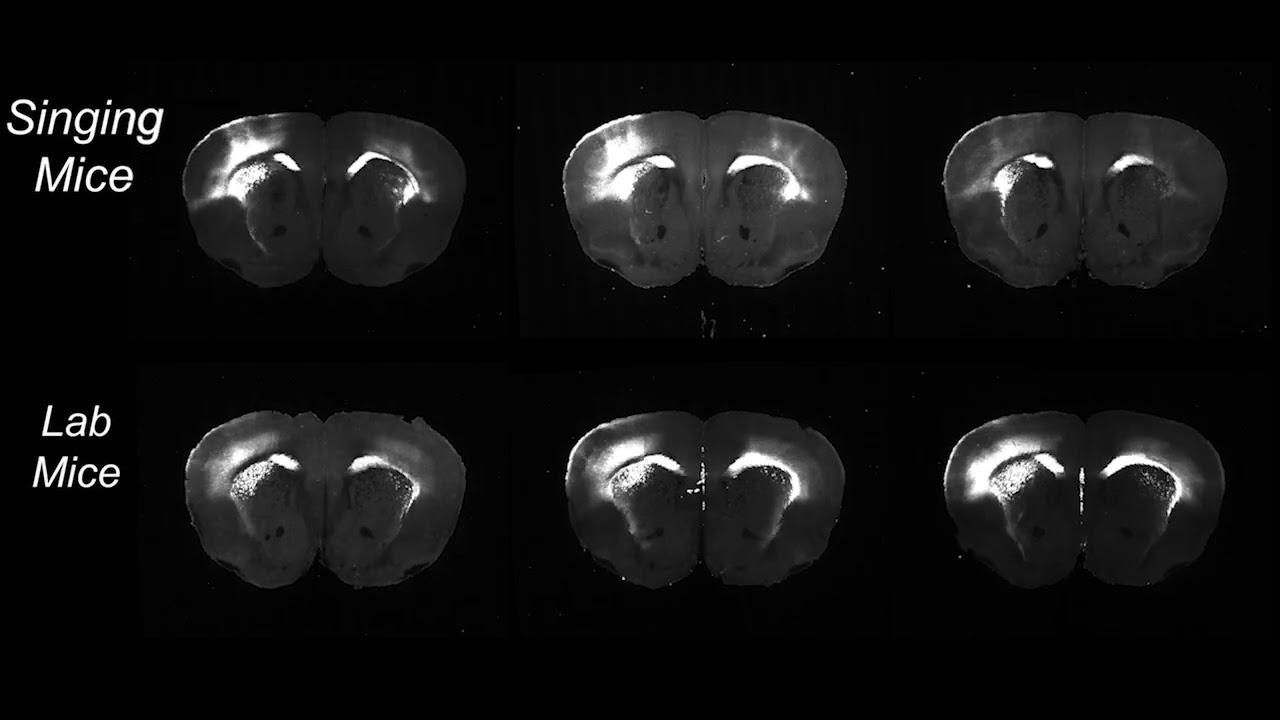
To map the neural pathways involved in rodent singing, the researchers used a process called Multiplexed Analysis of Projections by Sequencing, or MAPseq. With this technique, scientists infect the mice with a virus that plants distinctive RNA sequences into each neuron. Those barcodes act as labels on each cell, so when scientists genetically sequence the brain tissue, they can track the RNA codes to their originating neuron, creating a high-resolution map of neural connections.
These maps revealed that while similar pathways were engaged in both types of mice, singing mice had triple the number of neurons communicating between the motor cortex and two other regions of the brain than their non-singing counterparts did. One of those brain regions was related to hearing, and the other, located in the midbrain, is linked to vocalizations in many animals, including humans.
While three times as many neurons sending messages might sound dramatic, it’s actually more of “a relatively subtle change in brain wiring,” Anthony Zador, a neuroscientist at Cold Spring Harbor Laboratory and co-author of the study, tells the New York Times’ Annie Roth. That it results in such different vocal behavior, “raises interesting questions about how much rewiring was involved in the evolution of human language,” he adds.

Separately, another team of scientists recently unraveled a different part of the mystery of singing mice: How do they physically make their unique noises? Alston’s singing mice can combine around 100 different breaths and notes in their songs with a speed and length far more “extreme” than the vocalizations of other rodents, as Samantha Smith, an integrative biologist at the University of Lausanne in Switzerland, tells Science News’ Jake Buehler.
By carefully dissecting the mice’s tiny larynxes, Smith and her team determined that an inflatable air sac is critical to the serenades. Although other rodents have these sacs, they don’t seem to use them in the same way. These findings were published last week in Proceedings of the Royal Society B.
Did you know? The search for a language gene
- Scientists put a human-specific version of an animal protein called NOVA1 into lab mice for a study last year—and it made them squeak differently.
- Though researchers have long searched for a “language gene,” humans have many unique genetic changes linked to language.
Going forward, scientists hope to build on the brain-mapping results in singing mice to better understand how other forms of animal conversation work, a line of research that could even teach us more about ourselves.
“This is relevant far beyond singing mice,” Mirjam Knörnschild, a behavioral ecologist at the Museum of Natural History Berlin who was not involved with the study, tells the New York Times. This paper could “inform work on vocal turn-taking, vocal learning and vocal flexibility in other mammals, including bats, primates and humans.”