
These Moths Use Their Genitals to Fend Off Bats—but Not in the Way You Think. They Emit Ultrasound to Scramble the Predators’ Sonar
New research suggests male hawkmoths have three distinct anti-bat, ultrasound-producing systems. These may have evolved independently up to seven times between 5 million and 30 million years ago

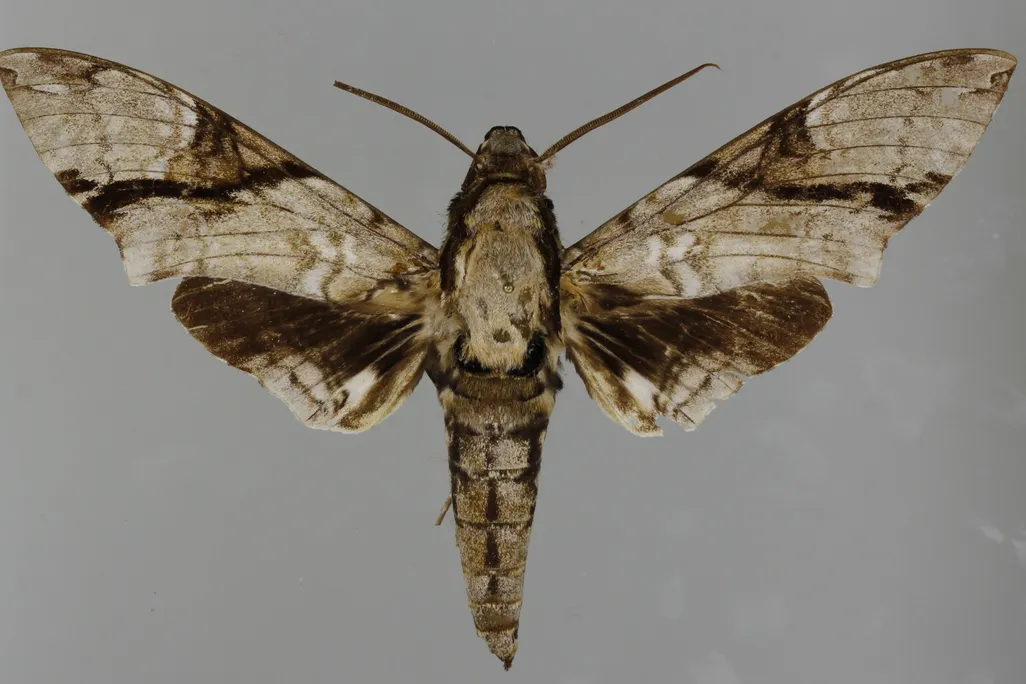
Bats primarily use echolocation to hunt prey, using their sophisticated biological sonar systems to find and capture tasty insects in the dark. But some moths have evolved a clever workaround to these attacks: They use their genitalia to produce high-frequency sound waves that essentially scramble their pursuers’ sonar, causing them to miss their intended target and fly away hungry.
This is such an effective strategy for staving off bat attacks that it’s arisen in moths independently up to seven times between 5 million and 30 million years ago, researchers report in a study published November 4 in the Proceedings of the Royal Society B.
Different lineages of hawkmoths—a group of large, agile pollinators—have separately evolved similar solutions to the same problem, a phenomenon known as convergent evolution. The findings highlight how “interactions between predators and their prey can drive the evolution of complex and sometimes bizarre adaptations,” lead author Paul Masonick, an evolutionary biologist at the Florida Museum of Natural History, tells IFLScience’s Rachael Funnell.
“Bat predation has been a major driver of insect evolution,” he adds. “It has contributed significantly to the remarkable diversity of bioacoustic defenses among moths that we see today.”
Hawkmoths, also known as sphinx moths, are sturdy, nocturnal insects known for hovering in mid-air while sipping nectar from flowers, just like hummingbirds. Scientists estimate there are 1,600 species of hawkmoths around the world, with most occupying warm, wet tropical regions.
Many species of hawkmoths use ultrasound to fend off bats, often by scraping their sex organs against structures on their abdomens, producing noise via stridulation. Scientists don’t know why moths first evolved these ultrasound-producing systems, but they suspect the behavior initially arose to help males attract mates.
“In all the species that make the noise, the males have to go to a lot of effort to impress a female,” Ian Kitching, an entomologist at the Natural History Museum in London who provided images of moths for the study, says in a statement. “This may have been the original use for the sounds. It was then co-opted as a means of defense, temporarily confusing the bats when they swoop in for the kill.”
Did you know? Bats’ evolutionary origins
In September, researchers published a massive genetic study on bats hinting that the flying mammals originated 65 million years ago in Europe, rather than Africa, North America or Asia—locations that have previously been suggested. Today, there are some 1,500 species spread across every continent except Antarctica.
In the new work, researchers set out to better understand the diversity of moths’ anti-bat defenses and how their ultrasound-producing systems evolved. They focused on male hawkmoths because scientists have little documentation of female stridulation.
The scientists first tested how several hawkmoth species responded when they sensed a potential bat attack. They conducted their behavioral experiments after dark, tethering each moth with a thin strand of fishing line so it could fly in place. Then, they played recordings of bat calls and gently handled each moth to simulate a predator grabbing it, recording any ultrasounds the insects made in response.
They also dissected moths and used detailed images to investigate the insects’ sound-producing anatomy. Finally, the team looked at an evolutionary family tree showing how different hawkmoth species are related and approximately when they diverged from common ancestors.
Of the 143 species of hawkmoths the researchers investigated, 77 produced ultrasound. But they did so in different ways.
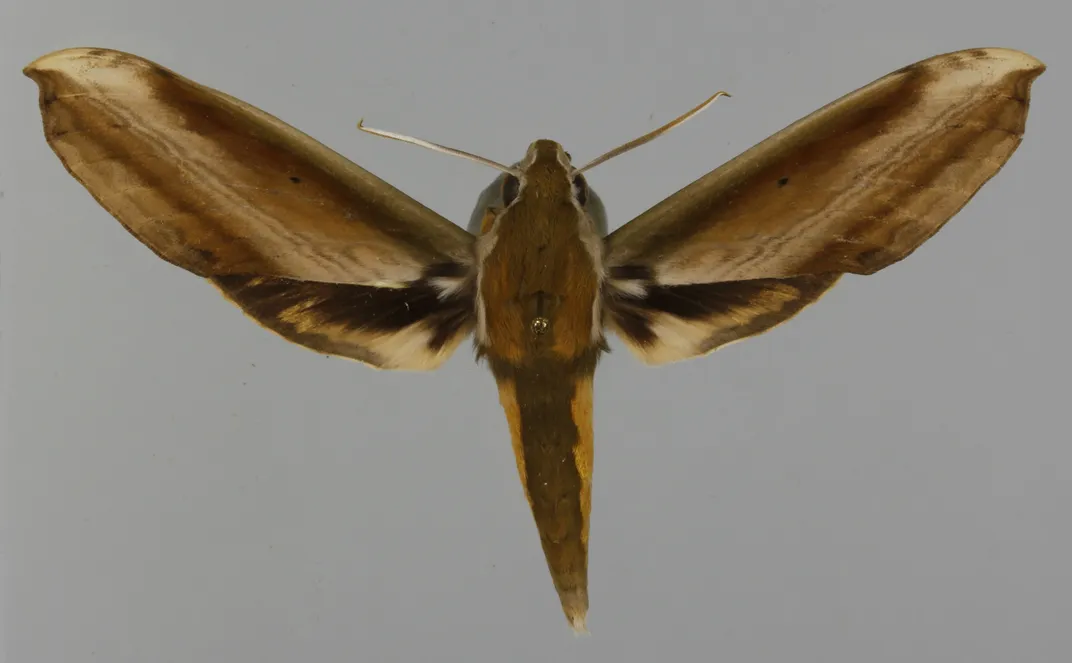
All rely on special enlarged genital scales that help them hold onto females during sex, the team found, but the moths used three distinct methods to generate sound. Some species scrape their genital scales against another row of scales located near the end of their abdomen, while others rub them against stiff spines along the edge of their abdomen. Another group drags their genital scales across a patch of tiny bumps on the underside of their body, which is a newly identified mechanism.
These methods produce different types of ultrasound, too, from continuous squeaks to irregular bursts. Species that scrape their genital scales against the bumpy patch on their underside can produce the widest range of sounds, the researchers found. That versatility may give them an evolutionary advantage, allowing them to develop new acoustic defenses against bats as the need arises.
“Clearly the hawkmoths as a whole have more tricks up their sleeve,” Marc Holderied, a biologist at the University of Bristol in England who was not involved with the research, tells Science News’ Elie Dolgin.
