
These Male Fruit Flies Have Sperm That Are Nearly as Long as Their Bodies. Here’s How the Cells Don’t Become a Tangled Mess
Males of the species Drosophila melanogaster pack thousands of almost two-millimeter-long sperm cells into significantly smaller storage organs. A new study reveals how they move in an orderly manner
/https://tf-cmsv2-smithsonianmag-media.s3.amazonaws.com/filer_public/c4/40/c4401a97-4f3b-4254-a012-76cb7e8a6f68/single-sperm-timelapse-blue_cj-imran-alsous_smaller.gif)
Among all the animals on Earth, tiny fruit flies produce some of the longest male reproductive cells, or sperm. Males of the species that typically swarms your indoor trash, Drosophila melanogaster, are only about two millimeters long—equal to the width of a wooden pencil’s lead. Their sperm, primarily the tails, are almost the same length as their bodies and roughly 40 times the length of human sperm cells.
Somehow, each insect holds thousands of sperm squeezed into two storage organs called seminal vesicles, each of which is ten times shorter than the cells. Scientists have puzzled over this super-packaging. How does the tiny creature cram so much in its microscopic organs without creating a catastrophic, knotty mess?
“Imagine putting thousands [of earbuds] in your pocket. The sperm are, of course, different from passive wires: The sperm are active, generating bending waves along their long tails,” Jasmin Imran Alsous, a computational biologist at the Flatiron Institute, a New York City-based research center, tells Laura Baisas at Popular Science.
Now, Imran Alsous and her colleagues have gotten a real-time visualization of how these microscopic giants stay perfectly organized. The sperm are neatly packed into parallel swirls, with some cells’ heads at the other cells’ tail ends. They wiggle and physically push off one another to move forward, creating a synchronized, collective churn, the team reports in a study published on June 22 in the journal Nature Physics.
“It’s like a 1,000-lane highway where all the cars are moving in opposite directions,” study co-author Michael Shelley, a mathematician at the Flatiron Institute and New York University, tells the New York Times’ Monique Brouillette.
Did you know? Record-holding sperm
Males of the fruit fly species Drosophila bifurca have the longest known sperm cells. They’re around two inches long, which is roughly 20 times their body length and about 1,000 times as long as human sperm.
In the study, the researchers dyed D. melanogaster sperm heads and tails with fluorescent markers, tracking their choreography under a high-powered microscope. Unlike human sperm, which whip their tails to swim through liquid, a fruit fly’s seminal vesicle is so crowded with sperm that fluid is practically nonexistent.
Computer simulations revealed that to move, the cells send undulating waves down their long tails, using their neighbors as physical leverage. As a wave from one cell meets another traveling the opposite direction, they push off each other. This constant, opposing friction keeps the entire mass sliding smoothly in organized lanes, preventing tangles, the team found.
“Each sperm is attached to a long tail. That tail is moving just as quickly as the heads, but the tails collectively move more slowly together, in this flowy slow churn,” Imran Alsous explains to Popular Science. “It would be as if the highways now began to fold and bend while the cars within them continued to dart in opposite directions.”
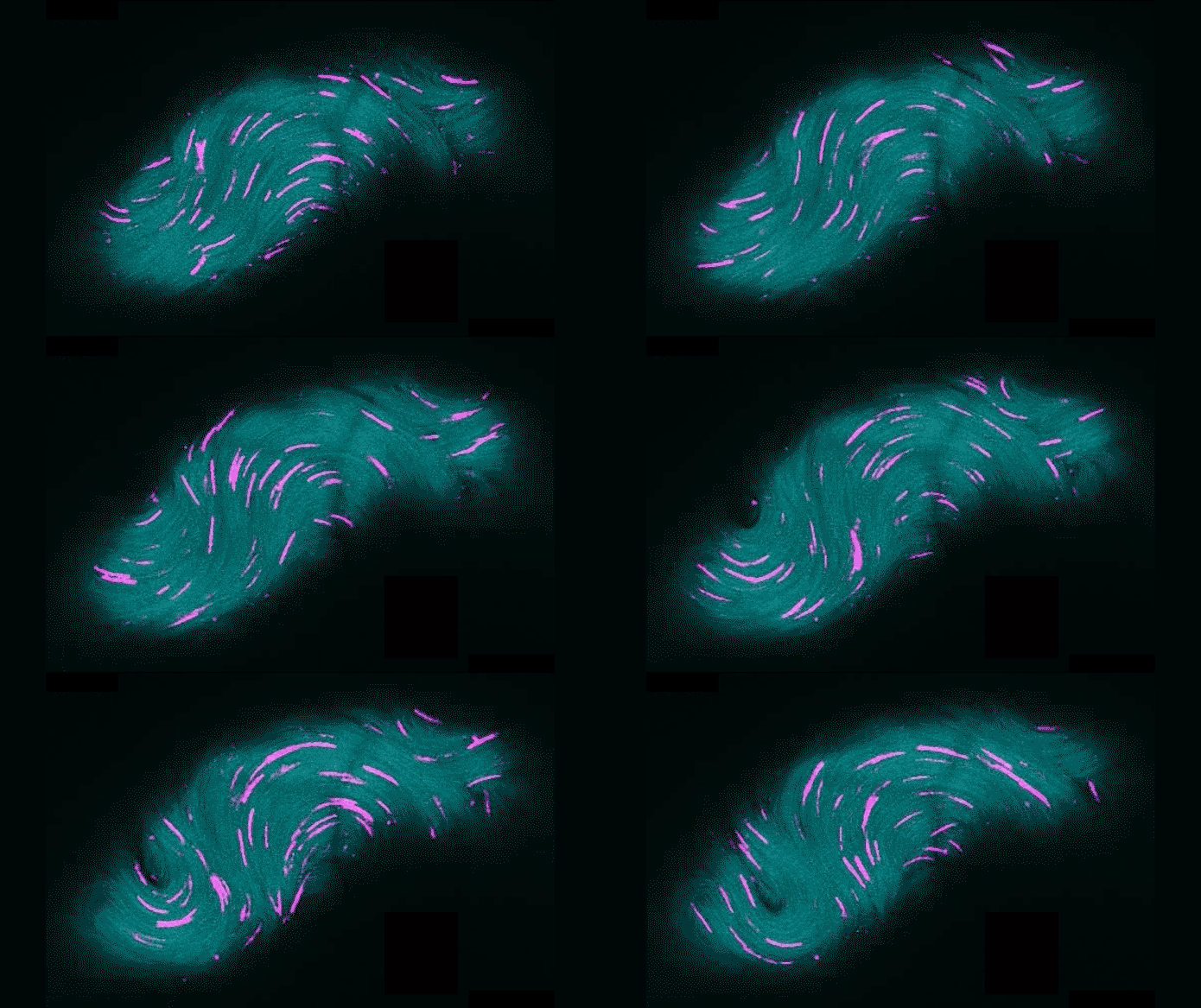
Interestingly, when the researchers isolated a single sperm, it merely wriggled in place without moving forward. That means the mechanism these cells use to propel themselves is different from that of human sperm.
“We have this view of sperm flapping their tails and swimming like someone in a pool, but that’s not what’s happening here at all,” John Fitzpatrick, an evolutionary biologist at Stockholm University, in Sweden, who was not involved in the study, tells the Times. “They have to be pushing against something to propel themselves forward, and the thing they’re pushing against could be sperm or the female reproductive tract. That’s a really cool finding.”
Fruit flies are not alone in their oversized reproductive strategy. Evolution has favored sperm gigantism across several small organisms, including featherwing beetles, seed shrimp and many frogs.
The new study helps provide a more nuanced view of sperm across the animal kingdom.
In “the textbook picture, there’s always this one sperm shown as the fastest, best sperm that makes it,” said Imran Alsous to Science’s Rohini Subrahmanyam last year after the study was posted on arXiv as a preprint. But for fruit fly sperm, she added, “their interactions with each other are key for any of them surviving.”