
These Four Giant Dinosaur Footprints Discovered in North Dakota Might Represent the First Trackway Made by an Adult T. Rex Ever Found
A high school teacher first spotted the remarkable trail while volunteering on a paleontological dig. Researchers suspect a hulking, full-grown dinosaur marched through the then-swampy landscape roughly 66.5 million years ago
/https://tf-cmsv2-smithsonianmag-media.s3.amazonaws.com/accounts/headshot/SarahKuta.png)
/https://tf-cmsv2-smithsonianmag-media.s3.amazonaws.com/filer_public/1a/a6/1aa67fc3-b755-4ed5-b9eb-5e3f801ad982/walkingtrexillustration_credit_andrey_atuchin.jpg)
Roughly 66.5 million years ago, a hulking Tyrannosaurus rex marched through the then-swampy forested landscape of southwestern North Dakota. Now, paleontologists say they have unearthed four of the massive creature’s three-toed footprints—the first adult T. rex trackway ever found.
Researchers describe their find in a study published September 8 in the Journal of Vertebrate Paleontology.
Kent Hups, a high school teacher and amateur fossil hunter based in Northglenn, Colorado, was the one who initially spotted the tracks in 2025. Hups was volunteering on a dig led by his friend Tyler Lyson, senior curator of vertebrate paleontology at the Denver Museum of Nature & Science, just outside of Marmarth, North Dakota, when he spotted something unusual sticking out of the ground. When Hups got closer, he realized the lumpy, wedge-shaped protrusion looked a lot like three splayed toes, reports National Geographic’s Dustin Renwick.
/https://tf-cmsv2-smithsonianmag-media.s3.amazonaws.com/filer_public/fa/0d/fa0d3d9e-e5c8-4214-94a9-15d7510bab13/kent_hups_w_track_credit_tyler_lyson.jpeg)
Hups was convinced he’d discovered a T. rex footprint. But when he let Lyson know what he’d found, the paleontologist was more skeptical. Only two adult T. rex tracks had ever been uncovered—one in New Mexico and the other in Montana.
Still, the team returned to the site the next day, where they were shocked to discover several additional footprints—a trackway measuring roughly 23 feet long featuring two left and two right footprints, each around three feet long. Based on the stride lengths and foot lengths, researchers estimate the T. rex was walking at a speed of roughly 3.4 to 4.5 miles per hour. One footprint even appears to have an impression of a T. rex claw.
“As a teacher, I’m always telling my students that science starts with curiosity, passion and careful observation. I never imagined that could lead me to a discovery like this,” Hups says in a statement.
/https://tf-cmsv2-smithsonianmag-media.s3.amazonaws.com/filer_public/7a/06/7a061ff6-f574-44c2-8fba-8d17df6512af/footprint_formation1_credit_andrey_atuchin.jpg)
The researchers are convinced the footprints were made by a T. rex because of their size, shape and location. Numerous T. rex bones have been found in the same area, encased in 66- to 68-million-year-old geologic layers collectively known as the Hell Creek Formation, which spans eastern Montana, the Dakotas and Wyoming. Finds include Sue, one of the largest and most complete T. rex skeletons ever discovered, and “Teen Rex,” the juvenile dinosaur discovered by three children in 2022. Gus, the T. rex fossil that sold for a record $50.1 million earlier this year, and Stan, which sold for $31.8 million in 2020 and is now on display at the Natural History Museum Abu Dhabi in the United Arab Emirates, were also found nearby.
Though dinosaur bones are relatively common, it’s unusual to find large theropod footprints in the Hell Creek Formation, let alone trackways. That’s because millions of years ago, the area was a riparian habitat—a floodplain braided with streams—so footprints usually eroded away.
/https://tf-cmsv2-smithsonianmag-media.s3.amazonaws.com/filer_public/99/95/9995fe86-3233-4768-8a74-4b8c8bbf0251/isolated_track_credit_tyler_lyson.jpeg)
In this case, though, scientists think a unique combination of conditions may have helped preserve evidence of the T. rex’s stroll. Their leading hypothesis is that water laden with bacteria flooded the footprint depressions, creating conditions that allowed dissolved minerals to accumulate, per National Geographic. Layer upon layer of minerals and sediments built up and solidified, with calcium carbonate and sandstone cementing into a dense mass that was harder than the surrounding mud.
Over time, erosion wore away the softer material, exposing the hardened footprints. Today, the tracks appear as raised, three-dimensional casts of each footprint, rather than as hollow molds.
Hups still can’t believe he found the trackway, telling National Geographic it’s “kind of that elusive thing that you look for, and you look for, and you look for, and you can never find.”
“Everybody hopes that they find that thing: You find a complete T. rex, or you find something that is just incredible to see,” he adds. “But you never think you’re going to find something that is the only one in the world.”

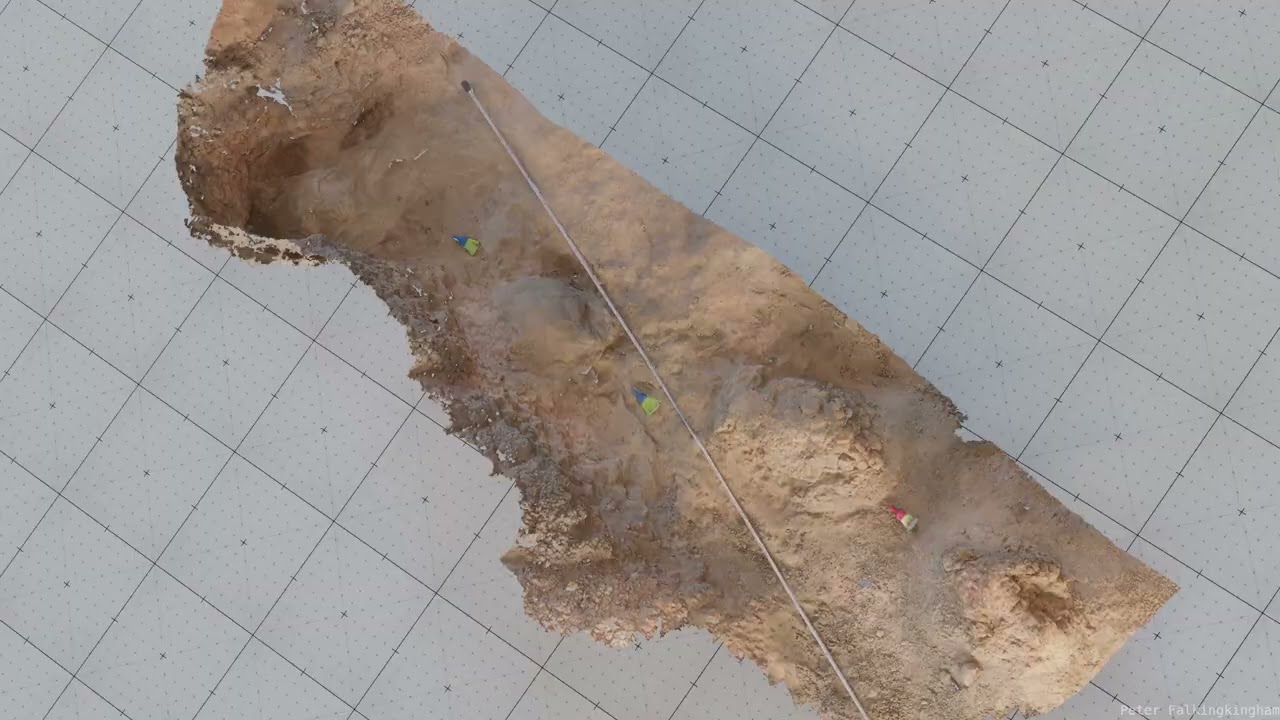
The researchers worried the tracks would eventually be lost to erosion if they remained in place. So this summer, they wrapped three of them in a protective layer of plaster and burlap in preparation for helicopter transport to the Denver Museum of Nature & Science. The footprints were found on federal land administered by the U.S. Forest Service, and the team is collecting the tracks with permission from the agency.
Before wrapping them up, the scientists also took high-resolution scans of the tracks, which they then used to create digital 3D models.
Did you know? Longest continuous dinosaur trackway
The world’s longest continuous dinosaur trackway is located near Ouray, Colorado, featuring 134 consecutive footprints made by a sauropod roughly 150 million years ago during the Late Jurassic period.
There’s still more to learn from the footprints. The physical tracks, coupled with the digital models, might reveal additional insights into how T. rex moved and how its feet were structured; if they’re lucky, scientists might even find preserved impressions of the creature’s skin.
“Bones tell us an enormous amount about these animals, but footprints capture a moment of behavior,” Lyson says in the statement. “With a trackway, we can actually follow an animal as it moved across the landscape. That is incredibly rare for T. rex.”
/https://tf-cmsv2-smithsonianmag-media.s3.amazonaws.com/accounts/headshot/SarahKuta.png)