
The James Webb Space Telescope Has Captured Our Galaxy’s Most Productive Star-Forming Region in Stunning Detail
Why Sagittarius B2 produces so many stars in comparison to the rest of the galactic center has remained an enduring mystery
/https://tf-cmsv2-smithsonianmag-media.s3.amazonaws.com/accounts/headshot/Margherita_Bassi.png)
/https://tf-cmsv2-smithsonianmag-media.s3.amazonaws.com/filer_public/4b/f9/4bf9d047-838a-42c7-81ba-9f709f51acee/smithsonian_feature_images_17.png)
A gorgeous mix of fuchsia and purple bruises shine against a dark background, illuminated by glowing cosmic dust heated by very young massive stars. That’s just one of the newest images generated by the largest telescope in space—and the James Webb Space Telescope’s (JWST) unprecedented view of the center of the Milky Way galaxy may help explain how stars, and even our galaxy, got their start.
The new images are of Sagittarius B2, a molecular cloud a few hundred light-years from Sagittarius A*, the supermassive black hole at the center of our Milky Way galaxy. The telescope used its Mid-Infrared Instrument (MIRI) and Near-Infrared Camera (NIRCam) to reveal new details about the cloud’s gas, dust and stars, literally shedding light on the galaxy’s most massive and productive star-forming region.
Researchers detail their results in a study published on the pre-print server arXiv in September.

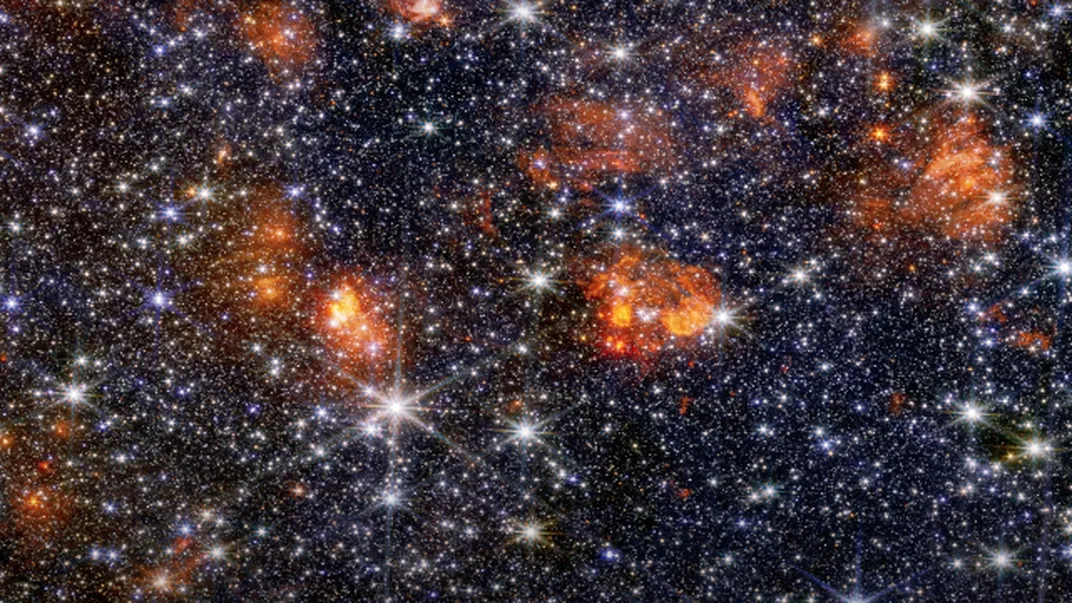
JWST’s “results suggest that, despite already holding the crown for most actively star-forming cloud, we have underestimated the total star formation in [Sagittarius] B2,” the researchers write in the study. “JWST unveils previously hidden massive stars and ionized structures, offering a transformative view of how stars form under some of the most extreme galactic conditions.”
Did you know? Space's largest telescope
Construction of the James Webb Space Telescope began in 2004. The telescope launched in 2021.Only the brightest stars are visible in the black-and-purple image. The reddest area on the right half of the image also captures Sagittarius B2 North, one of the most molecularly rich regions known to scientists, with record-breaking clarity.
/https://tf-cmsv2-smithsonianmag-media.s3.amazonaws.com/filer_public/e7/61/e761ac83-6c9b-493d-89bc-e39b3557a686/screenshot_2025-09-30_at_125321.png)
In contrast, Webb’s NIRCam image is overwhelmed by glittering stars, with just a faint blush of orange highlighting clouds of gas and dust.
The images also show that one end of Sagittarius B2 has a straight, sharp edge, suggesting a compression event that may have crushed the cloud, per a University of Florida statement. The images’ dark areas are not empty space—they are so full of gas and dust that Webb can’t penetrate them. These dense areas house stars too young to outshine larger stars and contain raw material for new stars.
“Webb’s powerful infrared instruments provide detail we’ve never been able to see before, which will help us to understand some of the still-elusive mysteries of massive star formation and why Sagittarius B2 is so much more active than the rest of the galactic center,” Adam Ginsburg, an astronomer at the University of Florida and a co-author of the research, says in a NASA statement.
/https://tf-cmsv2-smithsonianmag-media.s3.amazonaws.com/filer_public/27/9b/279bbf46-94c2-4e26-80ff-74ac406ed7a3/miri_image.png)
Though Sagittarius B2 contains only 10 percent of the galactic center’s gas, it produces half of the region’s stars. According to Space.com’s Keith Cooper, some researchers theorize that the magnetic fields twisted around the galactic center and its molecular clouds could play a role in this imbalance, but further research is needed.
Since Sagittarius B2’s internal environment is similar to that of galaxies billions of years old, the study also carries implications for our understanding of the early universe and its growth.
“This discovery shows the power of Webb to uncover the unseen,” Ginsburg concludes in the university statement. “It’s not just giving us a clearer picture of our own galaxy, but also helping us understand how galaxies grew and evolved across cosmic time.”
/https://tf-cmsv2-smithsonianmag-media.s3.amazonaws.com/accounts/headshot/Margherita_Bassi.png)