
Thawing Permafrost May Have Created a New Type of Landslide, Which Could Become More Common as the World Warms
Scientists call the events permafrost detachment slides. Instead of thawing from the top down, these landslides seem to originate from a weakened base

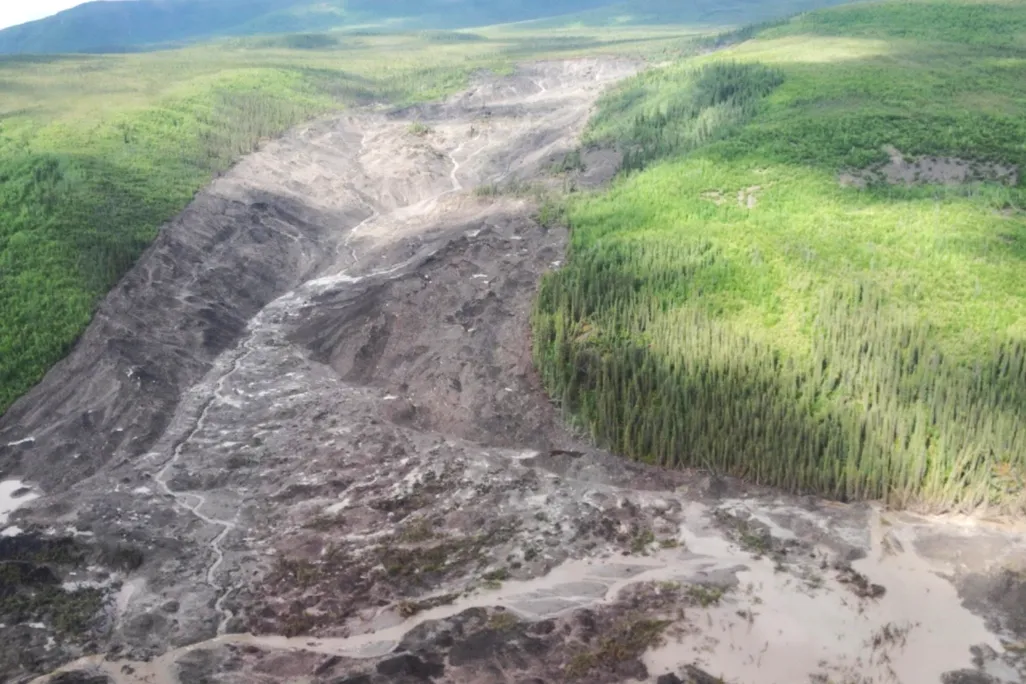
In 2017 and 2018, a pair of strange landslides moved huge masses of rock and dirt in Canada’s Northwest Territories. The events occurred in the central Mackenzie Valley, and one of them even dammed a river and created a lake.
The two natural disasters are part of a new class of landslides scientists are calling “permafrost detachment slides” in a study published in the journal Geophysical Research Letters in September. They may have been partially triggered by severe wildfires that occurred in 1995, which destabilized the ground and allowed the base of the permafrost to thaw. What’s more, these events may become more common as the planet continues to warm.
“It’s a very dramatic manifestation of the changing climate,” says study co-author Joseph Young, a geoscientist who conducted the work at the University of Alberta in Canada, to Matt Simon at Grist. “They’ve only started happening in the last 10, 15 years, and it’s a very drastic and abrupt change in the landscape.”
Young and his colleagues began the study after seeing something strange in the Northwest Territories in 2019. While conducting field research, they spotted large landslide scars in valleys that they knew were stable permafrost, or permanently frozen earth, reports Stephanie Pappas for Live Science.
To better understand what happened, the team homed in on two major events: the Johnson River slide in August 2017 that moved about 4.5 million cubic meters of dirt and rock, and the Redstone River slide in August 2018 that sent roughly 18 million cubic meters of debris tumbling down. Satellite imagery captured between 1980 and 2020 and field studies revealed some odd characteristics, the team found.
“Typically with permafrost, everything just thaws and melts in a slurry and moves like a mud downslope,” Young tells Live Science. “But with these large landslides, we found blocks of frozen material in the debris.”
The team monitored the temperature near the 1995 burn area near the slides and, for comparison, undisturbed forest from September 2020 to August 2022. Their data went into computer simulations, which allowed the researchers to investigate how the wildfires decades earlier may have affected the region.
Quick fact: Permafrost
The Northern Hemisphere’s permafrost regions cover an area equal to nearly 2.5 times that of the contiguous United States.
Their resulting hypothesis? The fires that swept through the landscape burned off the vegetation that usually keeps the permafrost cool on sunny days. “After about 20 years or so, that thermal signature from the burned forest can reach the base of permafrost,” Young tells Grist. “It’s slight, but it’s there.”
As the frozen ground warmed, it weakened and formed cracks, allowing water to seep in. That allowed the permafrost to thaw even more, destabilizing its bottom layers. Eventually, that caused the ground to detach and created the two landslides at the center of the study. They’re among more than 150 permafrost landslides in the area that happened around two decades after the severe wildfires, meaning the newly proposed mechanism could have contributed to many of these catastrophic events.
The findings suggest scientists need to better study what’s happening below the surface of permafrost regions, says Dmitry Nicolsky, a geophysicist at the University of Alaska Fairbanks who wasn’t involved in the work, to Nikk Ogasa at Science News. “We don’t know how [the ground] will move—it might go slowly or it might go catastrophically.”
Thankfully, Young says experts can look out for signs of an impending permafrost detachment slide and predict when it’s going to happen.
“That’s kind of the silver lining,” he tells Julia Parrish at the CBC. “It doesn’t just happen overnight; it kind of happens in a more progressive manner over the course of about 20 years after a fire, where you get a slow downslope movement of these slopes.”
