
Specialists Removed Three Thrilling, Century-Old Murals From the Walls of a French Monastery. Beneath, They Made ‘a Discovery for the History of Art’
Hidden under multi-paneled Symbolist murals by French artist Odilon Redon were sketches that he had drawn directly on the walls of the 11th-century Abbaye de Fontfroide

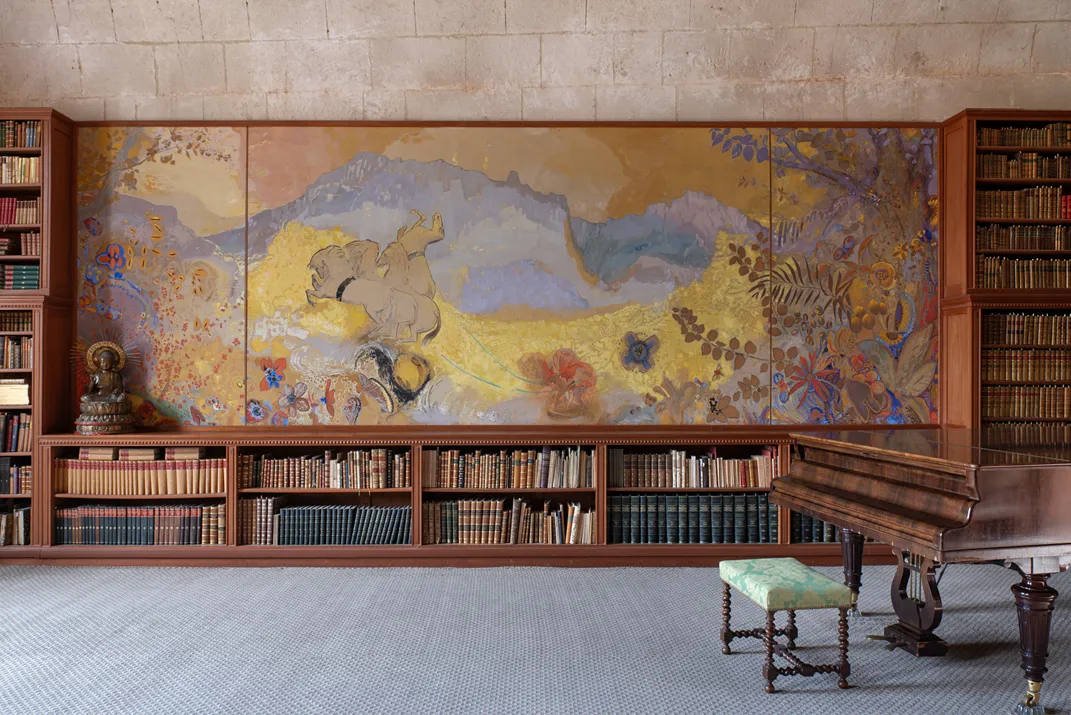
Since 1911, a stunning series of murals by the French Symbolist artist Odilon Redon have graced the library walls of the Abbaye de Fontfroide, an 11th-century Cistercian monastery in Narbonne, France.
Framed by wooden bookshelves, Le Jour (Day) and La Nuit (Night) are each more than 20 feet long and depict sweeping landscapes, animals, humans and vivid floral arrangements. Above the door, a third mural, Le Silence (Silence), shows a figure reminiscent of a monk with a finger raised to his lips, surrounded by yellow blooms.
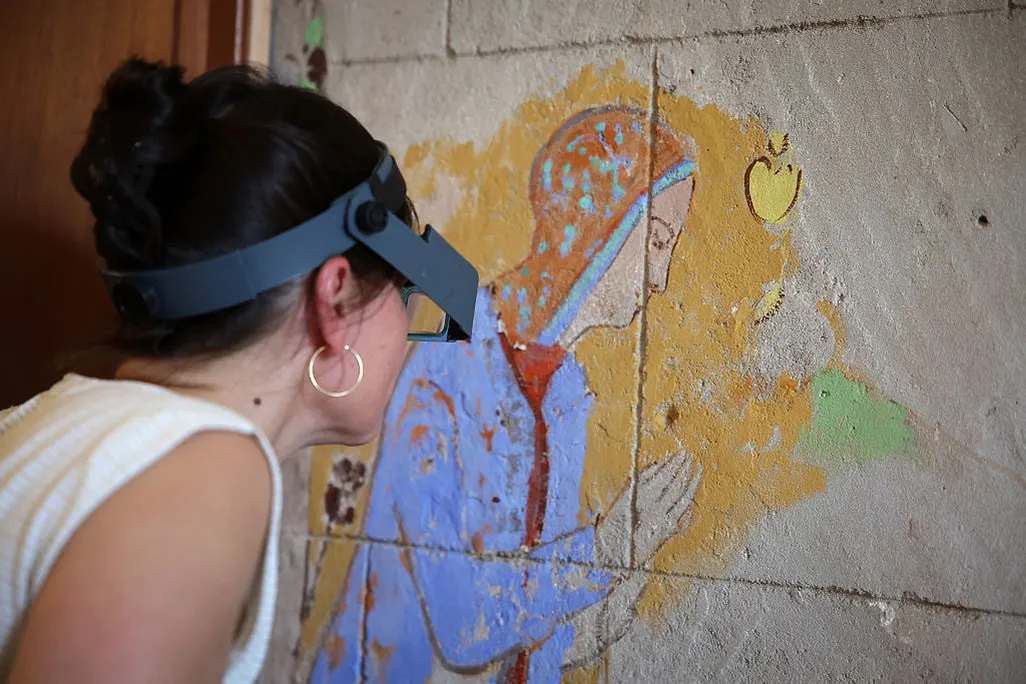
Earlier this year conservators removed the panels of the murals for the first time ever, to be loaned to an exhibition in Paris. Beneath, they discovered something no one had ever seen: colorful drawings, also by Redon, sketched directly onto the wall.
“It was a great surprise, nobody imagined the existence of these sketches,” Alexandre d’Andoque de Sériège, director of the abbey, tells ARTnews’ Maximilíano Durón. “It amuses just to imagine Redon painting them on the wall.”
In some instances, the sketches loosely resemble the figures and characters that appear on the finished murals placed over them, but they are noticeably smaller and more colorful. Researchers are unsure why Redon drew them. Were they tests for the final mural? Or were they aborted attempts at a fresco, painted directly on the library wall?
Redon first came to Fontfroide under the commission of Gustave Fayet, a friend and prominent collector who bought the former abbey in 1908. In a bid to transform it from a medieval religious space into a modern, creative one, Fayet funded all manner of renovations and installations, including a rebuilt church with art nouveau stained glass windows.
After an initial visit in 1908, Redon returned to the abbey for a 10-day stay in March 1910. With the renovations on the library completed, Redon had a better sense of how his murals, which he was painting in Paris, would appear in the space. D’Andoque de Sériège tells ARTNews he is “99 percent sure” that visit is when Redon drew the sketches, as a way to visualize the artwork in the room.
“A fresco in the library would have required Redon to stay very long in Fontfroide. It’s also physically a very hard job,” he adds.

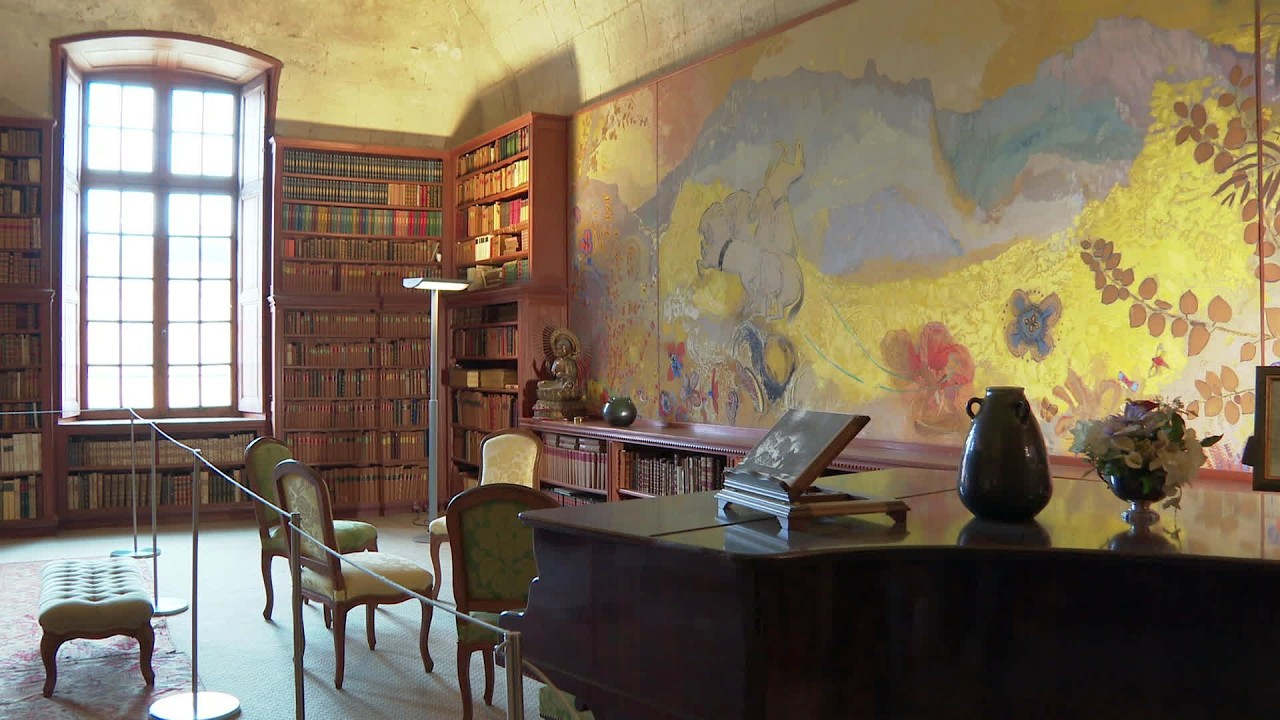
Seeing Le Jour, La Nuit and Le Silence is one of “the most thrilling art moments in the south of France,” the London Times’ Waldemar Januszczak writes. But in the monastery’s library, they can usually only be seen “twice a month on a special tour.”
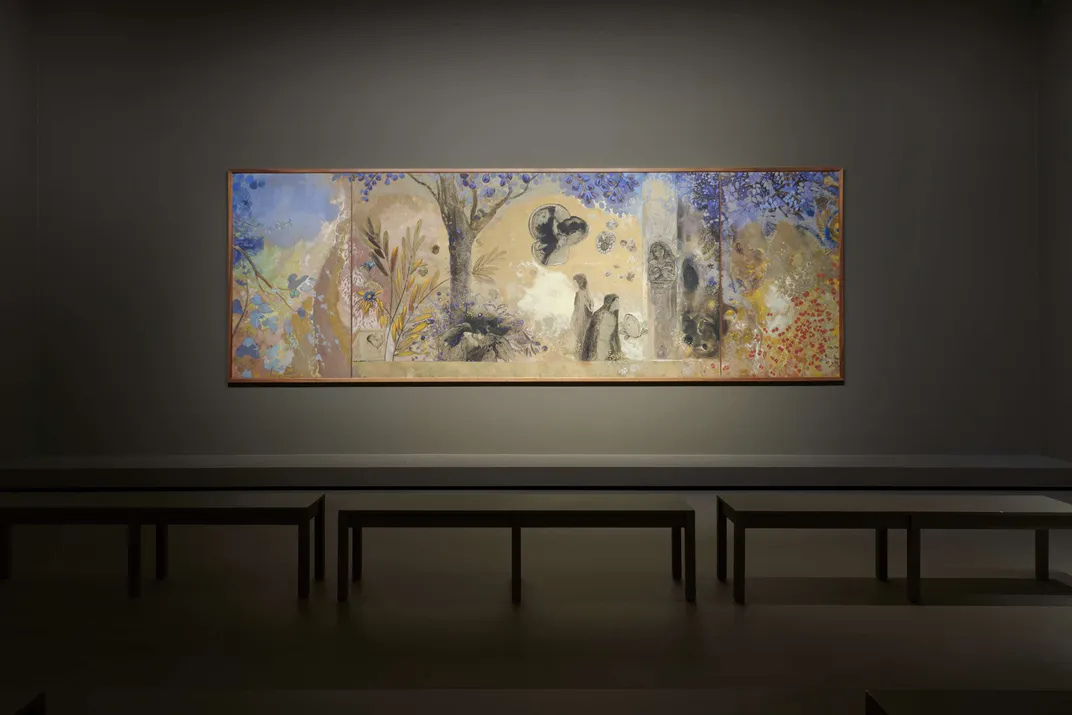
Removed from the walls for the first time ever, the panels are now among the 86 artworks by Redon currently on view at the Fondation Louis Vuitton in Paris as part of an exhibition about Fayet’s legacy.
“Gustave Fayet: Collector-Designer” displays more than 250 works which one composed Fayet’s collection, as well as 374 of his own creations. The exhibition will include 10 canvases by Vincent van Gogh, 78 by Paul Gauguin and a smattering of works by Edgar Degas, Paul Cézanne, Henri Matisse, Pierre-Auguste Renoir and many more.
“Though little known today, Fayet was one of the most influential advocates and pioneers of the avant-garde of his time … He was among the first to collect works by van Gogh, to exhibit Picasso and to establish a Gauguin ‘museum’ in his home in the heart of Paris, housing a collection of nearly 200 works and attracting artists and leading collectors of the time,” according to a statement.
Gauguin, in particular, was a passion for Fayet, who made his fortune in wine and also married rich. “Fayet bankrolled him and started buying every Tahitian picture he could get his hands on” before turning to Gauguin’s earlier works, set in France, per the Times.
The admiration appeared to be mutual. “Looking through your collection, I see that I am in the company of masters, and that makes me happy, but also rather shy,” Gauguin wrote in a letter to Fayet in 1902. “So, after all, there are people who know how to appreciate painting.”
Did you know? Redon and Poe
In 1882, Odilon Redon created À Edgar Poe, a series of six monochromatic lithographs inspired by the dreamy, gothic imagery of American writer Edgar Allen Poe.
At the end of the Fayet show, the three Redon murals will be returned to their original locations inside the Fontfroide library. Visitors will have only until March to come and see the newly exposed wall drawings before they are covered again.
“It’s a great emotion,” d’Andoque de Sériège tells France 3 Occitanie’s Théa Achterfeld and Frédéric Guibal. “First, because it’s a discovery for the history of art, but equally because it allows us to see that Redon truly invested himself in this work to the point that he did tests beforehand on the wall.”
“Gustave Fayet: Collector-Designer” will be on view at Fondation Louis Vuitton in Paris until March 8, 2027.
