
Sick Corals Can Heal With the Help of a ‘Magic Touch’ From Healthy Ones, Offering Hope for Heat-Damaged Marine Ecosystems
A coral is often a colony of tiny, genetically identical animals. New research suggests that when a bleached coral fragment comes into physical contact with a colorful, thriving clone, the pale one can revive within weeks

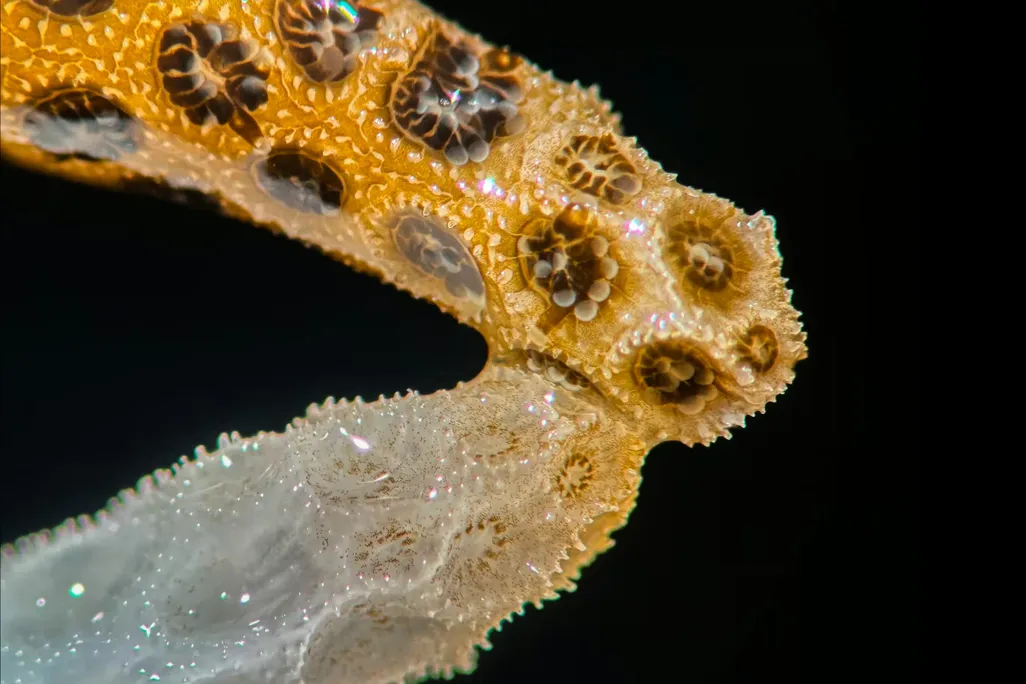
When humans need to feel rejuvenated, they touch grass. When corals need to recover from bleaching, they should touch a healthy clone, according to new research.
Lab experiments suggest that bleached coral can bounce back within weeks of coming into physical contact with a colorful, genetically identical piece of itself. While the remarkable healing method, published on October 14 in the journal Science Advances, likely can’t restore all the world’s sick corals on its own, the discovery could help inspire new recovery strategies.
“We were blown away [to] actually watch the healthy coral restore the color of the bleached corals essentially right before our eyes,” lead author Danny Collins, a marine biologist at Stanford University, tells KQED’s Danielle Venton. “It was so much faster and more intense than we ever expected.”
Most corals are colonies of small animals called polyps. Polyps in one colony have the same genetics, meaning they are clones of one another. When their watery environment gets too warm too fast, corals lose the colorful, beneficial algae in their tissues that provide energy. Without these vital partners, corals starve, are susceptible to harmful algae, and grow pale—hence the term bleached. Total recovery, if possible, can take months to years.

But in 2025, study co-author and Stanford marine scientist Steve Palumbi stumbled upon a strange possible cure. A healthy hunk of coral had accidentally tipped over and was touching a bleached piece from the same colony in a laboratory tank. At their point of contact, the pale fragment had regained its color, meaning the beneficial algae had returned.
Meanwhile, Collins had been brainstorming about how dangerous bacteria can enter corals when contaminated materials, like plastic debris, touch them. He wondered if researchers could leverage this phenomenon to help corals instead.
“Harmful bacteria enter corals through physical contact,” Collins explains in a statement. “We were curious about what would happen if we used contact to reintroduce something good—the beneficial algae from healthy corals.”
So, the team tested the idea with ten coral fragment pairs—each with one bleached and one colorful piece roughly 1.5 inches long—from the same colony. Half were set up so the sick and healthy fragments were touching, while the others had a millimeters-wide gap between the two branches. All bleached corals touching healthy clones fully healed within seven weeks, but the bleached fragments in non-touching pairs fared poorly, and some died.
“What was most exciting about this was seeing the remarkable potential that bleached corals have to rapidly recover,” Collins tells SFGate’s Anna FitzGerald Guth. “These bleached corals are often treated as a lost cause.”
Quick fact: Good news for wild corals
This past summer, researchers reported that more than 64,000 square miles of coral reefs might be more resilient to the warming ocean than previously thought.
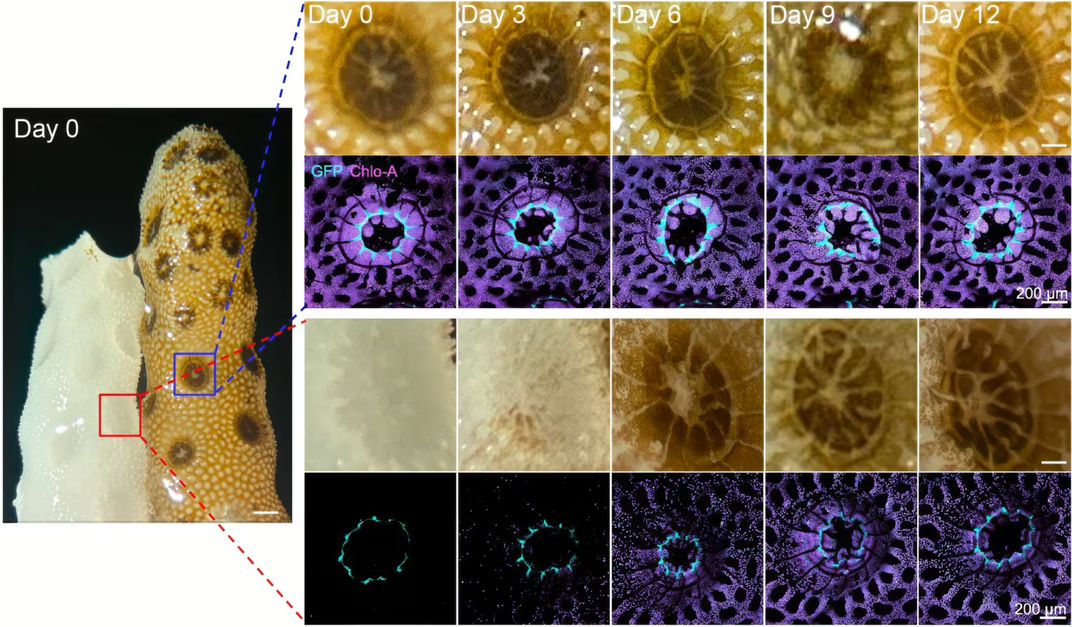
Taking a closer look under a high-powered microscope revealed that physical contact between two coral clones allowed them to align little channels in their tissues. The healthy coral could then send beneficial algae and nutrients to the stressed one. The team saw transferred material in sick corals after just three days of contact.
What’s more, the fragments didn’t have to touch for the entire duration of the recovery. After roughly one week of contact, bleached corals could disconnect and continue recovering independently. Separated fragments even recovered at the same rate as coral pairs that stayed together. Further experiments revealed that the speedy recovery was largely thanks to algae replicating at record-setting rates inside the sick coral, rather than continuous transfer from the healthy coral.
While the discovery is exciting, it won’t directly translate into a recovery method in the wild, Collins tells Agence France-Presse’s Issam Ahmed. “We likely will not be touching corals to each other on reefs,” he says. It’s impractical to create healthy clones of all corals before bleaching events, per KQED.
Additionally, the solution won’t help dead corals, Terry Hughes, a marine biologist at James Cook University in Australia who wasn’t involved in the study, tells the New York Times’ Raymond Zhong. He adds that the best way to aid corals is to reduce emissions of planet-warming greenhouse gases.
The findings are still “super interesting,” says Andrea Grottoli, a coral researcher at Ohio State University who also wasn’t involved in the study, to the outlet. She says that the work could pave the way to “more organic” ways to help corals. Reefs are invaluable marine habitats. Even though they make up merely 0.01 percent of the ocean floor, they support about a quarter of all sea life.
