
See Visions of the Past and Future in This New York City Exhibition on the Renaissance Roots of Tarot Cards
The Morgan Library & Museum traces the history of beautifully illustrated tarot cards from their origins as a card game to modern occult fascination
/https://tf-cmsv2-smithsonianmag-media.s3.amazonaws.com/accounts/headshot/Sonja_headshot.png)
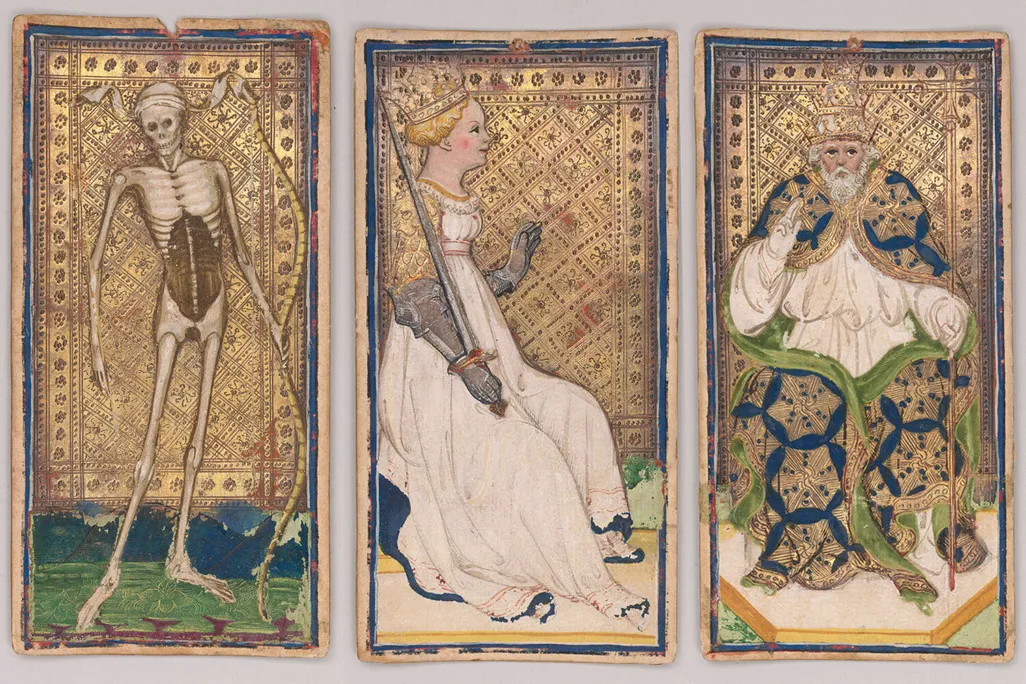
Fools, hanged men and high priestesses, some more than 500 years old, are taking up residence in New York City this summer. At an upcoming exhibition, visitors will be able to look upon a trove of colorful, gilded tarot cards—old and new.
“Tarot! Renaissance Symbols, Modern Visions” opens this month at the Morgan Library & Museum, the former private library of financier J. P. Morgan. According to a statement from the museum, the show will be presented in two simultaneous parts: Renaissance Symbols, which focuses on the history of tarot, and Modern Visions, which highlights decks created by contemporary artists.
“‘Tarot!’ offers fresh perspectives on a popular and widely known subject through a uniquely art-historical lens,” says library director Colin B. Bailey in the statement. “This exhibition marks the culmination of years of careful research into both the history and creation of a celebrated Renaissance art form and the broader history of tarot, tracing its influence up to the present day, where contemporary artists continue to draw on its imagery to create sublime works of art.”
/https://tf-cmsv2-smithsonianmag-media.s3.amazonaws.com/filer_public/6f/35/6f35e167-9db4-40ce-b449-d9006a1f045b/010-time.jpeg)
The exhibition’s oldest artifacts—which inspired the show—are the Visconti-Sforza tarot cards. They’re named for the wealthy Viscontis and Sforzas of Milan, the two Renaissance noble families who commissioned the cards in the 15th century to commemorate a marriage. The extravagant deck of portraiture, painted with gold and silver, is attributed to the Italian painter Bonifacio Bembo.
Dating to between 1450 and 1480, the Visconti-Sforza cards are some of the oldest tarot cards in existence. Seventy-four of the 78 original cards survive today; The Devil, The Tower, Three of Swords and Knight of Coins are missing. Most of the cards sport a miniature gilded portrait, depicting a fair-haired character like the Juggler or the Empress.
The Visconti-Sforza deck is divided among multiple institutions. The Accademia Carrara loaned its cards to the Morgan for “Tarot!” marking the first time most of the deck has been displayed together in North America. The exhibition will also include some cards from two closely related decks: the Visconti di Modrone tarot from Yale University and the Brambilla tarot from the Pinacoteca di Brera in Milan.
/https://tf-cmsv2-smithsonianmag-media.s3.amazonaws.com/filer_public/10/c5/10c54172-ae90-41cd-bd19-9a5d444d9f66/plate_8_1_bembo_strength_visconti_modrone_beinecke_33220616.jpeg)
Today, tarot cards are used as a method of divination. People “read” tarot cards and interpret them as fortunes. But in 15th-century Italy, tarot was simply a “courtly game of skill,” per the statement. A typical Italian deck of playing cards had been composed of four suits: cups, swords, batons and coins. Sometime in the 1400s, an unknown innovator added 21 trump cards, or tarocchi, wrote Metropolitan Museum of Art curator Tim Husband in 2016.
The tarocchi are all figural, representing characters like skeletal Death or objects like the Chariot. They’re now known as a deck’s Major Arcana, while the regular cards are called the Minor Arcana. They reflect ideas probably familiar to their Renaissance creators. “But today, the symbology of each card is really difficult for us to understand,” art historian Cristina Dorsini told Smithsonian magazine’s John Last in 2025.
/https://tf-cmsv2-smithsonianmag-media.s3.amazonaws.com/filer_public/8e/34/8e34a904-86b2-45d9-baa3-0e2cda417270/rider_waite_smith_fool_mlm210428_454473v_0005.jpeg)
The tarocchi were once simply pieces in a trick-taking card game. But in the late 18th century, some writers declared that tarot cards had ancient Egyptian origins—an unsubstantiated claim, per the Victoria & Albert Museum. So began the cards’ mystification. By the late 19th century, they’d gained a firm association with the occult and fortune-telling.
Fun fact: Ancient games
One of the world’s oldest games is senet, an ancient Egyptian board game. The goal was to get from one end of the board to the other. King Tutankhamun was buried with four senet boards made of ebony wood and ivory, per the Tūhura Otago Museum.The exhibition’s second section, Modern Visions, traces the development of tarot throughout the 20th and 21st centuries, examining Britain’s Occult Revival, Surrealism, the 1960s and ’70s in the United States and the last decade. The occult revival will be illustrated by perhaps the most famous tarot deck of all time: the Rider-Waite-Smith cards. Conceived by British mystic Arthur Edward Waite and manufactured by publisher William Rider & Son, the deck was illustrated by artist Pamela Colman Smith.
/https://tf-cmsv2-smithsonianmag-media.s3.amazonaws.com/filer_public/fe/2b/fe2b09e4-db84-41a6-b2ca-78e9fa0af382/screenshot_2026-06-11_41531_pm.png)
Representing 21st-century tarot will be a “broad sampling of contemporary artists working with tarot imagery in a variety of ways, both figurative and abstract,” per the statement. They include Elizabeth Colomba, Elijah Burgher, Kerstin Brätsch and Chris Ofili.
“Tarot! Renaissance Symbols, Modern Visions” will be on display at the Morgan Library & Museum in New York City from June 26 through October 4, 2026.
/https://tf-cmsv2-smithsonianmag-media.s3.amazonaws.com/accounts/headshot/Sonja_headshot.png)