
See the Sweeping Dune Walls and 125-Foot Bas-Relief Sculpture at the National Mall’s Newest Memorial, Dedicated to Veterans of Operations Desert Shield and Desert Storm
The Desert Shield and Desert Storm Memorial is an oasis-like place for honoring the Americans who served and lost their lives in combat to liberate Kuwait in the early 1990s

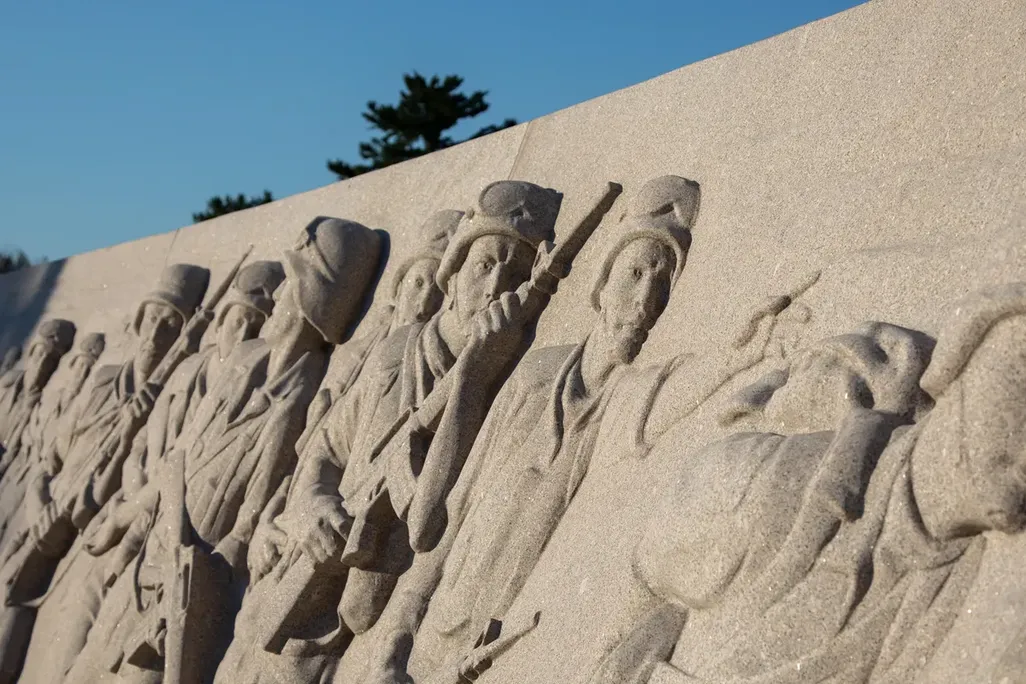
In 1990 and 1991, nearly 700,000 American troops took part in Operation Desert Shield and Operation Desert Storm, a multinational effort to drive Iraqi forces out of Kuwait. Now, 35 years later, those veterans have a memorial on the National Mall.
Over the weekend, officials in Washington, D.C. formally dedicated the new Desert Shield and Desert Storm Memorial, a permanent place for honoring the Americans who served and the roughly 300 who lost their lives during the two operations.
“The Desert Shield and Desert Storm Memorial honors the courage of the Americans who answered our nation’s call, the sacrifice of those who never returned home and the families who supported them,” Secretary of the Interior Doug Burgum says in a statement. “Here on the National Mall, their service will be remembered with the gratitude and respect it deserves, and their legacy will endure for generations.”
The memorial honors U.S. service members who participated in the two core military phases of the Gulf War. In August 1990, at the direction of Saddam Hussein, Iraqi forces invaded neighboring Kuwait, seeking control of its oil resources and claiming that Kuwaiti territory was part of Iraq. The invasion prompted widespread international criticism, with world leaders calling on Iraq to withdraw from Kuwait.
In response, the United States launched Operation Desert Shield, sending troops to Saudi Arabia to protect the country from a potential Iraqi attack and build an international coalition of countries committed to liberating Kuwait.
When Iraq refused to leave Kuwait despite diplomatic efforts and economic sanctions, the coalition launched Operation Desert Storm in January 1991, beginning with airstrikes against Iraqi military targets. A ground offensive followed in late February, driving Iraqi forces out of Kuwait and bringing the fighting to an end after roughly 100 hours of ground combat.
“It’s a part of history and it feels like sometimes it’s forgotten,” Deborah Trone, a veteran who deployed with the 10th Mobile Army Surgical Hospital, told the Colorado Springs Gazette’s Mary Shinn while watching a livestream of the memorial dedication ceremony from Colorado.
Located just north of the Lincoln Memorial, the $42 million memorial was funded entirely through private donations, including from individuals, Veterans of Foreign Wars chapters across the country and the State of Kuwait. It will be managed by the National Park Service.
Designed as a place for reflection and contemplation, the memorial draws inspiration from a desert oasis, featuring curving walls reminiscent of sand dunes and a shaded grove with trees and bubbling water. The memorial’s layout is meant to symbolize the “left hook” tactical maneuver led by U.S. Army General H. Norman Schwarzkopf during Operation Desert Storm, according to CSO, one of the architecture firms that helped design the memorial.
Did you know? Flying Warthogs
- Operation Desert Storm marked the first time that the Fairchild Republic A-10 Thunderbolt II—an attack plane better known as the “Warthog”—flew in combat.
- During the operation, Warthogs destroyed an estimated 900 tanks, 2,000 military vehicles and 1,200 artillery pieces.
As they walk along the clockwise, circular path, visitors will encounter two dune-shaped walls made of sand-colored granite. One, called the Storm Wall, features a 125-foot bas-relief created by sculptor Emily Bedard that moves chronologically from the buildup of the operation to the conflict and liberation of Kuwait. The other, called the Inscription Wall, has two commemorative wreaths and inscriptions honoring those who served and those who died during the operations.
The heart of the memorial is the Unity Shield Fountain, a 28-foot-wide bronze centerpiece engraved with the names of the 41 nations that came together to form the Gulf War coalition. Two stainless-steel sculptures—one depicting an American bald eagle, the other depicting a Kuwaiti falcon—symbolizes the ongoing partnership between the United States and Kuwait.
“Our goal is for visitors to come in and be inspired, make an emotional connection ... that will make them want to learn more about this very important time in history and realize that it is not a 100-hour war,” Scott Stump, a Desert Storm veteran who led the effort to build the memorial at the National Desert Storm Memorial Association, tells NBC4 Washington’s Mark Segraves.
