
See the ‘Mona Lisa of Illuminated Manuscripts,’ a 600-Year-Old Bible Covered in Intricate Illustrations
Created between 1455 and 1461, the Borso D’Este Bible is currently on view in the Italian Senate in Rome
/https://tf-cmsv2-smithsonianmag-media.s3.amazonaws.com/accounts/headshot/Sonja_headshot.png)
/https://tf-cmsv2-smithsonianmag-media.s3.amazonaws.com/filer_public/5e/ad/5ead34cc-e428-441a-a142-478c4f84b32c/gettyimages-541332759.jpeg)
The Borso D’Este Bible rarely goes on display. The 15th-century, two-volume illuminated manuscript filled with miniature paintings of gold and lapis lazuli is usually locked in a safe at the Gallerie Estense in Modena, Italy. But earlier this month, the text was packaged in bubble wrap and transported to Rome, where it’s now on display in the Italian Senate.
The text is the “Mona Lisa of illuminated manuscripts,” says Alessandra Necci, director of the Gallerie Estense, per the Associated Press’ Nicole Winfield and Paolo Santalucia.
The Bible was commissioned by Borso D’Este, who became duke of Ferrara in northeastern Italy in the mid-1400s. Borso enlisted a team of artists to create the illuminated manuscript, which functioned as a symbol of both faith and wealth.
Quick fact: What is an illuminated manuscript?
Illuminated manuscripts are handwritten books containing colorful decorations, including colorful paintings and gold and silver leaf.
The Borso D’Este Bible represents the “zenith of Ferrarese miniature painting and one of the highpoints of Italian Renaissance manuscript illumination,” according to the Library of Congress, which owns a facsimile copy of the book. The text was created by Pietro Paolo Marone, a calligrapher from Bologna, and its 1,202 illuminated pages were decorated by a team of artists led by Taddeo Crivelli and Franco dei Russi. The volume was finished between 1455 and 1461.
The Borso D’Este Bible “represents one of the finest expressions of the art of illumination, combining exquisite ornamental refinement, artistic mastery and religious inspiration,” per the senate. According to Italy’s culture ministry, its two-column pages are decorated with plants, animals, the duke’s coat of arms and scenes from the Bible.

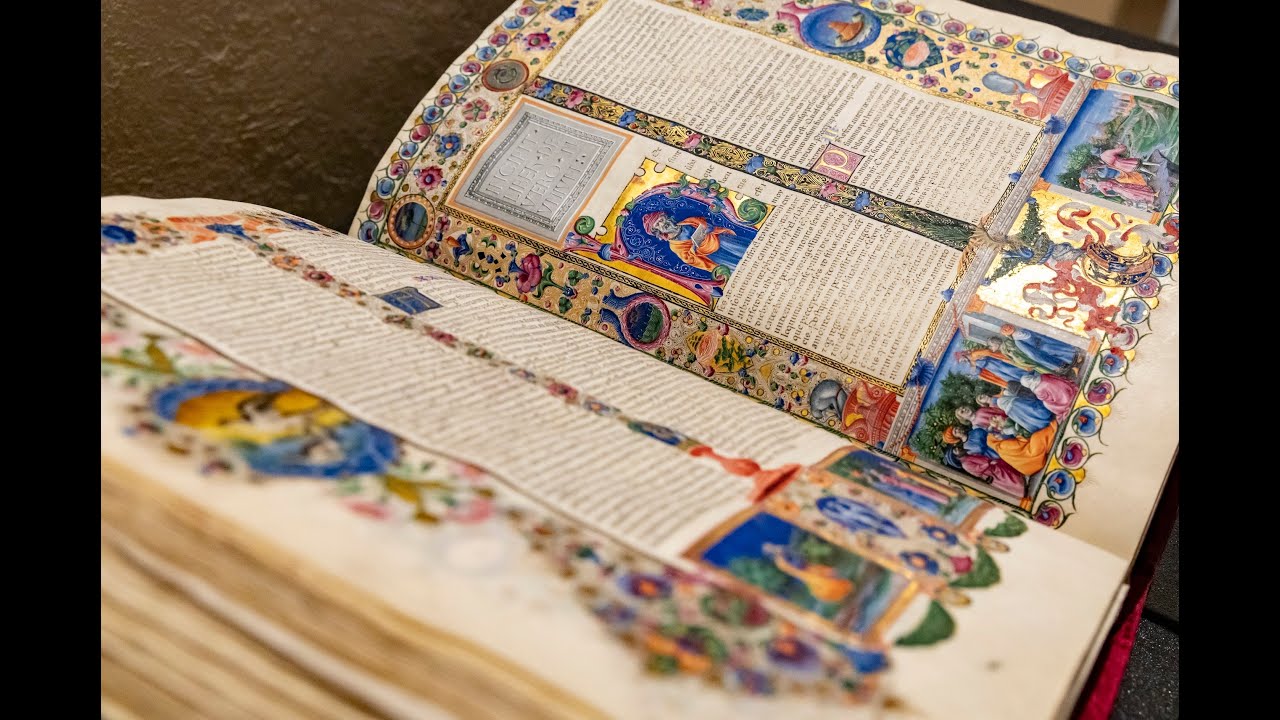
The intricately decorated text was extremely expensive to produce. Borso D’Este spent so much money because he “wanted to celebrate not only the sacred book par excellence but also the elevated idea he had of himself and his dynasty,” Necci says, per the AP.
The Este family eventually moved to Modena, and they brought the book with them. Because they were part of the Habsburg family, the volume eventually went to Empress Zita of Bourbon-Parma, who sold it to an antiquarian in Paris. It was then purchased by the Italian entrepreneur Giovanni Treccani, who donated it to the Italian government.
/https://tf-cmsv2-smithsonianmag-media.s3.amazonaws.com/filer_public/da/d4/dad4a85f-5f0f-4815-a0c0-11ccabfc366c/gettyimages-541332763.jpeg)
While the text is on display in the senate, it will remain behind humidity-controlled glass. Visitors will be able to digitally flip through the book using nearby touch screens loaded with high-resolution images of its pages.
The Bible’s display is part of celebrations related to the Jubilee Year. For centuries, the Catholic church has celebrated a Jubilee every 25 years. It’s meant to be a year of forgiveness and reconciliation, and the theme of 2025’s Jubilee is “Pilgrims of Hope.”
/https://tf-cmsv2-smithsonianmag-media.s3.amazonaws.com/filer_public/a1/af/a1af443e-4382-4350-8daa-1ec1b5fcde3b/gettyimages-527772823.jpeg)
Archbishop Rino Fisichella, head of the Vatican’s Jubilee celebrations, said at the Bible’s unveiling that he hopes visitors will be inspired to read their own Bibles after seeing the beauty of the Borso D’Este version, reports the AP. Fisichella called the illuminated text a “provocation” that forces readers to contemplate both its beauty and the beauty of the text inside.
The Borso D’Este Bible is on display in the Italian Senate in Rome through January 16, 2026.
/https://tf-cmsv2-smithsonianmag-media.s3.amazonaws.com/accounts/headshot/Sonja_headshot.png)