
See the 2,500-Pound Bronze Bison as They Arrive at Their New, Permanent Place at the Smithsonian’s National Museum of Natural History
More than a century ago, the massive mammals actually grazed beside the Smithsonian Castle. As of today, two large sculptures continue that legacy as they flank the museum’s main entrance
/https://tf-cmsv2-smithsonianmag-media.s3.amazonaws.com/filer_public/45/86/45865779-777e-476a-8a3d-158172cd53da/img_5994.jpg)
A decade ago, the bison received a long overdue title: the official mammal of the United States. An acknowledgment of its profound cultural, historical and ecological importance, the act of Congress asserted what biologists had known for a while, that bison (often called “buffalo”) are actually a distinct species found nowhere else in the wild but North America.
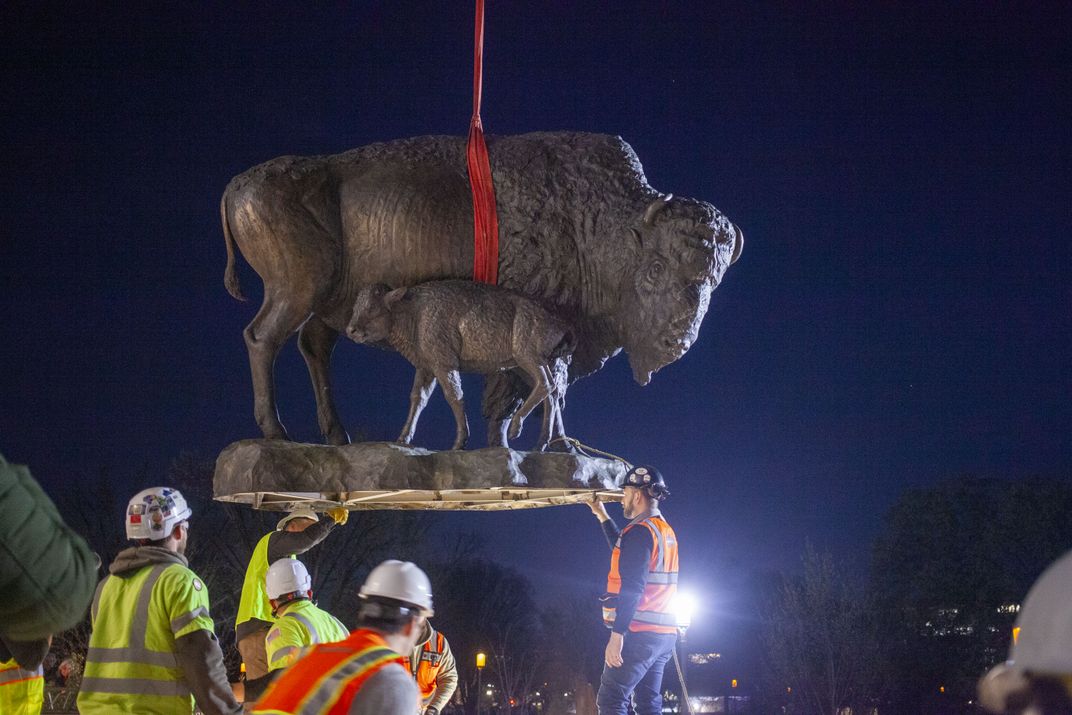
Starting today, the bison gets even more acclaim. As part of the Smithsonian Institution’s commemoration of the 250th anniversary of the founding of the United States, three bronze bison—a bull, cow and calf—now grace the entrance of the Smithsonian’s National Museum of Natural History.
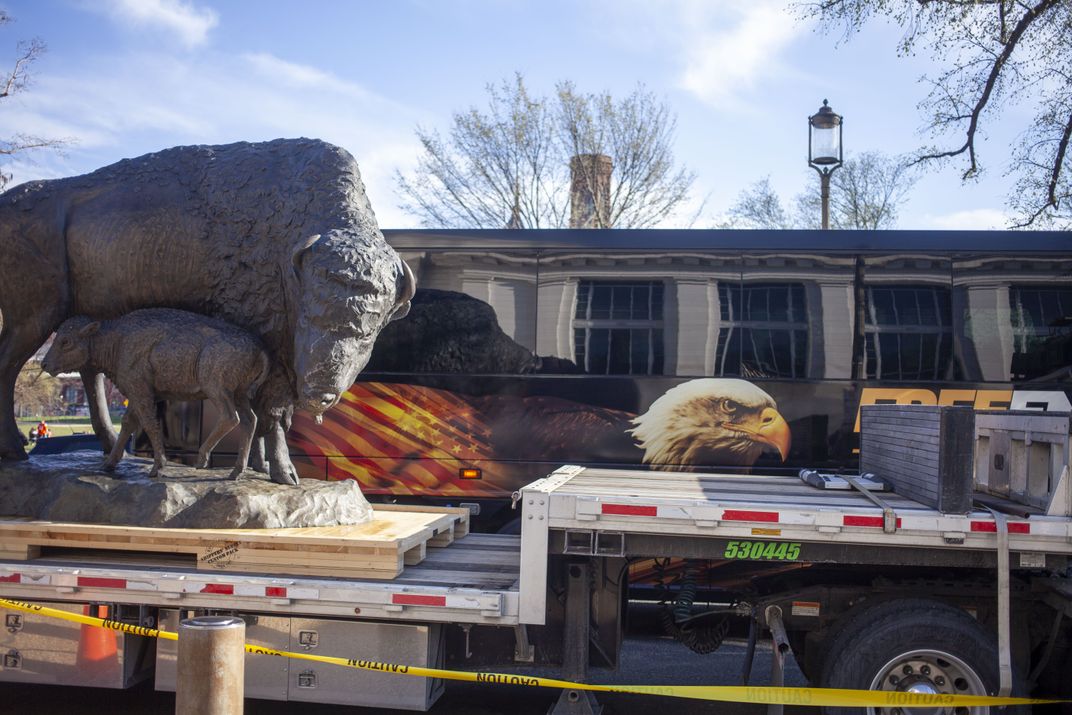
Award-winning sculptor Gary Staab was commissioned to design the colossal bronze trio. The bison loom at a massive 125 percent scale, a decision that was made with meticulous testing—including paper cutouts. According to Kirk Johnson, the director of the museum, their team experimented with paper replicas to gauge maximum physical impact in relation to the building.
/https://tf-cmsv2-smithsonianmag-media.s3.amazonaws.com/filer_public/e1/60/e160f529-108e-4749-938b-da6fd75c3884/img_5762.jpg)
/https://tf-cmsv2-smithsonianmag-media.s3.amazonaws.com/filer_public/51/cd/51cdaa4f-3734-4a5d-9b3d-1754185662a9/img_5813.jpg)
The bronze bison are modeled after zoologist William Hornaday’s taxidermy collection, which was on view at the Smithsonian from 1888 to 1957. In the late 1800s, four bison actually lived behind the Smithsonian Institution Building and grazed on the National Mall. The Smithsonian’s National Zoo—also founded by Hornaday—started with those bison in 1891, all of which traveled from Nebraska by train.
These efforts were the result of a movement to save the bison, which were on the brink of extinction at the turn of the 20th century. As the United States expanded westward, bison became targets. Railroads cut through migration routes. Commercial hunters killed for sport and trade. By the 1880s, fewer than a thousand bison remained. Saving them required something radical for its time: cooperation across deeply different worlds.
/https://tf-cmsv2-smithsonianmag-media.s3.amazonaws.com/filer_public/e2/0e/e20e9e17-85e6-4655-81db-615b99190142/img_5897.jpg)
/https://tf-cmsv2-smithsonianmag-media.s3.amazonaws.com/filer_public/b7/8e/b78e7661-66be-40da-b062-ca5feccc57f8/img_5924.jpg)
One of the loudest early voices was Hornaday, a zoologist who had witnessed the slaughter firsthand. Originally, he traveled west to collect a bison specimen for the Smithsonian Institution—only to discover that the herds were already nearly gone. What he saw transformed him from collector to advocate, resulting in his partnership with other burgeoning conservationists.
“You realize that in order for something to be saved in this country, people have to understand it,” says Johnson. He adds that Washington, D.C. is “really an amazing location.”
“It's where our nation wraps itself in museums, encloses itself. And museums are really one of the few portals of knowledge—be it history or science or culture—where you can access it at any point in your life for free.”
To celebrate the bison’s return to the Smithsonian, the two statues traveled cross-country from a foundry in Colorado to D.C. The week-long tour included multiple stops at regional museums.
“We’re driving across the range of bison,” explains Johnson. “If you look at the fossil record, they were over the entire continent.”
/https://tf-cmsv2-smithsonianmag-media.s3.amazonaws.com/filer_public/c5/22/c5227955-14a0-4c0d-bb04-8be2f1cc165a/img_6065.jpg)
/https://tf-cmsv2-smithsonianmag-media.s3.amazonaws.com/filer_public/91/39/9139ef92-56d1-474b-840e-10d258f7fa91/img_6050.jpg)
This upcoming installation is also a commemoration of the National Museum of Natural History’s new exhibition, “Bison: Standing Strong,” opening on May 7. The exhibition will trace the bison’s development thousands of years ago to present-day life on the Great Plains. A wide-ranging collection of fossils, specimens and other anthropological objects will round out the display.
“The whole arc of the wildlife conservation movement starts here with those bison,” says Johnson. “It’s all part of the big American story about how we interact as people with the natural world in North America.”
For millennia, bison kept local environments and communities thriving. From the Arapaho to the Cheyenne to the Cree, oral histories describe the bison as both a gift and a relative. The Lakota called them Pté Oyate, or “buffalo nation.”
The installation is a reminder that conservation is not just about saving a species, It is about restoring relationships—between people and land, past and future, and responsibility and hope.
/https://tf-cmsv2-smithsonianmag-media.s3.amazonaws.com/accounts/headshot/michelle2.png)