
Secrets From Centuries of Paris History Are Emerging From Archaeological Digs After the Notre-Dame Cathedral Fire
Ahead of planned redevelopment around the iconic Gothic landmark, researchers are digging into the city’s past, through medieval and Roman layers
/https://tf-cmsv2-smithsonianmag-media.s3.amazonaws.com/accounts/headshot/SarahKuta.png)
/https://tf-cmsv2-smithsonianmag-media.s3.amazonaws.com/filer_public/27/aa/27aa2593-9660-43a6-844d-52af3a7fd996/c69a7443_1.jpg)
Archaeologists are conducting excavations near Notre-Dame Cathedral, offering a rare glimpse into centuries of French history.
The famed cathedral, located in the heart of Paris, reopened in late 2024 after suffering severe damage in a 2019 fire. Now, officials want to add 160 new trees to the cathedral’s surroundings and transform the underground parking lot into a visitor center, among other updates.
But, before they can do so, archaeologists must first investigate and protect the remnants of the city’s past hidden in the ground below. The excavations started in January and are expected to take around eight months to complete, according to an update from the city’s archaeology department.
/https://tf-cmsv2-smithsonianmag-media.s3.amazonaws.com/filer_public/8b/c1/8bc1198f-0d8c-4d73-a9f5-bf7226540709/2026-r02-jp0308.jpg)
So far, researchers have slowly dug 13 feet beneath the surface, not far from where visitors line up to enter the iconic Gothic landmark each day. Already, they’ve recovered hundreds of objects from various eras, including some dating back to the Roman occupation of the city nearly 2,000 years ago.
“It makes Notre Dame feel alive again,” Emily Carter, a 34-year-old mother visiting the cathedral with her two children from Manchester, England, tells Thomas Adamson and Jeffrey Schaeffer of the Associated Press. “You come to see the cathedral, then realize there’s another city under your feet. That’s almost more moving.”

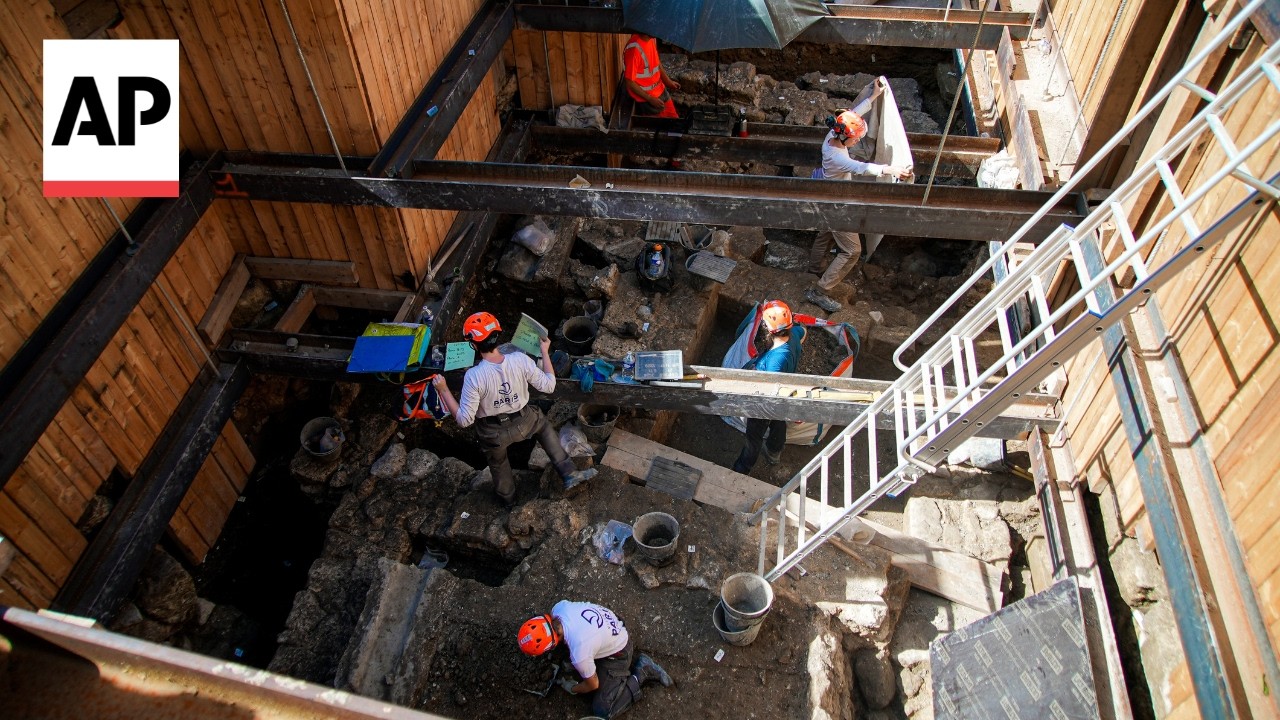
Notre-Dame is located on the Île de la Cité, a small, natural island in the Seine River. Construction of the cathedral began in 1163 and was largely finished by the mid-14th century. But before the cathedral’s iconic spire rose into the sky, the site already had a long history.
In the fourth and fifth centuries, it was home to a Roman settlement. From the sixth to the tenth centuries, the site housed Merovingian and Carolingian grain pits. And during the Middle Ages, it was full of medieval houses divided by a single street. Researchers have discovered the cellars of those homes, as well as the latrine pits used for collecting human waste and trash.
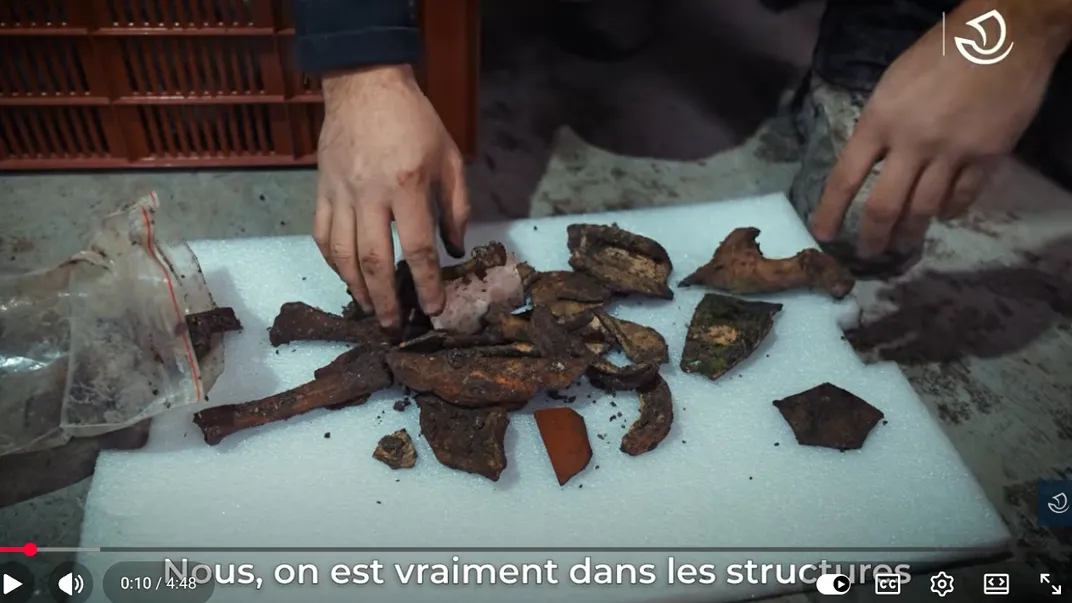
The dig has turned up numerous artifacts, including shards of medieval pottery with mysterious reddish markings and coins bearing the countenance of the Roman emperor Constantine. They’ve also uncovered animal bones, metal pieces and intact jugs and cups.
After archaeologists carefully remove each object, they send them off to the city’s archaeology laboratory for further conservation and study. There, specialists are cleaning, analyzing carbon-dating and, if necessary, reconstructing the artifacts.
“It’s a rare opportunity for us to work on something that’s tangibly going to make a difference to the history of Paris,” Lucie Altenburg, a conservator with the Paris archaeology unit, tells the AP.
Key takeaway: Historic fire
On April 15, 2019, a fire broke out during evening mass at Notre-Dame. Firefighters responded quickly and were able to save much of the historic structure, but the blaze caused the cathedral’s wooden roof and spire to collapse.
Hundreds of conservationists and craftsmen spent more than five years restoring and repairing the damaged landmark. During that process, they got an unprecedented look at the cathedral’s inner workings and hidden mysteries thanks to “the incredible adventure of the Notre Dame construction site,” as Dominique Garcia, the French National Institute for Preventive Archaeological Research, described it to Nathaniel Herzberg of Le Monde in 2022.
For instance, they discovered large, 800-year-old iron staples holding together the stone blocks in the upper walls, nave aisles and tribunes, which allowed them to build a sturdy structure that appears to be elegant and delicate.
Archaeologists digging beneath the church’s nave also discovered two mysterious lead coffins. One belonged to an 83-year-old high priest named Antoine de la Porte who died in 1710, while the other contained the remains of an unknown horseman who may have been Joachim du Bellay, a French Renaissance poet who died in 1560.
Additionally, researchers found pieces of the cathedral’s original 13th-century rood screen, a decorative partition that separated the choir from the nave, some of which still bore traces of their original paint. They also unearthed painted sculptures and the remnants of a 19th-century brick pipe underground heating system.
/https://tf-cmsv2-smithsonianmag-media.s3.amazonaws.com/accounts/headshot/SarahKuta.png)