
Scientists Ranked Hundreds of Spider Species by Running Speed. Australia’s Huge, Hairy Brown Huntsman Came Out on Top
The brown huntsman can sprint at a maximum speed of eight miles per hour, although it can only maintain that pace for a fraction of a second. The research will lead to a better understanding of the evolution and biomechanics of arachnids
/https://tf-cmsv2-smithsonianmag-media.s3.amazonaws.com/accounts/headshot/Sara_-_Headshot_thumbnail.png)
/https://tf-cmsv2-smithsonianmag-media.s3.amazonaws.com/filer_public/9d/f3/9df3e6fc-5c7b-48c3-b188-7178945996ac/huntsman_inside_lampshade.jpg)
Arachnophobes, beware: You don’t want the brown huntsman spider coming at you. The creepy-crawly might be the fastest spider species in the world—and its top speed outpaces the average human jogger.
The roughly hand-size hairy arachnid came out on top in an analysis of running speeds across 258 spider species, which was posted on the pre-print server bioRxiv on June 15. The findings, which have not been peer-reviewed, help scientists better understand the biomechanics and evolution behind the eight-legged critters’ movements.
Unlike other aspects of physical performance, running doesn’t directly correlate to an animal species’ size. The fastest creatures, such as cheetahs, are mid-size. To learn more about the factors that determine maximum running speeds, the researchers behind the new study focused on spiders from across the globe.
For about two-thirds of the analyzed species, the team studied live spiders. The animals were individually placed in a box with grid paper on the bottom, and a high-speed camera tracked their movements.
Most of the critters started running after a gentle nudge with a paintbrush or the blunt end of a pencil, though some were a bit harder to get moving. “This project would have been over in a month if spiders could understand English,” says Shreyas Kuchibhotla, a study co-author and spider behavior researcher who conducted the work at Imperial College London, to James Woodford at New Scientist. “Tarantulas aren’t built for running; they’d much rather stand their ground, so they had to be blown at with puffs of compressed air.”
The rest of the spider species’ data came from previously published studies by other researchers.
Analyses revealed that the speediest of the examined spiders is the brown huntsman—either Heteropoda jugulans or H. cervina, since they are hard to tell apart—which lives in eastern Australia. The spider’s speed topped out at about eight miles per hour, although it can only keep that pace for a fraction of a second. The critter’s average sustained speed is around 4.5 mph, which is still pretty fast. For comparison, the average human jogging speed is four to six mph.

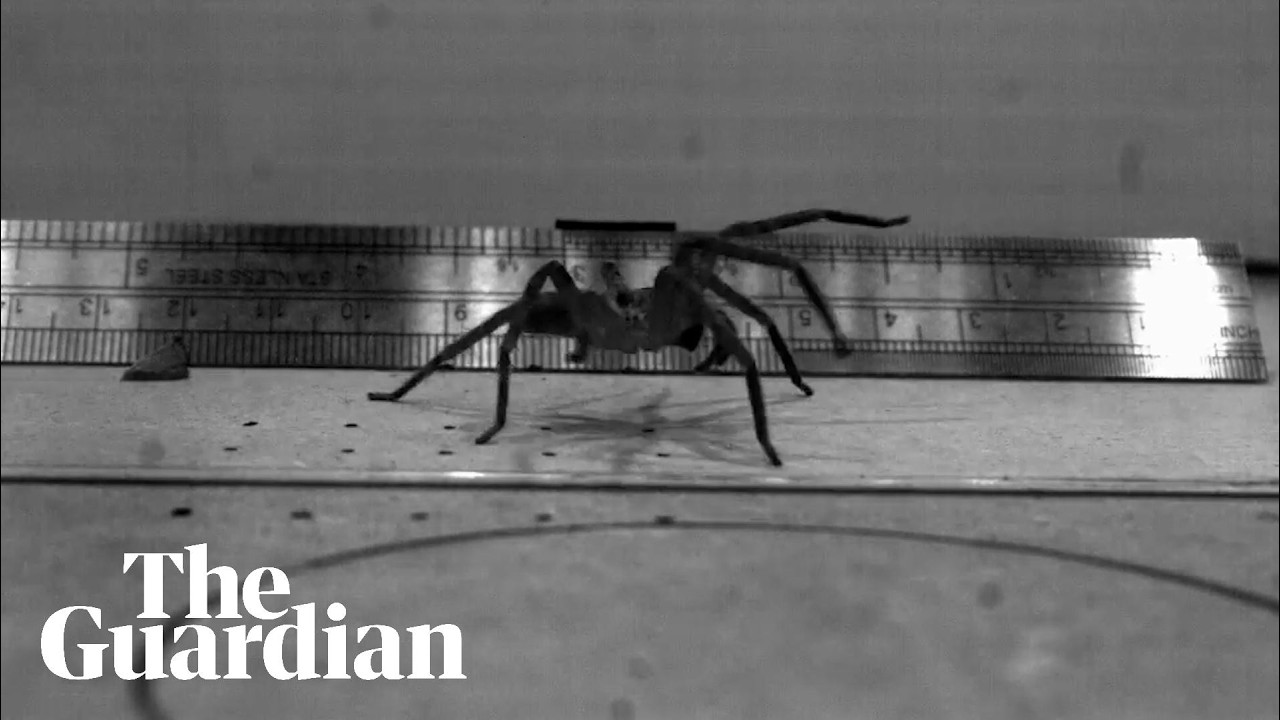

The huntsman spider’s speed measurements came from a study published in 2021 by evolutionary biomechanist Christofer Clemente, of the University of the Sunshine Coast in Australia, and his colleagues.
“We didn’t know it was the fastest spider at the time,” says Clemente, who was not involved in the new study, to Jacinta Bowler at the Australian Broadcasting Corporation. “We just measured the speed in that spider, and we said, ‘Wow, that’s really fast.’ But we had nothing to compare it to.”
To understand which characteristics make some spiders faster than others, the researchers also investigated the creatures’ body sizes, shapes, evolutionary histories and ecological specialties. The work hints that running speed tends to increase with size, likely because of longer legs, but there’s a dropoff point.
The three-gram brown huntsman might be at a sweet spot built for speed, with its relatively lightweight abdomen and lengthy legs. It can outrun much bigger spiders, such as the salmon pink bird eater (Lasiodora parahybana), which was the heaviest species in the study at 52 grams. The chunky tarantula ran at less than one mph.
Some spiders, however, punch way above their class.
The orange goblin spider (Oonops pulcher), for instance, weighs only 0.1 milligrams—roughly one-third the weight of a poppy seed—but can sprint at a speed of roughly 0.45 mph. “Nothing could have prepared me for how it practically teleported across the arena,” Kuchibhotla tells New Scientist.
Overall, the data suggests that “there is a threshold in body mass, after which running speed drops due to mechanical constraints in muscle physiology and the spider’s body plan,” says Jonas Wolff, a study co-author and an evolutionary biologist at the University of Greifswald in Germany, to Graham Readfearn, Nick Evershed and Andy Ball at the Guardian.
Need to know: Not a major threat to people
Despite their scary size and appearance, huntsman spiders are shy and rarely go after humans. They are venomous, but it’s not lethal to people, who might experience minor swelling and pain in the area where they were bitten.
What’s more, “the deeper discovery [of the new study] is that spider speed is shaped by leg architecture and evolutionary history, not simply by size or whether a spider spins a web,” says Leanda Mason, a conservation ecologist at Edith Cowan University in Australia, who was not involved in the research, to New Scientist. The work demonstrates, for example, that spiders that catch prey in webs aren’t always slower than those that chase their meals.
The brown huntsman has dethroned the Moroccan flic-flac spider (Cebrennus rechenbergi) as the world’s fastest spider. The latter species earned that designation in 2009 because it can reach speeds up to 3.8 mph, although it travels that fast by tumbling downhill rather than running.
However, the new record-holder might also one day give up its title.
“I would not rule out there are faster huntsman species than this one out there, which have not been tested yet,” Wolff tells the Guardian.
/https://tf-cmsv2-smithsonianmag-media.s3.amazonaws.com/accounts/headshot/Sara_-_Headshot_thumbnail.png)