
Scientists Don’t Know How Mars Acquired Its Two Moons. Japan Just Launched a Historic Space Mission That Will Fetch Samples to Find Out
The Japan Aerospace Exploration Agency’s spacecraft is expected to reach the Martian system in August 2027 and return samples from the moon Phobos to Earth in 2031

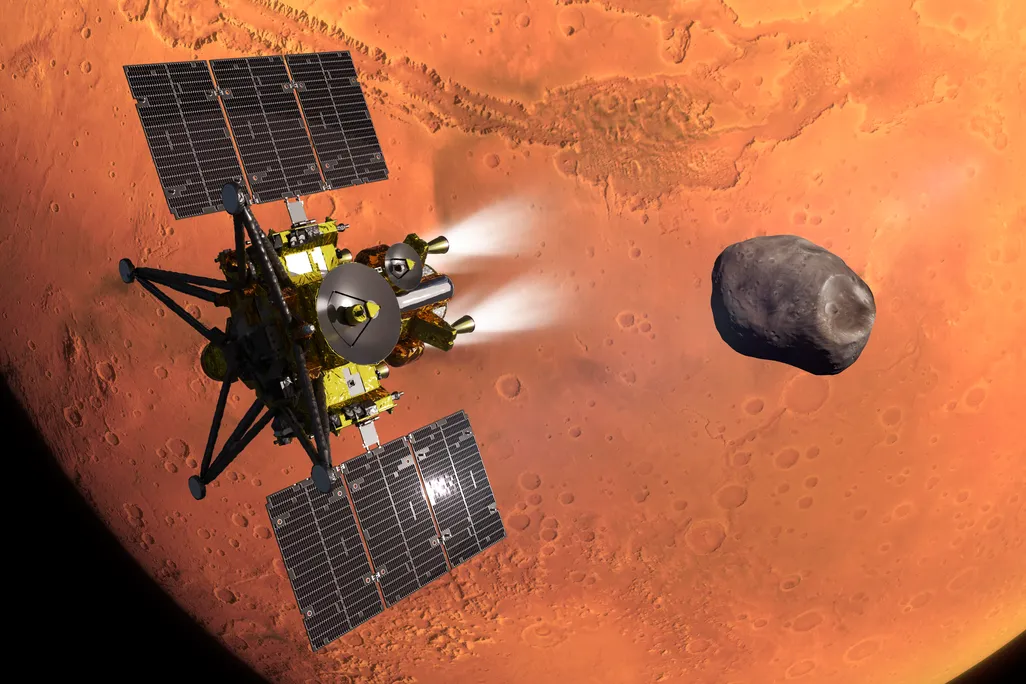
The Japan Aerospace Exploration Agency (JAXA) is sending a spacecraft toward Mars to help solve an enduring mystery of the solar system: Where did the Red Planet’s two lunar companions, Phobos and Deimos, come from?
JAXA’s Martian Moons eXploration (MMX) probe launched from the agency’s Tanegashima Space Center in southern Japan on October 20 at 4:41 a.m. local time (October 19 at 3:41 p.m. Eastern time). If all goes according to plan, the Japan-led mission will bring samples from Phobos, the larger of the lunar duo, back to Earth in five years. These precious bits of dirt could finally reveal how the moon and its smaller sibling came to be, while also shedding light on Mars’ history.
“Despite their potential importance, Martian moons have never been fully investigated,” JAXA planetary scientist and MMX project manager Yasuhiro Kawakatsu tells the Associated Press’ Mari Yamaguchi. “They are known as the most important unclimbed mountains in the solar system.”
There are two main hypotheses about Phobos and Deimos’ creation. One posits they may have formed the same way Earth’s own moon formed: Something slammed into Mars and shot tons of material into space, which eventually coalesced into the two moons. (Why this would have birthed dual mini moons, rather than a single large one like Earth’s, remains an open question.) The other possible explanation suggests that the two bodies were asteroids sucked into Mars’ orbit millions of years ago, according to a statement from NASA, which is contributing to MMX. Other collaborators include the European Space Agency, France’s National Center for Space Studies, the German Aerospace Center and the Australian Space Agency.
Quick fact: Itty bitty moons
Mars’ moons are quite tiny: Deimos is 7.5 miles wide, and Phobos is 14 miles wide. For comparison, Earth’s moon is 2,159 miles wide.
Both scenarios carry significance for understanding their host planet. If Phobos formed from Martian debris, it could be made of material from Mars’ earlier days, when the Red Planet may have been better predisposed to host life than it is now, according to a JAXA statement. On the other hand, if Phobos hails from the far reaches of the solar system, it may have brought along water-bearing minerals and organics that could’ve helped birth life on Earth.
Scientists are hoping that the MMX mission, which is slated to reach Mars’ system in August of next year, will help solve the matter. The spacecraft will first investigate Phobos from orbit before landing on the moon’s surface twice in separate locations to collect the highly anticipated samples. The MMX probe will also investigate Mars from a distance and perform flyby observations of Deimos.
“We’re going to choose a first landing site and then do some landing operations, and after that we’re going to lift off and get back to orbit,” Tomohiro Usui, a JAXA planetary scientist and member of the MMX team, tells CNN’s Ashley Strickland. “It takes another several months for the search of the next landing site. Landing operations are very risky.”
The mission will collect samples on Phobos via two instruments. One will collect ground surface samples by acting like a vacuum cleaner. It’ll emit bursts of high-pressure nitrogen gas to loosen the dirt and suck up the disturbed regolith. The other sampler will pull cores from a few inches deeper in the ground. Only 0.35 ounces of material will be transported back to Earth, but that’s plenty for scientists to work with, Chrysa Avdellidou, a planetary scientist at the University of Leicester in England who is working on the mission, tells BBC News’ Rebecca Morelle, Alison Francis and Kevin Church.
“We can do several studies even on individual grains. … You don’t need to have kilos back from a surface in order to do science. So, it’s worth every gram,” she tells the outlet.


If MMX is successful, it would become the first mission to return a sample from a Martian moon, and it could be the first to complete a round trip from the Martian system. And because scientists suspect Phobos has gotten sprayed with debris from asteroid impacts on Mars, the returned samples could include bits of the Red Planet. Phobos was chosen as the landing destination mainly because it’s the moon closest to the host planet, and therefore more likely to have Martian dust, reports the AP.
Only 1 percent of the material collected might be from Mars, Kiyoshi Kuramoto, a planetary scientist at Hokkaido University in Japan and MMX team member, tells Science’s Robin George Andrews. Still, that tiny fraction of otherworldly dirt might carry evidence of extraterrestrial life. “I do think there’s a possibility that chemical traces of biological activity might be contained within that sand sample,” Kuramoto says.
