
Scientists Discover Signs of Explosive Volcanic Eruptions 20,000 Feet Underwater—the Deepest Ever Found—in the Mariana Trench
The discovery puzzles researchers because volcanic activity at that depth should produce a goopy, seeping flow due to the immense pressure. Nevertheless, they say they’ve found evidence of explosive volcanism, thanks to a remotely operated submersible

Challenger Deep, located in the Mariana Trench in the western Pacific Ocean, is the deepest known point on Earth, plunging 35,876 feet—or nearly seven miles—below the water’s surface.
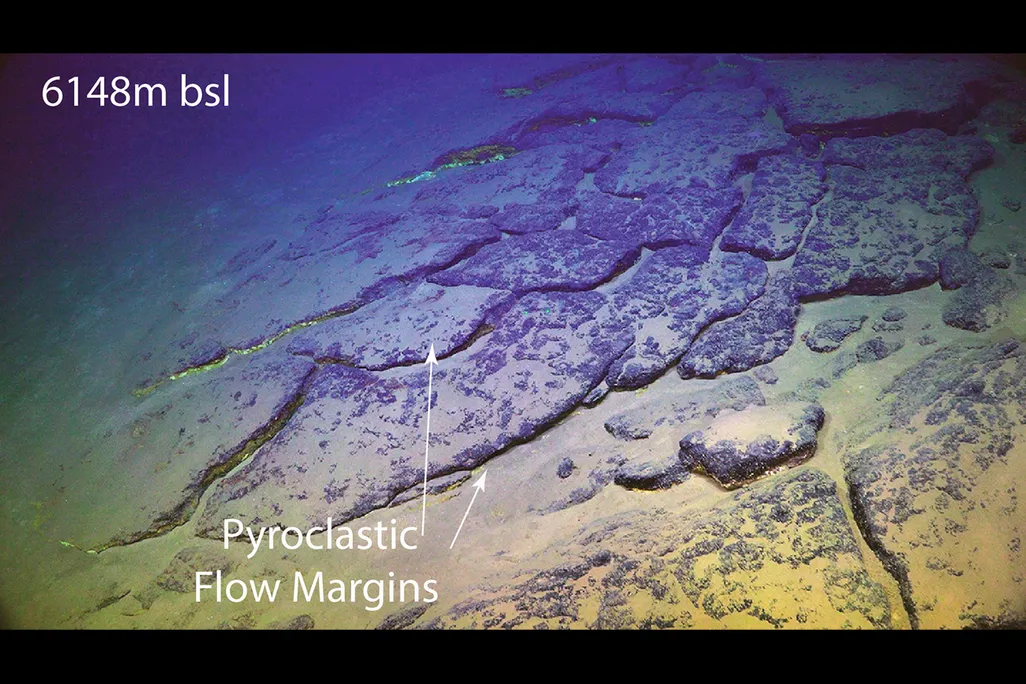
Now, Challenger Deep can add another distinction to its list: the site of the deepest known explosive volcanic eruptions on Earth. Using a remotely operated underwater vehicle, scientists recovered pyroclastic rocks and “abundant” evidence of ultradeep explosive volcanism from the site. They described their findings in a study published November 22 in the journal Frontiers in Earth Science.
The discovery is “surprising and unprecedented,” William Chadwick, a geologist at Oregon State University who was not involved with the work, tells Science News’ Carolyn Gramling. “Imagining this happening is … pretty mind-boggling.”
Challenger Deep is a dangerous place for humans to visit, with roughly 1,000 times the pressure we experience at sea level. So, scientists often turn to robots to explore this mysterious submarine depression. In 2024, researchers deployed a Woods Hole Oceanographic Institution submersible called Jason/Medea to explore part of the Mariana Trench.
Did you know? Deep dive
Some people have made the daring journey to Challenger Deep. The first were U.S. Navy officer Don Walsh and Swiss oceanographer Jacques Piccard, who ventured there in a submarine in January 1960.
The underwater device couldn’t reach the very bottom of Challenger Deep without risking implosion, but it did descend to a maximum depth of about 21,300 feet. On three dives, the submersible’s camera spotted flat, lobe-shaped rocks at different spots, some located more than about 19,685 feet below the surface, along a 60-mile stretch. Scientists say this material, some of which was brought back to the surface, represents the remnants of a pyroclastic flow, a fast-moving mixture of hot gas, ash and volcanic rock produced by explosive eruptions.
The team couldn’t find the exact location of the eruption, but they suspect it occurred somewhere nearby, along the trench wall. They also don’t know exactly when the eruption occurred, but they think it happened somewhat recently in geologic terms.
“They’re not yesterday, but I don’t think they’re a million years old,” lead author Robert Stern, a geoscientist who retired from the University of Texas at Dallas, tells Live Science’s Stephanie Pappas.
Most of Earth’s volcanic activity occurs underwater, forming island chains and extensive networks of hydrothermal vents along mid-ocean ridges. But scientists never expected to find explosive eruptions at such extreme depths, thinking they were only possible in shallower waters.
“It’s not something that, as a geoscientist, I would have said would be predicted,” Sune Nielsen, a geochemist at the University of Lorraine in France who was not involved in the study, tells Live Science. “Very far from it.”
In Challenger Deep, explosive eruptions were thought to be impossible, since the immense water pressure should prevent volcanic gases from expanding and triggering an explosion. Yet the evidence suggests some kind of volcanic explosion did occur there, raising new questions about what’s possible.
“Submarine volcanism is something we’ve got quite big knowledge gaps in,” Peter Rowley, a volcanologist at the University of Bristol in England who was not involved with the study, tells New Scientist’s Matthew Sparkes. “It’s that famous thing that we know less about the seafloor than we do about the moon.”
Scientists still don’t fully understand how explosive volcanism works at such extreme depths. They suspect, however, that these eruptions function very differently than those that occur on land. As Robin George Andrews writes for National Geographic, perhaps an underwater eruption at this depth would look like “a convulsing, crumbling, splintering stream of toothpaste angrily escaping out of the seafloor.”
Another puzzle is the location of the volcanic deposits. Scientists say they sit unusually close to the trench, a subduction zone that began to form about 52 million years ago when the older, denser Pacific tectonic plate started sliding beneath the smaller Mariana microplate.
In subduction zones, the sinking plate heats up and starts to melt into magma as it dives beneath the overriding plate. Typically, that magma rises to the surface and erupts hundreds of miles from the place where the two plates meet.
But scientists found the Mariana Trench volcanic deposits much closer to the meeting point of the Pacific and Mariana plates than they would have expected. One possible explanation for this proximity is that the Pacific plate makes a sharp, steep bend as it sinks beneath the Mariana Plate. This hypothesis might also help explain how Challenger Deep got so far below the surface in the first place, reports Science News.
Many questions remain unanswered. But the scientists behind the new work hope their discovery inspires other researchers to explore these largely uncharted underwater environments.
“The trenches are the last frontier,” Stern tells National Geographic. “We’ve opened a door.”
