
Scientists Discover a New Species of ‘Walking’ Shark in Papua New Guinea. They Suspect It’s at Risk of Going Extinct
The creature belongs to a unique group of sharks whose members can use their strong pectoral fins like legs to get around
/https://tf-cmsv2-smithsonianmag-media.s3.amazonaws.com/accounts/headshot/SarahKuta.png)
/https://tf-cmsv2-smithsonianmag-media.s3.amazonaws.com/filer_public/74/33/7433b20b-f03d-4524-8f6d-78ff2c48f8b8/h_dudgeonae_photo_mark_erdmann.jpg)
Residents of southeastern Papua New Guinea have long known about an unusual fish that can “walk” across the reef flats at low tide with most of its body out of the water. They call it kadedekedewa, which loosely means “lazy shark” or “dog shark,” a reference to its waddling gait.
Now, scientists have identified the creature as a previously undescribed species. They’ve dubbed it Hemiscyllium dudgeonae, or Dudgeon’s walking shark, and it belongs to a unique group of sharks whose members can use their strong pectoral fins like legs as they navigate the shores of Australia and the island of New Guinea.
Researchers describe H. dudgeonae—the first new species within the Hemiscyllium genus since 2013—in a paper published on June 15 in the Journal of the Ocean Science Foundation.
H. dudgeonae is named after study co-author Christine Dudgeon, an ecologist at the University of the Sunshine Coast in Australia. She first spotted the shark in March 2025 in the shallow waters of Milne Bay, which is located off the far southeastern tip of Papua New Guinea and opens into the Solomon Sea.
/https://tf-cmsv2-smithsonianmag-media.s3.amazonaws.com/filer_public/51/58/515837d9-0694-4aad-80a5-dd171889201b/dr_chris_dudgeon_of_unisc_with_shark_named_after_her.jpg)
Dudgeon was swimming around in search of sharks that belonged to a known species, the leopard epaulette shark, also called Michael’s epaulette shark, when she encountered a two-and-a-half-foot-long creature gliding along the seafloor. Dudgeon pointed her flashlight’s beam in front of the shark, which caused it to freeze. She swam closer, gently grabbed the individual, flipped it over and tucked its tail under her armpit to immobilize it.
Dudgeon passed the shark to lead author Jess Blakeway, also an ecologist at the University of the Sunshine Coast, who was waiting in a nearby boat. Right away, Blakeway could tell by the shark’s color pattern that it wasn’t a leopard epaulette shark—it was something completely different.
“This new one has got lots of spots and dashes that reminded me of braille or morse code,” Blakeway tells New Scientist’s James Woodford.

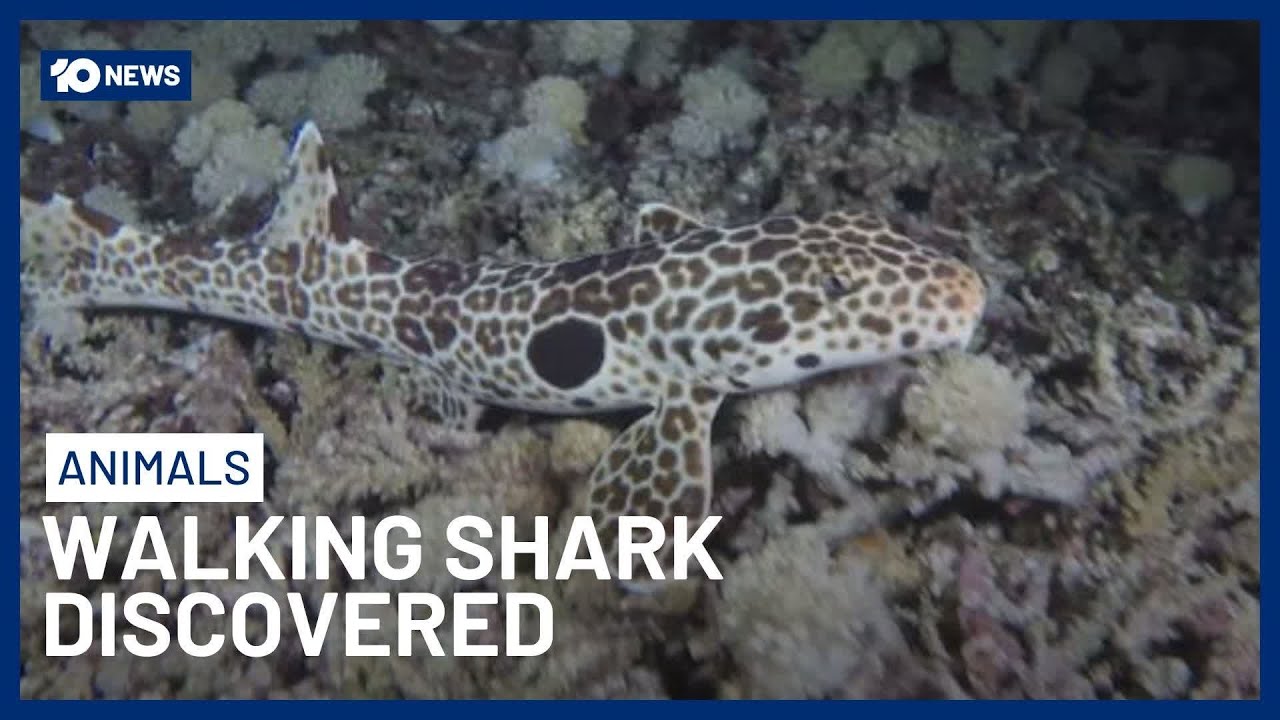
The team spent the next few days searching for other examples of the shark, catching a total of 12 individuals. They gathered biological samples from nine before releasing them, but they kept the other three for further study. DNA testing confirmed the sharks were genetically different enough from other walking sharks to warrant a new species.
Scientists are still learning about H. dudgeonae. However, they suspect it has a fairly narrow range. They collected members between the Amphlett Islands and the Trobriand Islands, which are north of Milne Bay. But they predict it lives throughout the D’Entrecasteaux and Trobriand islands, and possibly as far offshore as Muyua Island, located around 170 miles northeast of Milne Bay. The creatures seem to spend most of their time in shallow water, swimming among seagrass and scattered coral outcrops.
“A lot of the time, we talk about the deep sea as unknown—we don’t really think of the shallow water as being unknown,” Blakeway tells 10 News Perth’s Cyndi Lavrencic. “So, finding a new species of shark that is pretty shallow water-orientated is just so exciting.”
Did you know? Epaulette sharks
Walking sharks are also known as “epaulette” sharks. According to the New England Aquarium, the name is a reference to the two large black spots located behind their gills, which look like the decorative shoulder pieces found on some military uniforms known as epaulettes. The spots are “false eyespots,” an adaptation that helps trick predators into believing they are facing a much larger, more formidable creature.
Though scientists just learned of the species’ existence, they suspect that it is at risk of going extinct.
Walking sharks in Papua New Guinea face numerous threats, including climate change-induced coral bleaching and habitat loss and degradation from coastal development and the expansion of palm-oil plantations. Prior to the new discovery, there were nine recognized species of walking shark, two of which are considered “vulnerable” by the International Union for Conservation of Nature (IUCN), including the leopard epaulette shark that the team was originally searching for in Milne Bay.
Scientists hope to return to the region later this year to continue studying H. dudgeonae—work that might support an IUCN “vulnerable” or “endangered” designation.
“This species adds to Papua New Guinea’s extraordinary biodiversity, yet it faces local extinction without urgent conservation action,” Blakeway tells New Scientist.
/https://tf-cmsv2-smithsonianmag-media.s3.amazonaws.com/accounts/headshot/SarahKuta.png)