
Researchers in Turkey Have Unearthed an Ancient Fragment Inscribed With the World’s Oldest Peace Treaty
The piece of a clay tablet is marked with Akkadian cuneiform, and its text belongs to the Kadesh Peace Treaty, created by ancient Egyptians and Hittites in the 13th century B.C.E.
/https://tf-cmsv2-smithsonianmag-media.s3.amazonaws.com/accounts/headshot/Sonja_headshot.png)
/https://tf-cmsv2-smithsonianmag-media.s3.amazonaws.com/filer_public/22/0c/220c941c-e8a9-4eac-92d3-8ce7335fbb7d/515659-490ebdfb5c70cef8586e27ab5fe2e5eee7529cf2-0.jpeg)
Almost 3,300 years ago, two armies were fighting for control of ancient Syrian land. They were the Hittites of Anatolia, led by King Muwatallis, and the Egyptians, ruled by the pharaoh Ramses II. The pharaoh had invaded Hittite territory, aiming to expand his empire. The ensuing war involved tens of thousands of soldiers and some of the largest chariot battles ever fought. But the opposing sides proved too evenly matched. Their final standoff, the Battle of Kadesh, was a draw.
Some years after the battle, around 1269 B.C.E., Ramses II and Muwatallis’ successor, Hattusilli III, signed a lofty agreement officially ending the conflict—the world’s first international peace treaty. It promised “eternal friendship, lasting peace, territorial integrity, nonaggression, extradition and mutual help,” per the United Nations. Originally written on silver tablets that have since been lost to history, the treaty’s text was preserved in ancient copies: hieroglyphics on the wall of an Egyptian temple and at least three cuneiform clay tablets in Anatolia.
Now, archaeologists in Turkey have discovered another fragment of one of those ancient copies—a clay remnant inscribed with Akkadian cuneiform.
Did you know? Curious cuneiform
The cuneiform writing system, first used around 3200 B.C.E., is not an alphabet, as it doesn’t contain individual letters. Instead, its 600 to 1,000 characters represent syllables or entire words.“We have found traces of peace dating back thousands of years in the soil of Anatolia,” Mehmet Nuri Ersoy, Turkey’s culture and tourism minister, announced on social media, per a translation by the state-run Anadolu Agency. “Scientific examinations have determined that a fragment of a cuneiform tablet found during excavations at Büyükkale, in Hattusa, Çorum, belongs to one of the copies of the Kadesh Peace Treaty.”
Located in the Turkish province of Çorum, the archaeological site of Hattusa is the ruined capital city of the Hittites, per a statement from Turkey’s Ministry of Culture and Tourism. There, in 1906, researchers first discovered a copy of the Kadesh treaty, in the form of a broken clay tablet. Today, its pieces are displayed at the Istanbul Archaeological Museums—and a copper replica hangs in the United Nations building in New York.

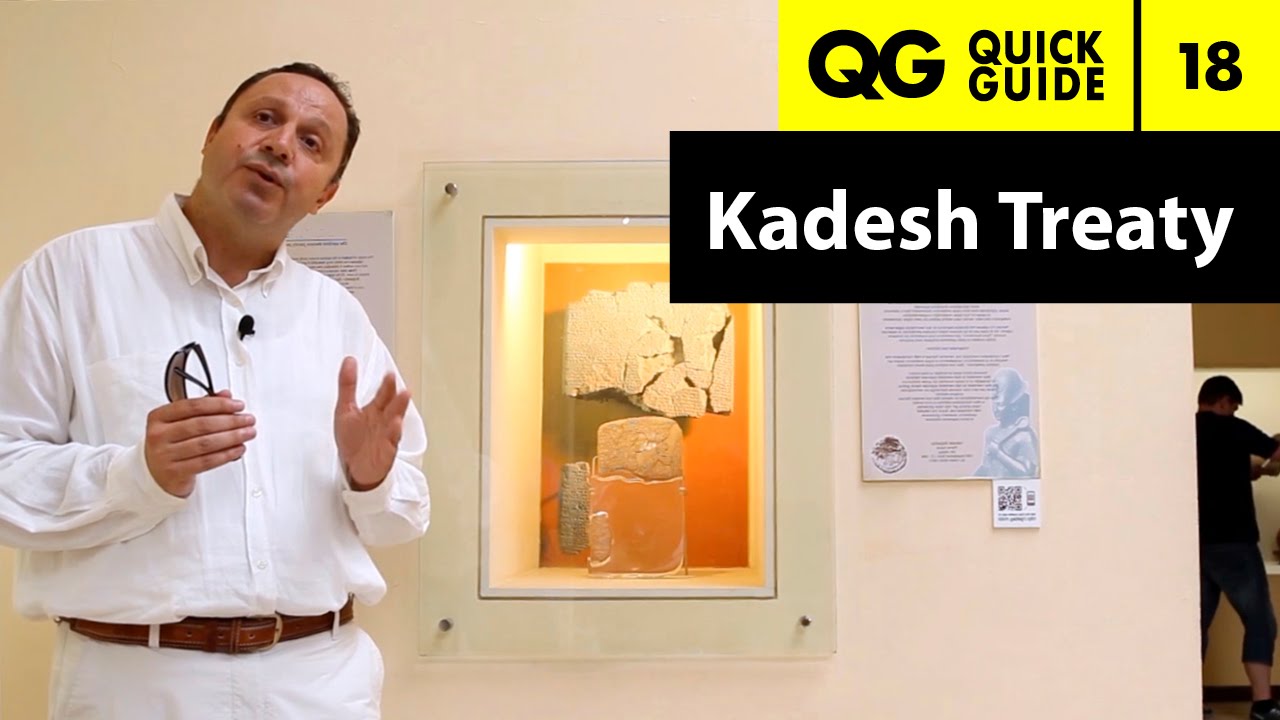
The Kadesh Peace Treaty was, in fact, the culmination of centuries of conflict between the Hittites and the Egyptians. Both kingdoms had attempted to conquer Syria, which lies between Egypt and Turkey, throughout the reigns of many different rulers. When the Battle of Kadesh ended in a stalemate, it was likely put to rest by an unpreserved, smaller treaty, as Egyptologist Camilla Di Biase-Dyson told ABC Radio National’s Fran Kelly in 2024. Sixteen years later, Hattusilli III sought a more comprehensive alliance with Egypt, in part to cement his power.
According to a translation by the Turkish Ministry of Culture and Tourism, the treaty declares an eternal bond between Ramses II and Hattusilli III. “He is a brother to me and he is at peace with me, and I am a brother to him and I am forever at peace with him,” narrates the pharaoh. “We are united, and a bond of fraternity already exists among us and of peace, and it is better than the bond of fraternity and of peace that existed between the country of Egypt and the country of Hatti.”
/https://tf-cmsv2-smithsonianmag-media.s3.amazonaws.com/filer_public/d5/8b/d58ba182-a5b1-496b-930f-b80187999e5b/battle_scene_from_the_great_kadesh_reliefs_of_ramses_ii_on_the_walls_of_the_ramesseum.jpg)
Researchers unearthed the new fragment while excavating in Büyükkale, where the Hittite royal palace was located, per the statement. They studied the artifact’s inscription for about a year before announcing the find. Researchers hope that further excavation will uncover the other segments of this copy of the treaty.
Experts say the fragment contains lines from articles 12 through 20 of the treaty of Kadesh. These lay out rules for dealing with people who fled Egypt or Hittite, seeking refuge in the other country. Per the statement, the fragment warns against destroying the refugees’ homes.
“The statements concerning the destruction of people’s homes carry a powerful message from thousands of years ago to the present day,” Ersoy said in his post, per the Anadolu Agency. “We wish for a future in which all people, particularly our Palestinian brothers and sisters, can live in safety, peace and tranquility.”
/https://tf-cmsv2-smithsonianmag-media.s3.amazonaws.com/accounts/headshot/Sonja_headshot.png)