
Researchers Create Rechargeable, Glow-in-the-Dark Succulents
The team hopes their work, which is still in the early phases, might one day build the foundation for a novel sustainable lighting system
/https://tf-cmsv2-smithsonianmag-media.s3.amazonaws.com/accounts/headshot/Margherita_Bassi.png)
/https://tf-cmsv2-smithsonianmag-media.s3.amazonaws.com/filer_public/e2/a7/e2a73750-beea-4bd1-b993-bcc565792f8d/low-res_1_1.jpg)
Imagine walking through a garden after sunset. Instead of flicking the outdoor lights on, the space is already lit by a soft glow emanating from common houseplants lining the path.
In a study published Wednesday in the journal Matter, researchers have taken a step toward making that scene a reality: Scientists created glow-in-the-dark succulents that recharge with exposure to light, in the hopes that they might pave the way for new sustainable lighting systems.
The team injected plants with strontium aluminate, the same material in the glow-in-the-dark stars children sometimes stick to their bedroom ceilings. Strontium aluminate displays phosphorescence—meaning it absorbs energy from light, then releases it slowly—as opposed to bioluminescence, which is when an organism emits its own light via chemical reactions, as reported by the New York Times’ Cara Giaimo.
Fun fact: Glowing plants
Researchers in the 1980s introduced a gene from a firefly into a tobacco plant, making it perceptibly glow in total darkness.
At first, the process was “continuous trial and error,” Shuting Liu, first author of the paper and a researcher at the South China Agricultural University, tells the New York Times. While other scientists had previously used strontium aluminate in plants, Liu and her colleagues sought a brighter and longer glow by injecting larger particles.
The winning size for these particles was around seven micrometers (less than 0.0003 inches), or roughly equivalent to the width of a single red blood cell. Smaller particles made a dimmer glow, whereas larger particles couldn’t travel through plants very far.
Several injections later, the researchers determined that succulents called Echeveria “Mebina” emitted a strong light, thanks to their leaves’ thin, uniform and evenly distributed channels, which enabled the particles to spread more successfully, according to a statement.

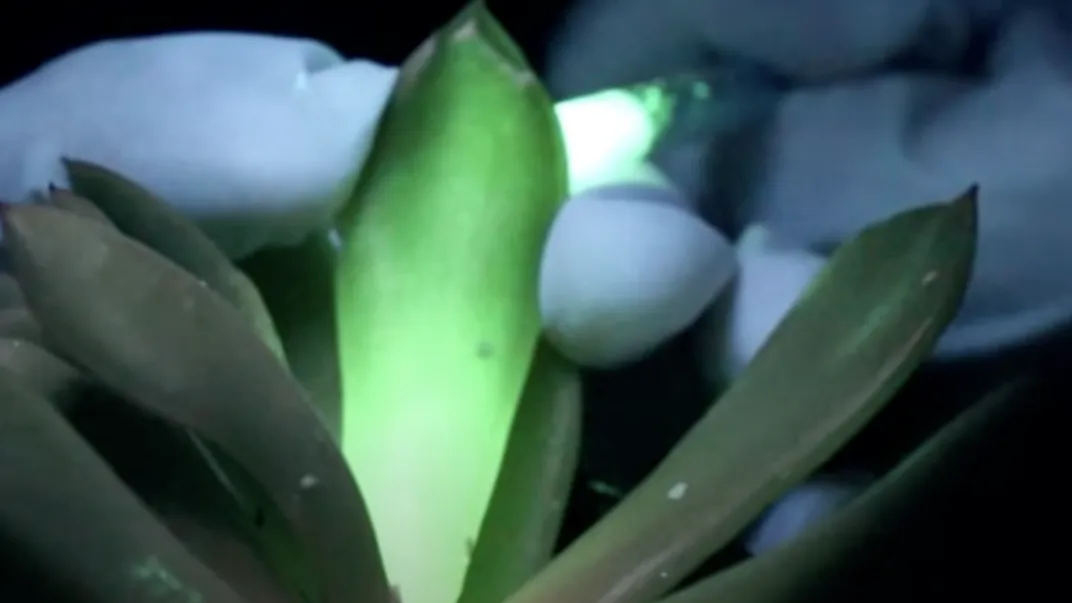
The succulents produced an initial glow to rival that of a typical candle or small night light, then continued to glow more dimly for up to two hours—in different colors, depending on the injection. It only took a few minutes of exposure to the sun or LED light to charge the plant. Each plant costs around $1.40 to make, excluding labor, but they are prepared in just around ten minutes.
“It was really unexpected,” Liu says in the statement. “The particles diffused in just seconds, and the entire succulent leaf glowed.”
Scientists have already achieved luminous plants via genetic engineering, but this process is expensive and complicated—and it typically results in a weak glow that’s limited to the color green, according to the statement.
Still, the newly injected succulents have their own limitations. The plants’ glow diminishes over time. And Keith Wood—chief executive of Light Bio, a company that sells genetically modified bioluminescent plants, who was not involved in the study—tells Nature’s Katherine Bourzac that the injected particles’ impact on the plants’ long-term health is still unclear. The researchers, too, note that more testing related to safety will be required.
“There is also a potential pollution issue when the plants die and are disposed of,” environment reporter Michael Le Page writes in an opinion piece for New Scientist. And there is no “discussion in the team’s paper of the environmental and safety aspects of plants with high levels of phosphors in their leaves,” he adds.
Liu tells the New York Times that “at this stage, our priority was to establish the proof of concept,” and that more research will be needed to diminish their approach’s environmental impact. The team’s ambitious vision would ultimately see these plants provide sustainable alternatives to low-intensity lighting.
“Imagine glowing trees replacing streetlights,” Liu says in the statement.
/https://tf-cmsv2-smithsonianmag-media.s3.amazonaws.com/accounts/headshot/Margherita_Bassi.png)