
Rare Trio of Leopard Sharks Spotted Mating in the Wild for the First Time, and a Snorkeling Scientist Captured a Video
Conservationists say the unexpected observation could inform efforts to protect or reintroduce leopard sharks, an endangered species
/https://tf-cmsv2-smithsonianmag-media.s3.amazonaws.com/accounts/headshot/Sara_-_Headshot_thumbnail.png)
/https://tf-cmsv2-smithsonianmag-media.s3.amazonaws.com/filer_public/62/81/6281e7dc-e028-4729-a5c1-901804daef7d/leopard-shark-sex-tape.jpg)
Scientists recently captured the first-ever video of wild leopard sharks mating, and the footage involves not two, but three sharks in action.
The Indo-Pacific leopard shark (Stegostoma tigrinum), also known as the zebra shark, has mostly been studied in captivity. To observe and monitor the animal in the wild, Hugo Lassauce, a marine biologist at the University of the Sunshine Coast in Australia, had been snorkeling with the sharks every week for a year off the coast of New Caledonia, according to a statement. In all that time, he had not been able to observe an entire mating sequence, until one day, he saw two male sharks grabbing a female’s pectoral fins in the sand.
“I thought, ‘Something is going to happen—I’m staying right here with my GoPros,’” he tells Ima Caldwell at the Guardian. “An hour later, it finally happened.”
Key context: Leopard sharks
A different species also known as a leopard shark (Triakis semifasciata) lives along coastlines in the far eastern Pacific Ocean, from Oregon to Mexico.
The entire mating event lasted less than two minutes. The first male took 63 seconds, and the other 47. Then, Lassauce explains in a statement, the males lost all their energy and stayed put at the bottom of the water, while the female swam away. The moment was detailed in the Journal of Ethology on September 18.

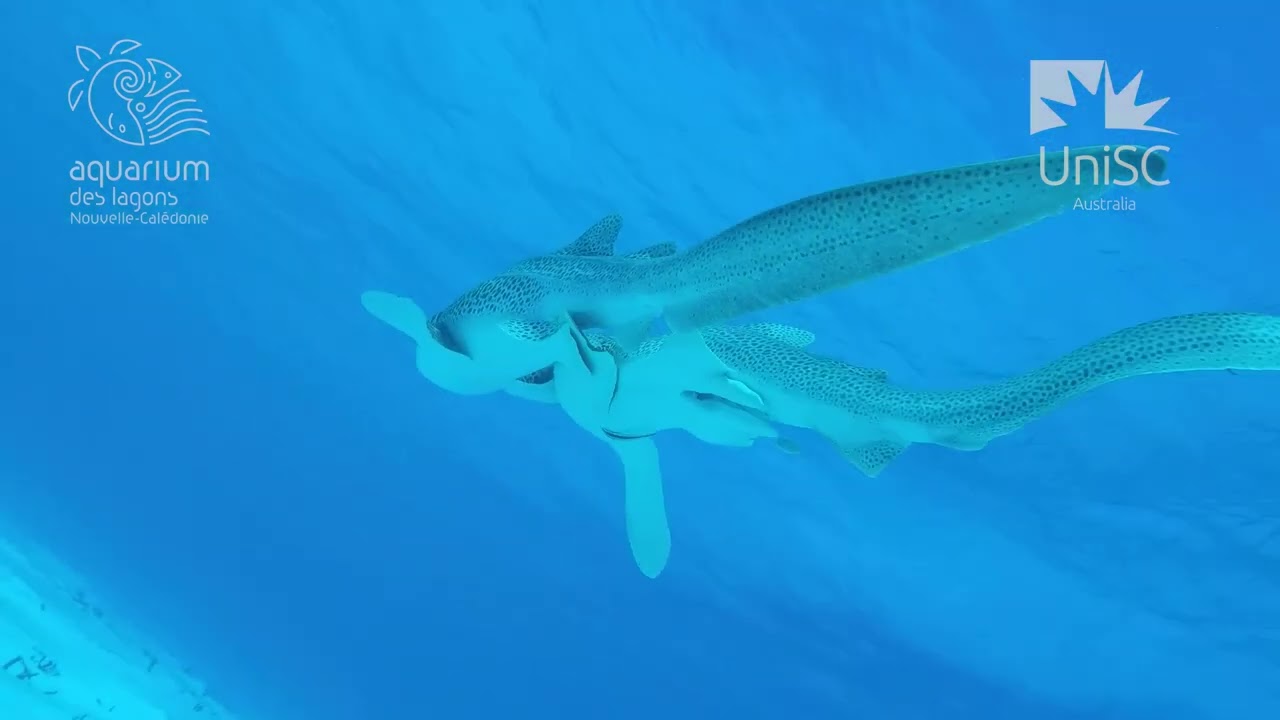
Once Lassauce swam back up to his research boat with the video, the team celebrated. That’s because the rare observation can inform conservation efforts for the leopard shark, a globally endangered species that is near extinction in some parts of the world. The primary threat to the animal is overfishing, mostly due to demand for its fins and skin. By better understanding the sharks’ behavior, such as their reproductive process, scientists could get a better idea of how to protect and reintroduce the species.
The work was done under ReShark, an international collective of NGOs, aquariums, researchers and conservationists aiming to rewild sharks and rays. “Our project in studying this shark is to try to inform a conservation program and implement measures that can protect them the best way possible,” Lassauce explains to Jay Carstens and Janel Shorthouse at the Australian Broadcasting Corporation.
“We need to know more about their behavior, about how far they can swim, how they reproduce,” he adds, “to make sure their reintroduction into [new] environments can be a success.”
The sighting could inform artificial insemination research aiming to rewild the species, says Christine Dudgeon, a study co-author and senior research fellow at the University of the Sunshine Coast, in a statement.
“It’s surprising and fascinating that two males were involved sequentially on this occasion,” she adds. “From a genetic diversity perspective, we want to find out how many fathers contribute to the batches of eggs laid each year by females.”
/https://tf-cmsv2-smithsonianmag-media.s3.amazonaws.com/accounts/headshot/Sara_-_Headshot_thumbnail.png)