
Raised in Apartheid South Africa, 2026 Nobel Peace Prize Winner Navi Pillay Is One of the World’s Leading Human Rights Jurists
When Pillay learned she had won the award, she was in the same courtroom where the Nuremberg Trials held Nazi war criminals to account. Her legal career has been dedicated to fighting against human rights abuses and mass atrocities
/https://tf-cmsv2-smithsonianmag-media.s3.amazonaws.com/accounts/headshot/SarahKuta.png)
/https://tf-cmsv2-smithsonianmag-media.s3.amazonaws.com/filer_public/dd/6f/dd6f5dc1-1cfb-4de1-ac62-ea52fffeaaf4/gettyimages-2298735670.jpg)
Navanethem Pillay has been awarded the 2026 Nobel Peace Prize “for her efforts to promote peace and international law.”
The Nobel committee lauded the 85-year-old South African jurist and former United Nations human rights chief for her “commitment to universal legal principles” and her “firm moral compass” throughout her long career.
Through decades of work in South African and international courts, Pillay, who is known as Navi, has helped shape legal efforts to hold governments and individuals accountable for human rights abuses and mass atrocities.


Pillay was born in Durban, South Africa, in 1941. She grew up in a poor family of Indian Tamil descent. The daughter of a bus driver, she pursued a career in law at a time when discrimination limited opportunities for non-white South Africans. She established her own law firm in 1967 and in 1988 became the first South African at Harvard Law School to become a Doctor of Juridical Science, the school’s most advanced degree.
Under apartheid, Pillay and other non-white South Africans were “treated like dirt,” she told the Agence France-Presse (AFP) in 2023. But rather than letting the mistreatment keep her down, she opted to “fight every step of the way.”
“I always had a sense of confidence about who I am and how you confront any kind of discrimination,” she told AFP. “Open your mouth and speak up, condemning it.”
Pillay’s early career centered on defending anti-apartheid activists, including Nelson Mandela, whom she joins as a Nobel Peace Prize laureate. In 1995, she broke another barrier when she became the first non-white woman appointed to South Africa’s High Court.
Her work subsequently took her onto the international stage. In 1999, Pillay became a judge and president of the International Criminal Tribunal for Rwanda, which investigated crimes committed during the 1994 genocide. During her tenure, she helped establish important legal precedents recognizing sexual violence as potential acts of genocide and crimes against humanity, bringing international attention to the estimated 100,000 to 250,000 Rwandan women who were raped during the three-month massacre.
“Rape had always been regarded as one of the spoils of war,” she said at the time. “Now it is a war crime, no longer a trophy of war.”
From 2008 to 2014, Pillay served as the U.N. high commissioner for human rights. From 2021 to 2025, she chaired the U.N. Independent International Commission of Inquiry on the Occupied Palestinian Territory, leading an investigation that concluded Israel committed genocide against Palestinians in the Gaza Strip. (Israel strongly rejected the report.)
Pillay also served as a judge on the International Criminal Court and currently serves as an ad hoc judge on the International Court of Justice, the U.N.’s primary judicial body, in an ongoing case assessing whether Myanmar committed genocide against its Rohingya minority.
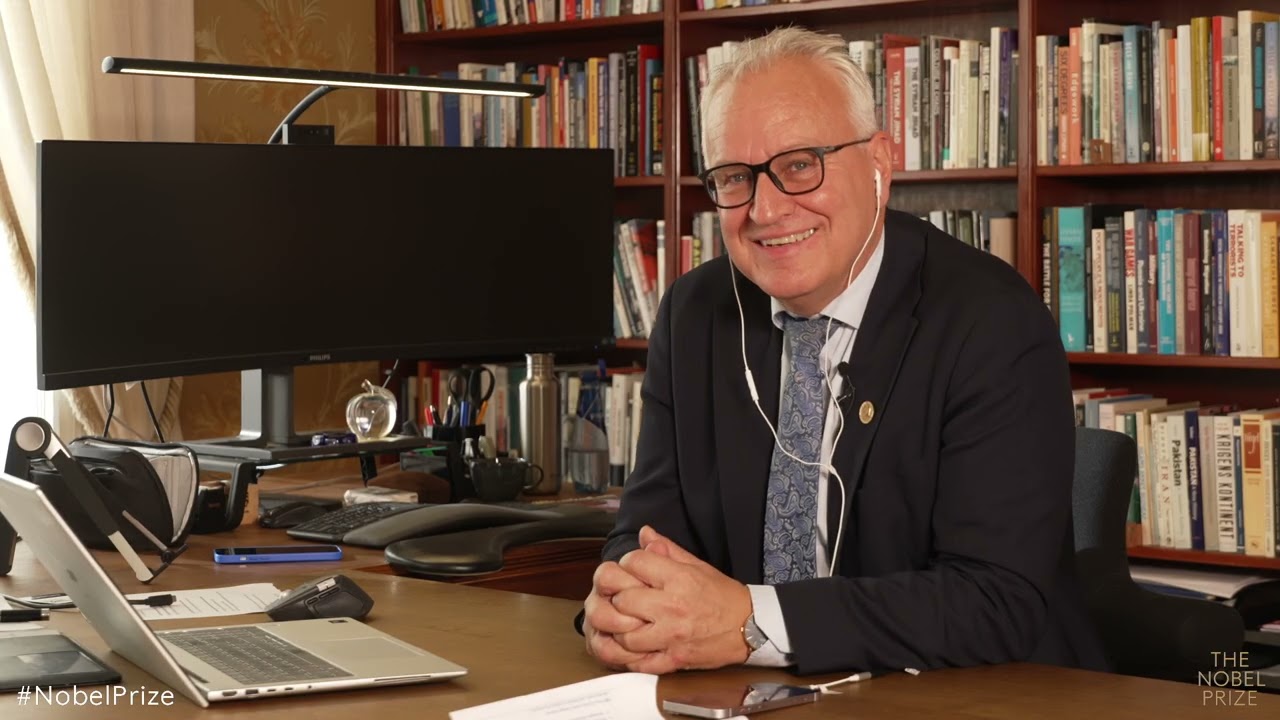
By honoring Pillay, the Nobel committee sought to remind the world that international law is the “foundation for a more peaceful world,” Jørgen Watne Frydnes, chair of the Nobel committee, said during the award announcement.
“International law has never been perfect,” Frydnes added. But it “sets the standards. Legal measures do prevent acts of war and violence. That is a fact.”
Pillay learned that she had won the prize while attending an international law conference in Courtroom 600 of the Nuremberg Palace of Justice, where top Nazi leaders were indicted and tried for their crimes during World War II.
“At this venue, your applause means a great deal,” she said after hearing the news. “But being a lawyer and a judge, I still want to verify this information.”
Did you know? South African winners
Pillay is the first South African woman to win the Nobel Peace Prize. Four South African men—Albert Lutuli, Desmond Tutu, Nelson Mandela and F.W. de Klerk—have received the award.
Swedish inventor Alfred Nobel established the Nobel Peace Prize, as well as prizes for physiology or medicine, chemistry, literature and physics, with a bequest in his will, which he drafted in 1895. The prizes were first awarded in 1901. The economics prize was established in Nobel’s memory in 1968.
This year, the Nobel Peace Prize celebrates its 125th anniversary, with 287 individuals and organizations nominated for the award. The committee noted that the 2026 prize “springs directly” from Nobel’s will, which stated that the award should be given to those who have “conferred the greatest benefit to humankind.”
Pillay is “one of the great defenders of international legal principles in our time,” according to the committee. “[Her] commitment to justice and human dignity is a source of hope and inspiration to all who seek to bring about a more peaceful world.”
/https://tf-cmsv2-smithsonianmag-media.s3.amazonaws.com/accounts/headshot/SarahKuta.png)