
Paleontologists Discover the First Known Amphibian That Lived Entirely at Sea: a Flat, Armored Creature From 237 Million Years Ago
Two nearly complete fossilized skeletons of the strange new species were found in southwestern China. Scientists suspect its marine lifestyle was an evolutionary accident

Amphibians are known for straddling two worlds, dwelling on land and in water at different points in their lives. In fact, their name means “double life” in Greek. But no amphibian species has ever been known to reside exclusively in a marine environment—until now.
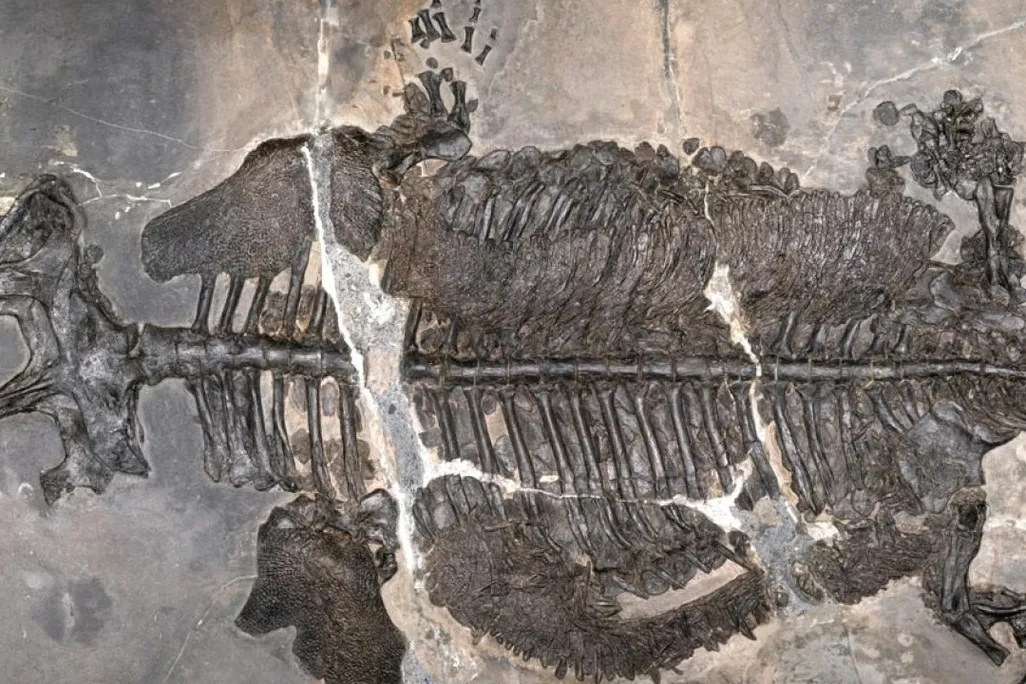
Two nearly complete fossilized skeletons found in southwestern China hint that an armored amphibian lived in the prehistoric salty waters there some 237 million years ago, researchers report in the journal Nature Ecology & Evolution on October 26. The new species, named Gerrothorax maritimus, forces scientists to reconsider how today’s amphibians have adapted to their environments.
“This is potentially a revolutionary discovery,” says Steve Brusatte, a paleontologist at the University of Edinburgh in Scotland who wasn’t involved in the study, to Sarah Wild at Nature. “If this Triassic amphibian … really was fully marine, then it is a game-changer.” (The Triassic period stretched from 201 million to 252 million years ago.)
Out of the more than 8,000 amphibian species currently living on Earth, none are known to live in marine environments and only 2 percent have some level of salt tolerance, including the crab-eating frog. However, even this frog doesn’t do well in brackish water. That’s because amphibians have thin, permeable skin that allows them to breathe and consume water. When that skin is exposed to salt water, the animals become dehydrated.
“When a frog swims in sea water, it loses its body water because the sea water sucks out the body water through the permeable skin through osmotic pressure,” explains study co-author Ryosuke Motani, a paleobiologist at the University of California, Davis, to Will Dunham at Reuters. “It cannot drink water either for the same reason. As a result, it loses body weight and will have to rest in freshwater to recover. This key feature prevents amphibians from becoming fully marine.”
So how could G. maritimus have accomplished a feat impossible for all amphibians today? The researchers suspect the answer lies in its unique biology and bony armor that would have prevented the animal from absorbing water through its skin. Instead, it had to drink water from its mouth, and its gills filtered out salt.
Fun fact: Name origin
G. maritimus’ species name means “of the sea” in Latin.
G. maritimus was probably a flat, bottom-dwelling creature that sucked in prey that passed by. Multiple signs suggest the roughly 30-inch-long animal resided in the ocean. The fossils, unearthed in deep-sea sediments from Guizhou Province, China, were largely complete, suggesting the two amphibians died close to where they lived.
“Carcasses at sea, unless they sink to the bottom right away, tend to dry out and lose limbs prior to sinking to the bottom,” Motani explains in a statement. The species was also found next to an ancient marine reptile called an ichthyosaur. Moreover, Motani and colleagues measured the fossils’ proportions of different forms of the element strontium, a method used to date minerals and water. The proportions matched those of Late Triassic oceans, when the amphibian lived, the researchers found.
Anatomical analysis suggested that the closest relative of G. maritimus is G. pulcherrimus, an extinct amphibian that also lived during the Triassic. The two animals had similar armor and flattened bodies, although G. pulcherrimus lived in fresh water. That discovery led the researchers to conclude that G. maritimus’ marine lifestyle was an accident of evolution.
“There was a freshwater amphibian that happened to have the equipment needed to colonize the sea—the body armor,” Motani tells James Woodford at New Scientist.
Overall, the findings “reinforce the fact that the evolutionary and ecological relationships of amphibians with salt water are clearly much more complex and ancient than originally assumed,” says Gareth Hopkins, a zoologist at Western Oregon University who wasn’t involved in the study, to Nature. “At a time of rising sea levels and freshwater salinization, understanding how amphibians adapt and survive in salt water is critical to their conservation.”
