
Octopuses Are the Ultimate Escape Artists. Now Scientists Know How the Creatures Contort Themselves to Squeeze Through Tiny Holes
A new study reveals the step-by-step process some octopuses use to cram themselves into tight openings. The findings could inspire new designs for soft robots used during search-and-rescue missions

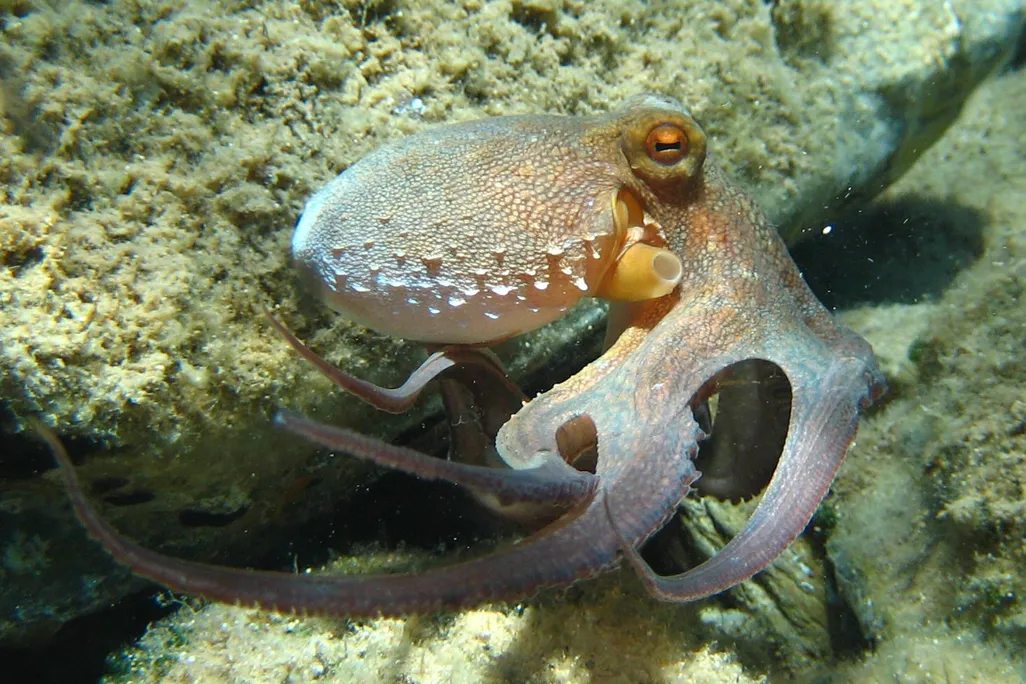
Octopuses are talented escape artists, capable of squeezing their bodies through seemingly impenetrable gaps to avoid danger, find hidden prey or break out of captivity. Scientists have long wondered how these eight-limbed creatures manage such impressive feats of flexibility. Now, they say they have some answers.
A study published November 5 in the Journal of Experimental Biology describes the step-by-step processes some octopuses use to cram themselves into tight spaces. In addition to expanding our understanding of these crafty cephalopods, the findings could help engineers improve the design of soft robots that need to fit into small spaces, such as those used during search-and-rescue missions.
“You always just think as a biologist that this is a minor question: How to squeeze your body into a crevice, through a hole or into a cave,” study co-author Michael Kuba, a biologist at the University of Naples Federico II in Italy, tells IFLScience’s Rachael Funnell. “But working with soft robotic engineers, you realize that there is so much more to how they manage to do this. They have several steps of the movement, and they have specific postures and body parts they use to move through a hole.”
In the study, Kuba and colleagues conducted laboratory experiments involving three subadult common octopuses (Octopus vulgaris) and four juvenile Mayan octopuses (O. maya). The team started by measuring the distance between each animal’s eyes to determine the size of the semi-rigid cartilage casing surrounding their brains. Then, they adjusted a clear, acrylic tank partition to create a single, central hole that was either smaller or larger than the measurements, which ranged from about 0.4 to 1.4 inches. One at a time, they placed the octopuses in the tank, then watched and filmed what happened next.
“We know that they can squeeze through all these spaces, but nobody’s actually looked at how they do this,” study co-author Tamar Gutnick, a biologist at the Haus des Meeres-Aqua Terra Zoo in Austria, tells NPR’s Ari Daniel. “So, what we did was take octopuses and systematically make them go through different-sized holes.”
Did you know? Octopus physiology
Octopus bodies are mostly soft and pliable. These creatures have only two stiffer body parts: a cartilaginous shell that protects their brains and a beak—made of a hard material called chitin—that they use to eat.
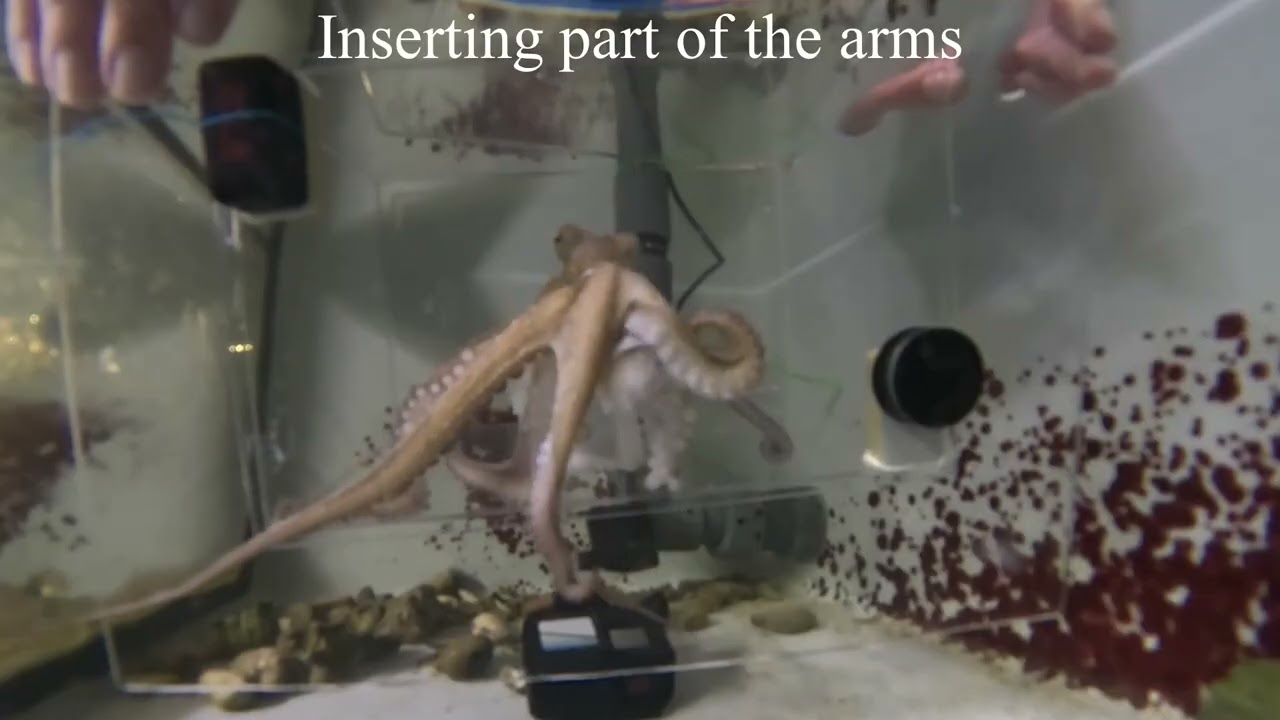
The common octopuses used two different strategies, depending on the size of the hole. When the opening was larger than the distance between their eyes, they tended to perform a three-step maneuver. First, they probed the hole with one arm, initially creating a U-shaped bend at the opening, then sticking the limb through. That might be the animals’ way of feeling out the situation.
“The idea is that the octopuses use the tactile sense on the arms to investigate the opening,” Kuba tells Reuters’ Marta Serafinko.
Then, they snaked a few more arms through the hole. Finally, they used the arms that were already through the hole to push against the back side of the partition, using leverage to pull the rest of their bodies through.
When the hole was smaller than the distance between their eyes, the common octopuses used a similar strategy, except they broke the final step into two stages. After probing and then threading a few arms through, they put the remaining arms through. Then, they pulled their head and mantle through.
“This change initially puzzled all of us,” lead author Wenci Xin, a roboticist at the National University of Singapore, tells IFLScience. “However, after thinking about it carefully, we felt that it made sense: The animals were still following the same general pattern, while the new strategy simply divided the process of pulling the body through into separate stages.”
The Mayan octopuses deployed a similar strategy as the common octopuses when the hole was larger than the distance between their eyes. But when the hole was smaller, they simply ignored it—they didn’t even try to squeeze through.
It’s not clear why the two species behaved differently. However, the researchers suspect their unique approaches likely stem from differences in their biologies or environments. Other species of octopuses might also have their own squeezing strategies.


The new work sheds light on how some octopuses pull off their acrobatic stunts. But scientists still don’t fully understand how octopuses can tolerate the physical demands of these movements.
“It’s really remarkable that they carry on about their daily business,” Trevor Wardill, a neuroethologist at the University of Minnesota who was not involved with the study, tells the Washington Post’s Meghan Bartels.
If humans or other animals with backbones tried something similar, he says, “that level of brain distortion … would be like a massive concussion—you’d be really spaced out for a very long time, if not dead.”
Moving forward, the researchers hope the results of their experiments will help them develop flexible, octopus-like robots that can successfully navigate confined spaces. Today, most search-and-rescue robots are long and slender—more like snakes than octopuses, a design that helps them wriggle through narrow crevices. But an octopus-inspired robot might have other benefits, such as the ability to carry sensors, communication devices and tools on its flexible arms.
“This incredible capability could enable robots to overcome environmental limitations and enter spaces that are difficult to reach,” Xin tells Science News’ Nora Bradford.
