
Nine-Pound Eagles Seem to Be Hunting 60-Pound Baboons in Africa—Hinting the Predators May Have Gone After Our Ancestors, Too
In northeastern Chad, researchers found evidence of Verreaux’s eagles attacking full-grown olive baboons weighing as much as a small human. The findings suggest early hominins had to watch out for ambushes from the sky, which may have shaped their evolution


Eagles are formidable aerial predators capable of taking down animals much larger than themselves, including primates. But scientists have long believed that eagles tend to go after smaller primates, generally weighing less than 30 pounds.
New research suggests otherwise. Scientists have found evidence of Verreaux’s eagles hunting full-grown olive baboons weighing nearly 60 pounds, which they describe in a study published November 18 in the American Journal of Biological Anthropology.
The findings add to scientists’ understanding of predator-prey relationships. But they also raise the intriguing new possibility that eagle attacks might have influenced human evolution. Some of our ancestors, such as Australopithecus afarensis, weighed about as much as modern baboons, so it’s plausible that eagles went after them, too, millions of years ago. The threat of these attacks, researchers posit, might have affected how early humans communicated and cooperated with one another.
In February and March 2025, primatologists went looking for olive baboons on the Ennedi Plateau, a remote area in northeastern Chad filled with sandstone cliffs, gorges and rock formations. They were hoping to collect genetic samples so they could chart the history of the baboons’ movement across Africa.
But the focus of their expedition took an unexpected turn when they stumbled upon an olive baboon skull with a distinctive hole at the back of one of the eye sockets—clear evidence that a razor-sharp eagle talon had speared the primate’s head. The researchers had noticed Verreaux’s eagles soaring overhead, but it hadn’t occurred to them that the birds might be going after the baboons.
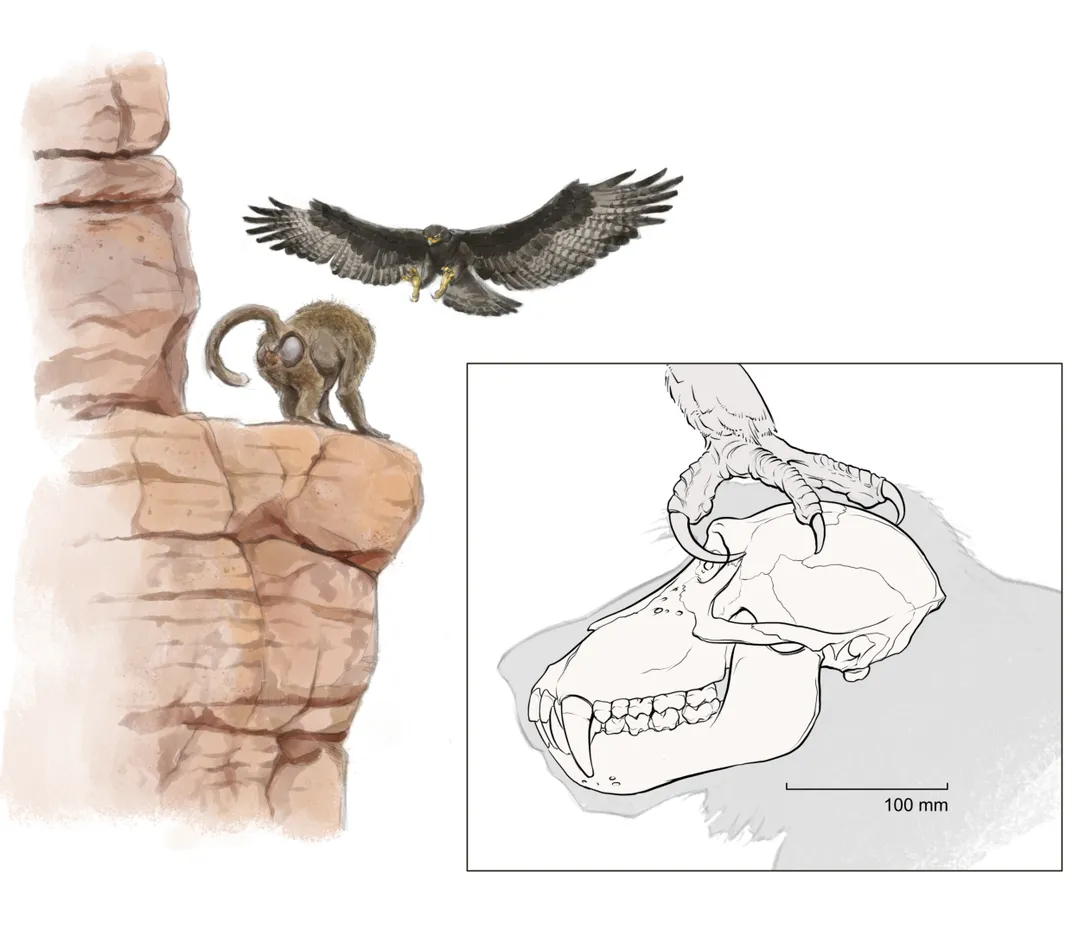
During that initial trip, they recovered the remains of nine olive baboons, including eight adult males. Two of the skulls had talon-shaped puncture marks, while one shoulder blade was covered in what appeared to be talon scratch marks. In June 2026, they found another skull and partial skeleton, which also showed signs of eagle predation.
The study authors can’t definitively rule out scavenging. But “the severity of punctures is suggestive of lethal interactions through a killing grip,” they write in the paper.
Further supporting the idea that Verreaux’s eagles were actively hunting the baboons, not just scavenging their remains, the scientists noted how groups of baboons responded whenever the birds got close, based on previously published observations. As soon as Verreaux’s eagles came into view, the primates started warning each other with alarm calls and taking cover. The baboons didn’t behave this way when other big birds of prey were nearby, suggesting they viewed the Verreaux’s eagles—which typically max out at about nine pounds—as legitimate threats.
“At first, the idea of eagles hunting adult male baboons seemed to exist on the thin edge of possibility, until it didn’t,” study co-author Nathaniel Dominy, a primatologist at Dartmouth College, says in a statement. “Our skepticism slowly gave way to acceptance. The evidence was convincing.”
The scientists estimate that, when they were alive, the baboons whose remains they initially discovered weighed approximately 49 pounds on average. But the one found in 2026 appears to have been much heavier, possibly weighing as much as 58 pounds. That’s well within the range of early hominin species: “Lucy,” the famous A. afarensis individual who lived in what is now Ethiopia roughly 3.2 million years ago, is believed to have weighed about 62 pounds.
Quick fact: Taung Child
The only known case of an eagle hunting and killing an ancient hominin is the Taung Child, reports Live Science. The A. africanus individual is estimated to have been about 3 at death, and their skull contains puncture marks at the bottom of the eye sockets.
Scientists know that our ancestors were vulnerable to attacks from ground-based predators like crocodiles and hyenas. But the new findings suggest they might also have needed to be on alert for ambushes from the sky.
That could have affected their behavior. Modern primates that live in areas with predatory eagles tend to move around in large groups made up of various primate species. “That means extra competition for the food—but the benefits of the added protection seem to be worth the cost,” lead author Catherine Hobaiter, a primatologist at the University of St. Andrews in Scotland, tells Live Science’s Owen Jarus.
Perhaps our ancestors deployed a similar strategy, learning to cooperate, rather than compete, with other hominin and primate species because they discovered there’s safety in numbers. They might also have evolved other adaptations in response to potential eagle attacks, such as calling out to warn others or living in places where they could easily hide.
Scott McGraw, a primatologist at Ohio State University who was not involved with the study, tells the Washington Post’s Meghan Bartels he isn’t surprised by the findings, as birds of prey, commonly called raptors, are “extraordinary predators.”
“As long as there have been primates, there have been raptors killing and eating them, and that’s been going on for 55 million years,” McGraw adds.
