
Notorious Feral Cat That Feasted on Rare New Zealand Ducks Captured After Three-Year Hunt
The gray tabby, known as Nine Lives because it eluded capture so many times, had devastated efforts by conservationists to reintroduce the birds to the wild
/https://tf-cmsv2-smithsonianmag-media.s3.amazonaws.com/accounts/headshot/SarahKuta.png)
/https://tf-cmsv2-smithsonianmag-media.s3.amazonaws.com/filer_public/f4/58/f4588e77-e118-43cc-a6d1-dcf9efac50c2/9_lives_feb_2024.jpg)
For the past three years, a feral cat has been preying on New Zealand's rarest mainland duck. Now, after an extended and at times frustrating pursuit, conservationists have finally captured and killed the elusive predator.
The infamous cat, a large gray tabby known as Nine Lives, was “humanely shot” on July 30, according to Andy Mentor, project manager for the Pest Free Purerua conservation project.
“We don’t take for granted that we’ve had this success because it had us baffled for so long,” Mentor tells the Guardian’s Eva Corlett.
/https://tf-cmsv2-smithsonianmag-media.s3.amazonaws.com/filer_public/7d/0c/7d0cba6a-3205-45de-b441-33e6307bb836/9_lives_2026.jpg)
The saga began in 2023 on the Purerua Peninsula, an area on the northeastern coast of New Zealand’s North Island. At the time, conservationists thought they had gotten the region’s feral cat population largely under control and, as a result, had recently released 20 captive-raised brown teal ducks, or pāteke, into the wild. But they quickly realized how wrong they were.
“Within a week, we had our first [pāteke] death,” Mentor tells the Guardian.
/https://tf-cmsv2-smithsonianmag-media.s3.amazonaws.com/filer_public/a2/79/a2793d0c-787f-41b4-82f3-b2fcf458bedb/9_lives_2024.jpg)
Pāteke kept dying. Conservationists installed surveillance cameras to see if they could uncover what was slaughtering the rare ducks. A cat that later came to be known as Nine Lives and had specific markings kept appearing on the footage.
Over the ensuing months, they managed to capture other feral cats, but could never pin down the elusive predator. The team released another 20 pāteke in 2024, but Nine Lives killed many of them, too.
“Once [he] got the blood of the duck he just kept going,” Mike Cadogan, a trapper with Pest Free Purerua, told CNN’s Antoinette Radford earlier this year. “The cats’ll just keep killing for the sake of killing.”

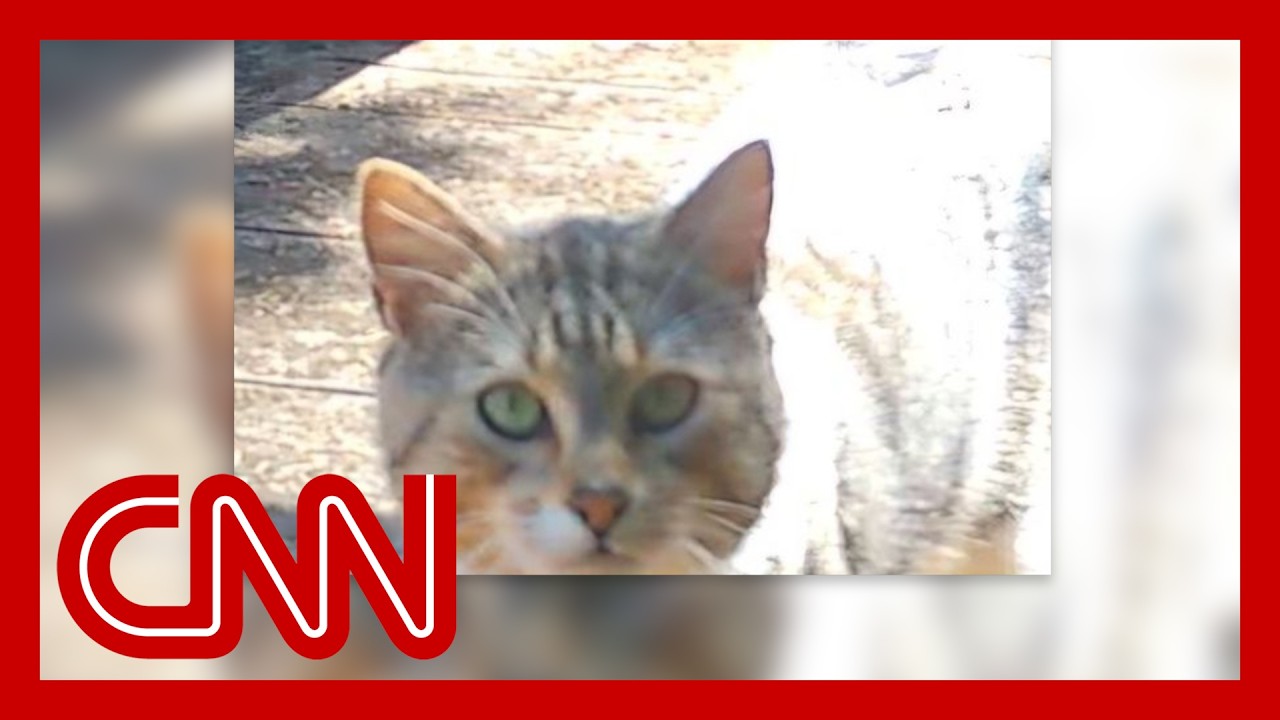
They ramped up their efforts to capture Nine Lives. But the cat was “erratic,” which made it “very, very difficult” to track, Mentor tells the Guardian.
“It would show up in a particular place and then not show up for another two or three months,” he adds. “It would show up in the dusk, midnight, early morning, through the day, so it was never a predictable pattern.”
Then, last month, Nine Lives showed up at the same spot three nights in a row. Mentor and his team sprang into action, setting up cages and traps and laying out a smorgasbord of foods, including salmon, fried chicken and rabbit, they hoped the cat would find irresistible.
Their plan worked. Nine Lives was finally caught in one of the cages, bringing the yearslong ordeal to an end.
Did you know? New Zealand's cats
New Zealand is home to three types of cats: feral, stray and companion. While feral cats can look nearly identical to household pets, they often grow much larger, with some reaching more than three feet in length from nose to tail tip.
In the end, they suspect the cat killed as many as three-quarters of the pāteke they released. Conservationists think Nine Lives was also eating kiwi chicks, geckos and other native animals.
Hundreds of thousands of pāteke once lived across New Zealand. However, their populations declined dramatically after the arrival of non-native predators, including possums, rats, stoats, weasels and feral cats. Their petite size—about half that of a mallard—and nocturnal habits made them especially vulnerable to predation and, by the 1990s, just 700 individuals remained. Now, thanks to more than two decades of conservation efforts, the species has rebounded to around 2,000 birds—but it remains one of New Zealand’s rarest waterfowl.
It’s not clear why Nine Lives was so unpredictable. But, to Mentor, the case illustrates that “cats, being the apex predator that they are, are very difficult to remove from the environment they know so well,” he tells Radio New Zealand’s Peter de Graaf. “And feral cats just don't want anything to do with humans.”
Next, researchers will analyze the cat’s stomach contents to determine what it ate before it died. Its body will then be taxidermied and used as an educational tool to help community members understand the threat feral cats pose to native wildlife.
New Zealand is home to more than 2.5 million feral cats. Many are descended from North African hunting cats, so experts say their instinct to stalk and kill prey remains deeply ingrained. Pāteke are far from their only targets. They’re also threatening black stilts, black-fronted terns, kākāpō, kea, skinks, native bats, New Zealand dotterels and other species.
/https://tf-cmsv2-smithsonianmag-media.s3.amazonaws.com/filer_public/b7/32/b732e294-a556-46cc-9465-351f8831ad6c/9_lives_2025.jpg)
Last year, New Zealand officials added feral cats to the nation’s Predator-Free 2050 strategy, setting a goal of eradicating the animals over the next 25 years.
“In order to boost biodiversity, to boost heritage landscape and to boost the type of place we want to see, we’ve got to get rid of some of these killers,” Tama Potaka, New Zealand’s conservation minister, told Radio New Zealand’s Farah Hancock at the time.
The plan only includes feral cats, not those kept as pets. Conservation officials have emphasized that the goal is to remove invasive predators from the wild—not target domestic animals that are part of people’s households.
“We love our companion cats and we don't want to harm them,” Mentor tells Radio New Zealand. “But when it comes to feral cats and the species we hold so dear, we just need to keep working on removing them because there are so many in the environment.”
Did you know? The differences among cats
- Feral cats live entirely outdoors and generally avoid humans. Unless socialized when they are very young, feral cats are unlikely to be able to be brought into a human home or in regular contact with humans. Feral cats may belong to a colony with other feral cats.
- Stray cats, having once been pets, may be way of humans but are much more comfortable around then.
- Wild cats, meanwhile, are an entirely different species and can grow bigger and stronger than feral or stray cats.
/https://tf-cmsv2-smithsonianmag-media.s3.amazonaws.com/accounts/headshot/SarahKuta.png)